
Executive Overview
In an era where the broader ecumenical movement has largely flatlined into a state of polite mutual indifference or institutional fatigue, the fractured relationship between the Roman Catholic Church and the Eastern Orthodox communion remains a singular, if deeply troubled, exception. While decades of Protestant-Catholic dialogues have repeatedly struck structural and theological walls—particularly regarding ecclesiology, clerical practice, and modern ethical shifts—the East-West schism that fractured Christendom a millennium ago has occasionally seemed ripe for healing. Theological breakthroughs regarding historical stumbling blocks, such as the filioque controversy, have hinted at the possibility of a restored communion.
Yet, this fragile hope faces severe, contemporary headwinds. The post-Soviet collapse upended the delicate geopolitical balance of Eastern Orthodoxy, sparking fierce jurisdictional disputes between regional churches and the Patriarchate of Moscow—crises that have been exponentially aggravated by Russia’s ongoing invasion of Ukraine. Furthermore, centuries of entrenched institutional inertia, deep-seated mutual distrust, and complex questions surrounding the nature of papal primacy continue to stall progress.
Enter Reuniting Rome with the Orthodox: How the Great Schism Unfolded—And Might Yet Be Healed (Creed & Culture), a lucid, scholarly, and remarkably evenhanded volume by author Dmitri Solzhenitsyn. Weighing in at 272 pages, Solzhenitsyn’s work offers a comprehensive investigation into the historical genesis of the Great Schism, an honest appraisal of modern bilateral progress, and a sober look at the arduous path forward. Eschewing naive optimism in favor of rigorous historical realism, Solzhenitsyn—grandson of the famed Russian dissident Aleksandr Solzhenitsyn—poses the fundamental, uncomfortable question that underpins all modern ecumenical efforts: Do the divided bodies of East and West actually want to reunite?
This review-analysis explores the complex topography of Catholic-Orthodox relations, examining the historical anatomy of the schism, the theological evolution of bilateral dialogues, the persistent stumbling blocks of authority and practice, and the interplay between natural skepticism and supernatural hope required for any future reconciliation.
Detailed Chronology: From First-Millennium Unity to the Great Breach
To understand the modern impasse, one must navigate what can only be described as a maddeningly complex tapestry of history. Solzhenitsyn’s book dedicates its first half to charting the trajectory of East-West Church relations from the Apostolic era through the nineteenth century.
The Drifting Apart of Two Worlds
The division of Christendom was never merely the result of a single catastrophic event in 1054, when mutual excommunications were hurled across the altar of the Hagia Sophia. Rather, it was the culmination of centuries of inexorable, compounding drifts. Culturally, linguistically, and politically, the Latin-speaking West and the Greek-speaking East grew increasingly alienated. The fall of the Western Roman Empire birthed a feudal, decentralized Europe where the Bishop of Rome emerged not only as a spiritual pontiff but as a temporal anchor. Meanwhile, the Eastern Roman (Byzantine) Empire sustained a centralized, imperially tethered ecclesiastical structure where the Emperor played a definitive role in church governance.
Solzhenitsyn excels at untangling how these macro-historical trends interacted with contingencies of strong personalities and subtle theological disputes. As he demonstrates, the chronic error of modern theologians is to assume that ecumenism is exclusively a matter of abstract theological propositions. In reality, ecumenism deals with complex religious communities shaped by theology, language, politics, and historical trauma.
The Anatomy of Ancient Disputes
For the first millennium, communion between Rome and the East was largely preserved, though tensions regarding the scope and exercise of the Roman Bishop’s primacy constantly bubbled to the surface. While the East generally acknowledged Rome’s primacy of honor, it vigorously rejected anything resembling universal jurisdiction or administrative overreach.
Compounding these jurisdictional frictions were profound theological debates, most notably:
- The Filioque Controversy: The Western addition of the phrase filioque (“and the Son”) to the Nicene Creed regarding the procession of the Holy Spirit from the Father was viewed by the East as an uncanonical alteration that threatened the foundational unity of the Trinity.
- The Nature of Papal Authority: The gradual consolidation of papal power in the West—culminating centuries later in the dogmas of Vatican I regarding universal jurisdiction and papal infallibility—cemented Eastern fears of an autocratic papacy.
Solzhenitsyn’s historical accounting reveals an unvarnished truth: simply returning to the exercise of papal primacy as it existed in the first millennium is not a silver bullet. While those early centuries maintained communion, they did so within a world where information traveled at the speed of a ship or a courier. Communication barriers often masked underlying structural disagreements. An administrative arrangement suited for a pre-modern world cannot easily withstand the scrutiny and friction of the internet age.
Supporting Context & Metrics: The Ecumenical Stagnation
To fully appreciate the weight of Solzhenitsyn’s intervention, one must examine the broader ecumenical landscape. Since the turn of the 21st century, institutional ecumenism has largely stalled across the board.
| Ecumenical Dialogue Track | Primary Focus / Area of Agreement | Major Stumbling Blocks & Obstacles | Current Status |
|---|---|---|---|
| Protestant Mainline – Catholic | Conceptual agreement on the doctrine of justification. | Divergences in ecclesiology, practice, and radical shifts in mainline ethical/moral teachings. | Stalled / Friendly mutual indifference. |
| Evangelical – Mainline/Catholic | Shared core creedal beliefs (historical orthodox Christianity). | Structural aversion to institutional ecumenism, diverse governance models, biblicism. | Non-Starter / Minimal formal engagement. |
| Catholic – Orthodox | Substantial convergence on the filioque; shared sacramental theology. | Papal primacy, jurisdictional conflicts, post-Soviet geopolitics, the war in Ukraine. | Slowed to a Crawl / Fragile yet ongoing. |
| Intra-Orthodox Relations | Shared Byzantine liturgical and theological heritage. | Independence (autocephaly) disputes, Moscow-Constantinople schisms, nationalist politics. | In Crisis / Institutional turmoil. |
As the metrics indicate, while Catholic-Orthodox relations have avoided the total stagnation seen in Protestant-Catholic spaces, they remain deeply vulnerable to geopolitical shocks. The collapse of the Soviet empire unleashed long-suppressed nationalisms within Eastern Europe, leading various Orthodox bodies to aggressively seek autocephaly (independence) from the Moscow Patriarchate. Moscow’s fierce resistance to these movements, heavily exacerbated by its geopolitical alignment and military actions in Ukraine, has crippled intra-Orthodox unity. Consequently, the Orthodox house must be in some degree of internal order before it can collectively engage Rome in definitive, binding reunion talks.
Official Statements and Bilateral Milestones
The second half of Solzhenitsyn’s volume shifts focus to the modern era, beginning with the mid-nineteenth-century stirrings of rapprochement and accelerating through the watershed moment of the Second Vatican Council.
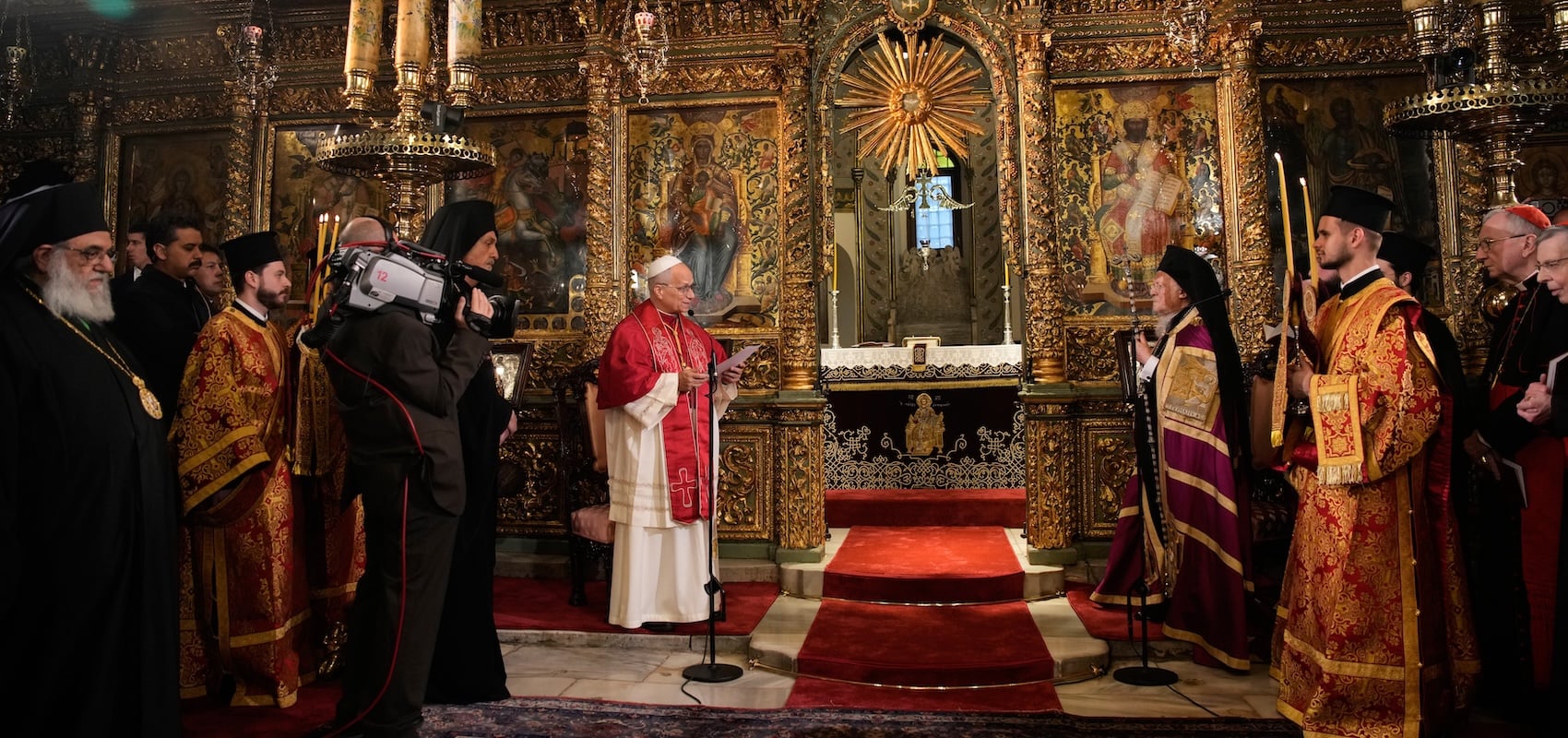
The historic meeting in Jerusalem in 1965 between Pope Paul VI and Ecumenical Patriarch Athenagoras remains the gold standard of modern ecumenical gesture politics. By issuing a joint declaration that consigned the mutual excommunications of 1054 to oblivion and lifting the long-standing anathemas, both leaders opened a door that had been bolted shut for nearly a thousand years.
Subsequent national and international dialogues have achieved significant technical victories, which Solzhenitsyn meticulously summarizes:
- The Filioque Convergence: Decades of theological panels have yielded widespread agreement that a certain degree of linguistic and conceptual variation is permissible regarding how one articulates the procession of the Holy Spirit, provided the underlying Trinitarian faith is uncompromised.
- Reframing Papal Primacy: While primacy remains a formidable hurdle, theologians from both sides have successfully elaborated a shared methodological framework. Both East and West now affirm that a fully faithful ecclesiology requires both a principle of primacy and a principle of conciliarity (synodality). Catholic theological developments emphasizing the Church as communion have offered a helpful bridge to Orthodox ecclesiology, while some forward-thinking Orthodox theologians openly admit the structural need for a more effective, globally recognized center of unity.
However, moving from theological frameworks to concrete administrative reality remains a dizzying challenge. Solzhenitsyn addresses various structural proposals, such as establishing a sharper legal and theological distinction between the Bishop of Rome’s local authority as Patriarch of the West and his broader authority as universal primate.
Yet, this immediately prompts pressing, unresolved questions: What precisely does universal authority entail in practice? To what extent can or should it be exercised? For instance, many critics wonder if a universal primate would possess the authority to intervene in or discipline a regional patriarch who lends uncritical religious backing to an aggressive, unjust war of conquest. These are not merely academic hypotheticals; they are burning, real-world tests of institutional credibility.
Future Outlook: Faith, Risk, and Supernatural Hope
In his concluding chapter, Solzhenitsyn forces his readers to confront a sobering reality check. Drawing upon sociological and historical insights—such as those articulated by theologians Ephraim Radner and R. R. Reno regarding the tenacity of ecclesial identities forged in opposition—he demonstrates that division is deeply resilient.
History shows that structural separation breeds distinct cultural and institutional habits that resist deep change. Even when Rome and the various Orthodox bodies have reached historic agreements with ancient non-Chalcedonian (Oriental) churches in recent decades, actual, on-the-ground communion has failed to materialize. The clergy and laity simply display an overwhelming institutional inertia, often harboring a deep-seated resistance to compromises that might threaten local autonomy or cultural identity.
Using the poignant analogy of marriage, Solzhenitsyn—and reviewers reflecting on his work—reminds us that entering into a covenant requires taking profound risks. Just as a couple vows to remain faithful through unknown trials, an ecumenical union cannot be negotiated down to every last administrative detail in advance. Some risks must be taken in the spirit of adventure and love.
Yet, as any counselor would note, love must be paired with deep prudential wisdom. If the greatest challenge facing global Christianity in the coming decades is the defense of the faith against an increasingly aggressive, secularizing culture, church leaders must ask a strategic question: Do we need a centralized primacy with broader emergency powers, or do we need decentralized synodality to safeguard local resilience? Persons of profound good faith and orthodox commitment can—and do—disagree.
Solzhenitsyn quotes the Danish philosopher Søren Kierkegaard to remind readers that true love does not calculate its own interests. But as wise stewards, Christians are called to be "innocent as doves and wise as serpents" when designing the organizational structures meant to embody that love.
Conclusion: Preparing for the Spirit’s Outpouring
Ultimately, Reuniting Rome with the Orthodox refuses to offer cheap optimism or Pollyannaish cheer. Natural optimism is easily crushed by the weight of geopolitics, historical grievances, and institutional self-preservation.
Instead, Solzhenitsyn’s book points us toward a more durable theological virtue: supernatural hope. As the late theologian Robert Jenson observed, contemporary ecumenical hope can no longer rest on mere human strategizing; it must look forward to a new, sovereign outpouring of the Holy Spirit.
Our human task is not to force a premature, superficial merger, but to meticulously prepare the ground—intellectually, spiritually, and historically—so that when that divine grace eventually manifests, the Church will be ready to receive it. Dmitri Solzhenitsyn has provided an indispensable, scholarly, and remarkably honest tool for that preparation. For anyone seeking to understand the past, present, and possible future of Catholic-Orthodox relations, this vital text is the definitive place to begin.



Comments
Facebook App ID not configured. Please add it in the Customizer.