
Executive Overview
The landscape of New York City’s premier cultural institutions is facing an unprecedented labor crisis. In a decisive show of solidarity and frustration, unionized employees at three of the city’s most esteemed cultural landmarks—the Brooklyn Museum, the American Folk Art Museum (AFAM), and the Whitney Museum of American Art—have voted overwhelmingly to authorize a strike. Represented by Local 2110 of the United Auto Workers (UAW), these workers are demanding substantial improvements in wages, enhanced healthcare benefits, and ironclad job security.
While the strike authorization does not carry an immediate shutdown deadline—as bargaining committees continue to meet with institutional management—the vote represents a critical tipping point. Workers across curatorial, educational, visitor services, and administrative departments argue that their current compensation packages have become entirely untenable. In a city where the cost of living has skyrocketed to historic highs, front-line museum workers, educators, and assistant curators find themselves priced out of the very metropolis they help cultural tourists and local residents navigate.
The ramifications of this multi-institution strike authorization extend far beyond individual gallery floors. They strike at the heart of the modern museum model, forcing trustees, directors, and city officials to confront a systemic contradiction: world-class institutions dedicated to preserving human history and creative expression are struggling—and in some cases, failing—to provide humane, living wages to the human beings who keep their doors open.
Read Also
Detailed Chronology: From Union Organizing to Strike Authorization
To understand how three distinct institutions arrived at this unified labor precipice, it is necessary to examine the specific timelines and historical friction points that have characterized labor relations at the Brooklyn Museum, the American Folk Art Museum, and the Whitney Museum over recent years.
The Whitney Museum of American Art: A Slog Toward a Second Contract
Labor relations at the Whitney Museum have been on a volatile trajectory since 2021, when approximately 200 employees unionized with Local 2110 UAW. That organizing wave followed a tumultuous period that saw two rounds of pandemic-era layoffs, shrinking the workforce by roughly 20 percent.
Following their initial organization, Whitney staff endured 16 months of arduous negotiations before finally ratifying their first collective bargaining agreement. That hard-fought contract secured vital protections against arbitrary layoffs, instituted minimum pay increases, and won an average 15 percent retroactive wage increase.
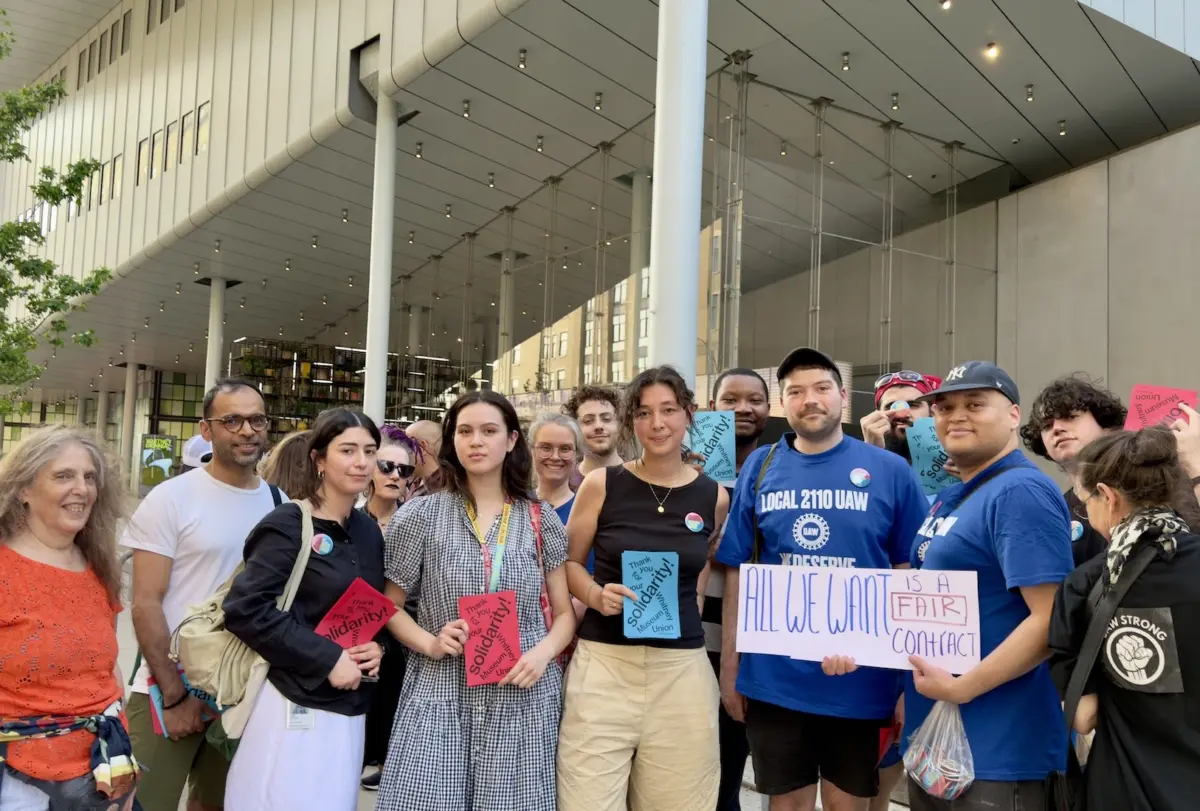
However, the goodwill generated by that first agreement has evaporated during negotiations for their second contract. Frustration spilled into the public sphere on May 19, when union members staged a high-visibility rally outside the museum’s annual spring gala. Donning buttons and carrying placards bearing slogans like "We love fair contracts," workers signaled to museum leadership and high-net-worth donors alike that negotiations had stalled over core economic demands. The frustration culminated in today’s strike authorization vote, driven by workers who feel their economic reality has deteriorated relative to the city’s surging cost of living.
The American Folk Art Museum: Rapid Organizing Meets Contract Realities
The labor movement at the American Folk Art Museum (AFAM) represents a newer chapter in New York’s cultural sector organizing. In June 2024, staff across multiple departments—including education, curatorial operations, visitor services, and information technology—voted unanimously to unionize with UAW Local 2110.
AFAM operates across two distinct footprints: its prominent galleries on the Upper West Side of Manhattan and a specialized center in Queens. Because these workers are relatively new to the collective bargaining arena, the current negotiations represent their foundational contract. The strike authorization vote underscores the urgency with which these newer bargaining units are approaching talks, signaling to AFAM leadership that staff expect structural changes to minimum pay rates and departmental equity right out of the gate.
The Brooklyn Museum: Deficits, Proposed Layoffs, and Political Intervention
Perhaps the most fraught and publicly combative relations belong to the Brooklyn Museum, where labor disputes have repeatedly drawn the attention of municipal lawmakers.
The friction escalated dramatically in February 2025, when Brooklyn Museum leadership announced plans to cut more than 10 percent of its staff, targeting over a dozen workers. Management cited a widening structural deficit as the primary driver behind the cuts. Crucially, however, the two unions representing the museum’s workers—DC 37 Local 1502 and UAW Local 2110—publicly asserted that these sweeping reductions were announced unilaterally, entirely bypassing the collective bargaining process.
What followed was a weeks-long campaign of public pressure. Union members and supporters staged vocal rallies outside the museum’s Beaux-Arts facade, demanding accountability and structural transparency. The pressure proved effective, drawing the intervention of city leaders. On February 28, the New York City Council’s Committee on Civil Service and Labor convened a special oversight hearing. During the proceedings, Committee Chair Carmen De La Rosa sharply criticized the museum’s approach, declaring that employee layoffs "should be the absolute last resort."
The political pressure yielded a temporary financial reprieve when the New York City Council secured a $2.5 million grant, enabling museum leadership to reverse the planned layoffs. Yet, the underlying financial instability and labor distrust were not resolved by the grant alone. Those deep-seated anxieties over job security, healthcare continuity, and baseline compensation have now fused with the broader UAW strike authorization movement.
Supporting Context & Metrics: The Reality of Working in NYC’s Cultural Sector
The catalyst behind this coordinated strike vote is not abstract ideological posturing; it is a stark, mathematically verified crisis of affordability. The cost of living in New York City has reached unprecedented heights, creating an unbridgeable chasm between institutional wages and basic human survival.
The Numbers Behind the Struggle
To contextualize the workers’ demands, Local 2110 UAW has drawn heavily upon official municipal data regarding the actual cost of urban survival:
- The True Cost of Living (TCOL) Measure: According to the New York City government’s 2026 NYC True Cost of Living Measure Annual Report, a single adult living in New York City without children must earn a minimum of $34 an hour simply to make ends meet. This translates to an annual salary requirement of approximately $71,000.
- Front-Line Realities: The disparity between this municipal benchmark and actual museum compensation is stark. Derrick Charles, a membership associate at the Whitney Museum and union chairperson, has worked in his role since 2018. As one of the institution’s primary public-facing employees—stationed in the lobby to sell admissions, direct visitors, and answer questions—Charles earns $24 an hour, falling $10 short of the city’s own calculated survival wage.
- Sector-Wide Averages: Across the three striking institutions, average staff salaries languish well below the $71,000 annual threshold identified by the TCOL report. Administrative assistants, education coordinators, and even assistant curators find themselves struggling to balance student loan debt, exorbitant rents, and basic healthcare expenses.
The Human Cost of Passion
This economic squeeze has created a profound moral injury for workers who entered the museum field out of passion and specialized expertise. Elizabeth St. George, an assistant curator at the Brooklyn Museum, captured the sentiment of many creative professionals in a recent statement:
"I’ve never expected to get rich as a curator, but I want to be able to rely on having a job with affordable health care and a reasonable salary so I can concentrate on doing the work I love."
For decades, the cultural sector has relied on a systemic assumption of prestige—the idea that working in a world-renowned museum compensates for sub-market wages through cultural cachet and occupational fulfillment. However, as inflation, soaring rents, and healthcare costs compound in post-pandemic New York City, that unspoken social contract has collapsed. Passion can no longer pay monthly rent or cover emergency medical procedures.
Official Statements and Institutional Responses
As the threat of a coordinated strike looms over the city’s cultural calendar, leadership teams at the affected museums have issued carefully calibrated public responses, balancing commitments to good-faith bargaining with institutional fiscal constraints.
The Whitney Museum
A spokesperson for the Whitney Museum of American Art issued a formal statement to ARTnews emphasizing the institution’s ongoing commitment to the negotiation table:
"The Whitney continues bargaining in good faith and remains committed to arriving at a fair, reasonable contract that respects the needs of all parties."
Despite these diplomatic assurances, union representatives maintain that management’s economic proposals have failed to meaningfully address the gap between current salary tiers and the living wage metrics established by the city.
The American Folk Art Museum
Similarly, leadership at the American Folk Art Museum expressed a desire for a collaborative resolution. An AFAM spokesperson told ARTnews:
"Leadership is committed to continuing to bargain in good faith toward a fair and mutually beneficial contract."
Given that AFAM’s staff unionized as recently as June 2024, the establishment of this first collective bargaining agreement will serve as a foundational precedent for how the institution values its multidisciplinary workforce moving forward.
The Brooklyn Museum
In stark contrast to the Whitney and AFAM, the Brooklyn Museum has maintained a notable silence. Institutional leadership did not respond to multiple requests for comment from media outlets prior to publication. This lack of communication mirrors the administrative opacity that sparked last year’s protests over proposed layoffs, leaving union members and public observers uncertain about how management intends to address the strike authorization.
Future Outlook: What Happens Next?
The authorization of a strike by Local 2110 UAW members at the Brooklyn Museum, the American Folk Art Museum, and the Whitney Museum marks a critical inflection point for New York City’s cultural economy.
Immediate Next Steps
- Continued Bargaining Sessions: While strike authorization has been granted by an overwhelming majority of union members, no specific walkout deadline has been established. This leaves a crucial window for federal and independent mediators, bargaining committees, and institutional executives to bridge the economic divide.
- Escalation Contingencies: If management teams fail to present revised economic packages—specifically targeting minimum pay thresholds that reflect the city’s $34-per-hour living wage standard—Local 2110’s leadership retains the legal authority to call a sudden, coordinated strike.
Broader Industry Implications
A successful strike—or even the credible threat thereof—will send shockwaves through the broader museum and non-profit ecosystem. New York City is home to dozens of major cultural institutions, many of which are facing parallel pressures regarding unionization, wage equity, and post-pandemic financial stability.
If major flagships like the Whitney, the Brooklyn Museum, and AFAM are forced to restructure their compensation models to meet living wage standards, it will establish a powerful benchmark for cultural workers nationwide. Conversely, a prolonged labor stalemate or active picket lines could severely disrupt exhibition schedules, educational programming, and visitor operations during peak tourist seasons, forcing trustees and municipal leaders to reckon with the indispensable value of the workers who bring these institutions to life.



Comments
Facebook App ID not configured. Please add it in the Customizer.