
Executive Overview
In an era defined by digital fragmentation, algorithmic echo chambers, and an increasing hunger for substantive human connection, a centuries-old tradition is experiencing a vibrant resurgence in the academic and cultural hub of Cambridge, Massachusetts. The Plough and Stars, a beloved local watering hole renowned for its unpretentious charm and community spirit, has struck a resonant chord by introducing a series of public "philosophy nights." Far from the ivory towers of nearby universities, patrons are trading standard tavern chatter for deep intellectual discourse, packing the venue to capacity for spirited debates on the nature of reality, mathematics, and human existence.
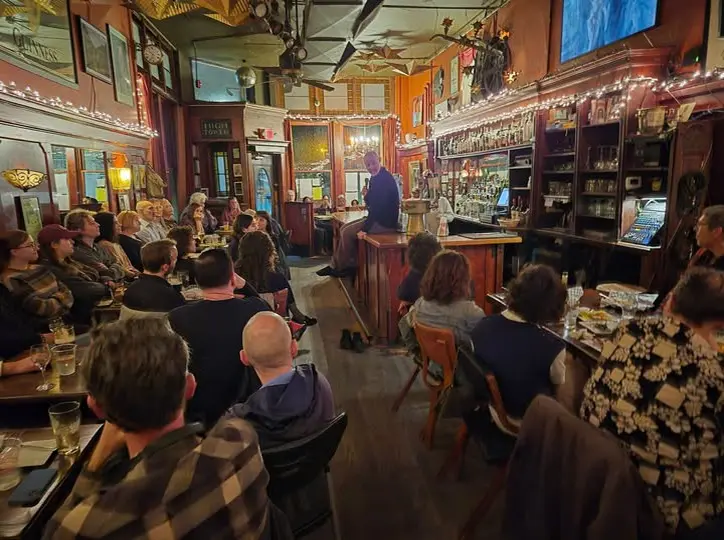
What began as a localized experiment in public scholarship has quickly metastasized into a cultural phenomenon. When MIT philosopher Agustín Rayo took the floor last month to dissect the elusive concepts of mathematics and certainty, the pub overflowed with an eclectic mix of graduate students, tech workers, blue-collar locals, and curious retirees. The overwhelming success of the inaugural event was not an isolated anomaly; demand for upcoming sessions has reached unprecedented levels. Later this month, Wellesley College philosopher Helena de Bres is scheduled to lead a discussion on the perennial question, “What is meaning in life?” In a testament to the ravenous public appetite for existential inquiry over pints of stout, organizers report that an astonishing 120 people are currently languishing on the event’s waitlist.
This burgeoning movement at The Plough and Stars serves as a microcosm for a broader, global pivot toward public philosophy—taking complex theoretical frameworks out of academic journals and embedding them directly into the public sphere. Yet, while the Boston-Cambridge metro area enjoys a uniquely high concentration of intellectual capital, this phenomenon begs a larger, more pressing question: What is happening in bars, pubs, and eateries across the globe? As communities search for antidotes to modern alienation, public philosophy in watering holes is emerging as a vital cultural touchstone. This report examines the mechanics of this academic-culinary crossover, explores the broader landscape of public philosophy, and invites an international dialogue on how local establishments are fostering community through critical thought.
Read Also
Detailed Chronology
The Genesis of the Plough and Stars Initiative
The convergence of academic philosophy and pub culture in Cambridge did not happen overnight. For years, cultural programmers and academic institutions have sought effective ways to bridge the gap between rigorous research and the tax-paying public. Traditional venues—such as university lecture halls, sterile community centers, and quiet libraries—often impose an invisible barrier of intimidation. Recognizing this, local organizers and philosophers sought a neutral, welcoming environment where hierarchical dynamics could be dissolved.
The Plough and Stars, located in the heart of Cambridge’s bustling Central Square area, presented an ideal canvas. Historically known as a gathering space for live music, political debate, and social camaraderie, the pub offered a built-in atmosphere of warmth and informality. The transition from hosting folk bands and literary readings to high-level philosophical discourse was organic, driven by an underlying thesis: profound ideas deserve a vibrant, unpretentious stage.
Inaugural Success: Agustín Rayo on Math and Certainty
The initiative’s inaugural event last month set a high benchmark for subsequent gatherings. MIT Professor Agustín Rayo stepped up to lead a session centered on a notoriously dense subject: the intersections of mathematics and certainty.
Rather than delivering a dry, academic lecture laden with jargon, Rayo adapted his pedagogical approach to fit the cadence of a crowded pub. Patrons holding pints of local craft beer and plates of pub fare found themselves grappling with foundational questions regarding how humans arrive at absolute truths, the nature of mathematical objects, and the limits of human comprehension. The conversational, highly interactive format invited immediate pushback from the audience, transforming passive listeners into active participants in a collaborative philosophical inquiry. The night proved that intellectual curiosity is not bounded by university walls; patrons lingered long after the formal talk concluded, hashing out paradoxes over sticky tables.
The Overwhelming Response: Helena de Bres and the 120-Person Waitlist
Building upon the momentum of the inaugural night, the series quickly gained viral traction within local digital circles and word-of-mouth networks. The upcoming session featuring Wellesley College philosopher Helena de Bres—titled provocatively, “What is meaning in life?”—showcased the exponential growth of the program’s popularity.
Within hours of the event’s announcement, RSVP lists maxed out the physical capacity of The Plough and Stars. Organizers were forced to cap attendance to comply with fire safety regulations, inadvertently creating a backlog of hopeful attendees. As of this writing, an astonishing 120 individuals remain on the waitlist, hoping for a last-minute cancellation to secure a seat. This unprecedented bottleneck underscores a profound cultural reality: modern urbanites are desperately seeking spaces where they can collectively process life’s deepest inquiries over shared food and drink.
Supporting Context & Metrics
The Demographics of Public Philosophy
To understand the mechanics of the Plough and Stars phenomenon, one must examine the unique demographic and cultural ecosystem of the Greater Boston area. Boasting one of the highest densities of institutions of higher learning globally—including Harvard, MIT, Boston University, Tufts, and Wellesley—the region possesses a massive pool of both academic producers and consumers of knowledge.
However, organizers note that the attendees at these philosophy nights extend far beyond the traditional academic bubble. Data gathered from event RSVPs and informal venue surveys reveal a remarkably diverse demographic breakdown:
- Tech and Engineering Professionals: Software engineers and biotech researchers from Kendall Square seeking intellectual stimulation outside their technical domains.
- Blue-Collar Locals: Long-term residents and neighborhood regulars drawn by the community-oriented atmosphere and accessible presentation styles.
- Students and Young Adults: Undergraduates and early-career professionals looking for authentic, face-to-face discourse in an increasingly digital world.
- Retirees and Lifelong Learners: Senior citizens utilizing the pub as a salon for continuous education and social engagement.
Economic and Social Impact on Hospitality Venues
The integration of public philosophy into dining and drinking establishments also highlights a shifting economic model for the hospitality industry. In an era where post-pandemic consumer habits have fundamentally altered the restaurant and bar business, establishments are constantly searching for value-add programming to drive mid-week foot traffic.
Philosophy nights transform traditionally slow nights—such as Tuesday or Wednesday evenings—into high-revenue operations. Patrons purchasing food, appetizers, and multiple rounds of beverages while engaged in deep conversation substantially increase per-table check averages. More importantly, these events foster deep brand loyalty, converting casual patrons into dedicated regulars who associate the venue not merely with consumption, but with personal enrichment and community belonging.
Official Statements
While the initiative at The Plough and Stars operates with grassroots informality, the participating academics and venue operators view the program through a lens of profound cultural mission.
Reflecting on the nature of public scholarship, Agustín Rayo emphasized the democratization of thought:
"Philosophy does not belong exclusively to the seminar room. When you strip away the institutional scaffolding and invite people to think together in a space built for human gathering, you realize how deeply hungry people are for foundational questions. The pub strips away pretense; it forces clarity and humility upon the speaker, and it empowers the audience to claim ownership of the ideas."
Echoing these sentiments, upcoming speaker Helena de Bres highlighted the emotional and psychological resonance of exploring existential themes in communal spaces:
"Asking ‘What is meaning in life?’ within the sterile confines of a lecture hall can sometimes feel clinical. Doing it in a room packed shoulder-to-shoulder, with the low hum of conversation and the clinking of glasses in the background, grounds the question in actual lived experience. We are not just talking about meaning abstractly; we are enacting it through shared presence and dialogue."
Venue management at The Plough and Stars has likewise expressed astonishment at the overwhelming community reception, noting that the events align perfectly with the historical identity of the pub as a neighborhood hearth—a place where ideas, stories, and human lives intersect without barriers.
Future Outlook
Scaling the Cambridge Model
The resounding success of the philosophy nights at The Plough and Stars raises an obvious strategic question: Can this model be successfully replicated across other neighborhoods and cities?
The early indicators suggest yes. Urban centers characterized by high walkability, vibrant independent hospitality scenes, and strong intellectual cultures are prime candidates for similar programming. Several other Cambridge and Somerville establishments have already initiated preliminary inquiries with local university departments to explore launching parallel series.
However, organizers warn that replication requires careful attention to atmosphere. The success of the Plough and Stars model hinges on its authenticity; it is not a corporate lecture series rebranded with a drink menu, but a genuine fusion of intellectual rigor and convivial pub culture.
Global Call to Action: Public Philosophy Across the Map
While the Boston-Cambridge metro area enjoys a high concentration of academic-friendly spaces, the phenomenon of public philosophy in watering holes is not exclusive to Massachusetts. Across the globe, independent pubs, neighborhood cafes, bistros, and taverns are quietly serving as incubators for civic dialogue, philosophical inquiry, and grassroots community building.
The editors and organizers behind this movement are now issuing a broad call to action to readers and observers worldwide: Tell us about the public philosophy happening in the bars and restaurants in your neck of the woods.
Whether it is a monthly ethics roundtable in a Melbourne pub, a political philosophy salon in a Parisian bistro, or an impromptu metaphysical debate in a rural diner, these localized initiatives form an invisible, global network of modern Enlightenment. By documenting these spaces, understanding their challenges, and celebrating their triumphs, we can better chart the cultural revival of public thought.
As the lines between formal academia and public life continue to blur, spaces like The Plough and Stars demonstrate that the ancient Greek tradition of philosophizing in the agora—or in this case, over a pint at the local pub—is not only alive and well, but desperately needed.




Comments
Facebook App ID not configured. Please add it in the Customizer.