
Executive Overview
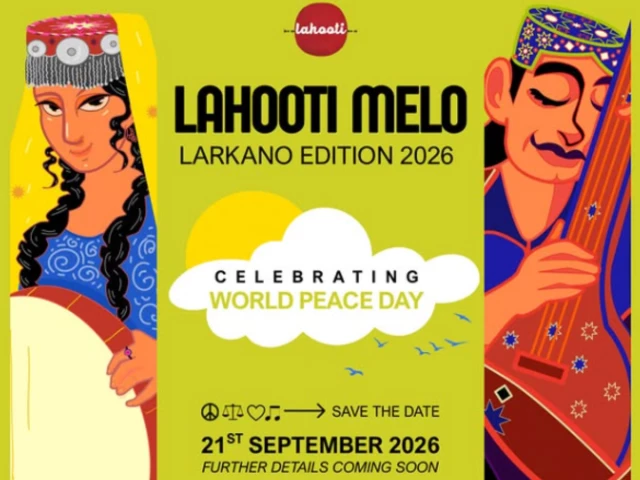
The cultural landscape of Pakistan is once again bracing for a profound convergence of heritage, resistance, and harmony as the Lahooti Melo prepares for its 16th milestone edition. Scheduled to commence on September 21, 2026, to globally observe World Peace Day, the festival is returning to the historic city of Larkana for the second consecutive year. Co-founded in 2016 by Saif Samejo—the visionary frontman of the Sufi rock band The Sketches—and his partner Sana Khoja, the festival has evolved from a localized gathering at the Lahooti Ashram in Hyderabad into Pakistan’s premier nomadic sanctuary for independent music, folk preservation, and socio-political discourse.
The 2026 edition promises a rich, expanding lineup that boldly bridges the chasm between mainstream contemporary stardom and remote regional roots. Renowned vocal powerhouses Quratulain Balouch (QB) and Shafqat Amanat Ali have been officially confirmed as the main headliners, bringing decades of chart-topping legacy, international acclaim, and classical training to the stage. Yet, true to the ethos of the Melo, the marquee names are matched in weight by an eclectic mosaic of traditional folk and Sufi artists hailing from the expanses of Sindh, Khyber-Pakhtunkhwa, and Gilgit-Baltistan.
Set against the backdrop of an increasingly fractured geopolitical and social climate, this year’s festival theme centers resolutely on peace, cultural diversity, and the radical proposition that music and the arts remain humanity’s most potent tools for unification. This comprehensive report delves into the operational lineage of Lahooti Melo, explores the artistic profiles headlining the 2026 chapter, analyzes the socio-cultural ramifications of taking the festival deep into Pakistan’s interior, and charts the future outlook of a movement that refuses to let indigenous narratives fade.
Read Also
Detailed Chronology: From Hyderabad Roots to Larkana’s Cultural Renaissance
The Genesis (2016): A Seed Planted in the Lahooti Ashram
To fully understand the weight of the upcoming 2026 festival, one must trace the institutional lineage of Lahooti Melo back to its inception in 2016. Conceived by Saif Samejo and Sana Khoja, the festival was born out of a desperate need to create physical and ideological spaces for artists who existed outside the commercialized, urban-centric pop circuits of Karachi, Lahore, and Islamabad.
Operating from the Lahooti Ashram in Hyderabad, the founders envisioned a platform that did not merely entertain, but actively educated, archived, and platformed endangered musical forms. In its early years, the Melo established a reputation for tackling uncomfortable social paradigms, boldly dedicating its programming and panel discussions to progressive causes such as the global #MeToo movement, gender equity, freedom of expression, and the existential threat of climate change in South Asia.
The Evolution of a Nomadic Festival
Over the next decade, Lahooti Melo refused to remain static. It traveled across universities, public squares, and cultural hubs, functioning as a traveling university of sound. It brought together master craftsmen of traditional instruments—such as the alghoza, borrindo, and surando—alongside modern indie-rockers, electronica producers, and political activists.
However, a pivotal geographic shift occurred in early 2025. For its 12th overall iteration, the festival broke with tradition and ventured into Larkana on February 15–16, 2025. Marked by stellar performances from mainstream icons like Hadiqa Kiani, Shae Gill, and Umair Jaswal, alongside regional stalwarts Sajan Sindhi and Dilbar Jalal Chandio, the Larkana experiment was an unmitigated success. Saif Samejo characterized that milestone as a vital exercise in "bridging cultures, breaking barriers, and amplifying voices that deserve to be heard."
Building upon that triumphant debut, the organizers announced that the 16th edition would return to Larkana, cementing the city as a permanent autumnal pilgrimage site for peace and musical solidarity on World Peace Day.
Artistic Profiles: The Headliners and Regional Vanguard of 2026
The curatorial philosophy of Lahooti Melo has always relied on juxtaposition: placing heritage side-by-side with contemporary reinvention. The 2026 lineup is a masterclass in this philosophy, uniting generational masters of classical lineages with boundary-pushing regional voices.
Shafqat Amanat Ali: Carrying the Torch of the Patiala Gharana
Making his eagerly anticipated Lahooti Melo debut, Shafqat Amanat Ali represents royalty in the South Asian vocal landscape. As a direct scion of the legendary Patiala Gharana, Ali possesses a vocal fluidity that seamlessly navigates complex classical khayal architecture as effortlessly as stadium-ready pop-rock anthems.
First capturing the public consciousness as the mesmerizing lead vocalist of the groundbreaking band Fuzön, Ali’s career spans decades of cultural diplomacy and commercial dominance across both sides of the border. Festival-goers in Larkana can expect an emotionally resonant setlist drawing from his deep catalog, including generational anthems such as Aankhon Ke Saagar, Mora Saiyaan, Mitwa, and Yeh Honsla. His inclusion signifies the festival’s capacity to honor classical purity while engaging contemporary festival audiences.
Quratulain Balouch (QB): The Soulful Voice of Resilience
No stranger to the Lahooti ethos, Quratulain Balouch—universally known as QB—returns to anchor the 2026 festival with her gravelly, deeply haunting vocal timbre. Rising to meteoric fame overnight with her haunting rendition of Woh Humsafar Tha, QB carved out a niche that merges classic folk cadence with contemporary alternative rock sensibilities.
Her footprint on the Pakistani music industry is indelible, marked by iconic Coke Studio staples like Sammi Meri Waar, Faasle, and Thagyan. Beyond domestic acclaim, QB’s career boasts prestigious international milestones, including a historic performance alongside the BBC Philharmonic Orchestra, where she represented the rich musical heritage of Pakistan on a global stage. Her performance in Larkana is expected to be a visceral, deeply cathartic experience, aligning seamlessly with the themes of World Peace Day.
The Regional Vanguard: Amplifying Indigenous Voices
While the headliners command mainstream attention, the beating heart of Lahooti Melo remains its commitment to regional and folk artists. The 2026 edition highlights an extraordinary roster of traditional performers:
- Tahir Mithu: Raised in Kotri, Jamshoro, Mithu began his rigorous vocal training under the tutelage of Ustad Muhammad Yousuf around the age of ten. He broke into the national consciousness with his mesmerizing performance of Pere Pavandi Saan on Coke Studio Season 5. Recently, his viral, emotionally charged rendition of O Jani Kamal Tho Karin at the Otherwise by Lahooti platform showcased his ability to move contemporary digital audiences while remaining fiercely rooted in Sindhi folk traditions.
- Farzana Bahar: A luminous custodian of Sindhi folk and Sufi poetry, Bahar draws deep from the mystical wells of the soil. Her signature performances—including Bhali Yaar Aayein and her soul-stirring interpretation of Bulleh Shah’s Ishq Bulleh Nu Nachave—serve as a spiritual bridge connecting Sufi metaphysics with modern listeners.
- Ashique and Mussadique Nizamani: This Larkana-based father-son duo represents the unbroken generational transmission of indigenous artistry. Seamlessly traversing Sindhi classical idioms, contemporary pop structures, and devotional Sufi Kalam, their presence anchors the festival firmly within the cultural soil of the host city.
Supporting Context & Metrics: The Socio-Cultural Impact of Lahooti Melo
To evaluate Lahooti Melo purely as a musical festival is to misunderstand its broader sociological framework. In a country grappling with rapid urbanization, cultural homogenization, and security challenges, autonomous arts festivals like Lahooti serve as critical civic infrastructure.
Decentralizing Cultural Capital
Historically, major cultural productions in Pakistan have been concentrated in metropolitan centers like Karachi and Lahore. This centralization often alienates the interior provinces, creating a cultural disconnect where the regions that produce the raw material of Pakistani folk lore—Sindh, Balochistan, and rural Punjab—are treated as passive consumers rather than active creators.
By staging its flagship event in Larkana for two consecutive years, Lahooti Melo actively decentralizes cultural capital. It injects economic vitality, tourism, and media attention into the interior of Sindh, proving that world-class production values and massive audiences do not require a Karachi or Lahore postcode.
Music as a Diplomatic and Therapeutic Tool
The selection of World Peace Day (September 21) as the focal date for the 2026 edition is neither accidental nor purely symbolic. In an era marked by geopolitical polarization, sectarian friction, and economic anxiety, the festival positions art as an instrument of peacebuilding. Sufism—the spiritual backbone of much of the featured music—has historically preached universal brotherhood, humanism, and the dissolution of ego-driven borders.
By bringing together artists and audiences from diverse ethnic linguistic groups—spanning Sindh, Khyber-Pakhtunkhwa, and Gilgit-Baltistan—Lahooti Melo creates a localized microcosm of a harmonious pluralistic society. It provides a safe, inclusive harbor where young people can engage with alternative narratives, question societal dogmas, and heal through shared acoustic experiences.
Official Statements and Institutional Vision
Reflecting on the trajectory of the festival, co-founder Saif Samejo has consistently emphasized that Lahooti Melo is an act of cultural preservation masquerading as a music festival.
"Our mission has never changed since day one," Samejo noted during preliminary rollouts of the 2026 schedule. "We are building spaces where the stories, languages, and melodies of our elders are not treated as museum artifacts, but as living, breathing forces that can guide our future. Bringing this energy back to Larkana on World Peace Day is a statement that peace is cultivated through understanding, and understanding begins when we truly listen to one another."
Organizers have also stressed that the ongoing rollouts on Instagram are merely the tip of the iceberg. As preparations accelerate toward the September 21 kickoff, final confirmations are underway for additional artists, poets, and intellectual panels hailing from the northern mountains of Khyber-Pakhtunkhwa and Gilgit-Baltistan, ensuring a pan-Pakistani representation that defies regional segregation.
Future Outlook: Sustaining the Movement Beyond 2026
As the 16th edition of Lahooti Melo approaches, the festival stands at an important crossroads of institutional maturity and grassroots expansion. The successful pivot to Larkana demonstrates that the festival model is robust, scalable, and deeply welcomed by regional communities hungry for authentic cultural engagement.
Key Trajectories for the Future:
- Institutional Partnerships and Archiving: With over a decade of live performances, rare folk collaborations, and academic panel discussions, the organizers face an urgent mandate to establish a digital archive. Preserving these oral and musical histories will ensure that future generations of ethnomusicologists have unfettered access to endangered regional repertoires.
- Pan-Regional Expansion: While Larkana currently serves as the autumnal epicentre, discussions are reportedly underway to explore pop-up "Lahooti Caravan" events in remote districts of Balochistan and southern Punjab, further knitting together the disparate threads of Pakistan’s diverse musical tapestry.
- Youth Mentorship and Masterclasses: Integrating hands-on workshops where master folk musicians can pass down the intricacies of indigenous instruments to younger generations will be critical in ensuring that instruments like the alghoza and surando do not fade into obscurity.
Conclusion
When the first notes ring out across Larkana on September 21, 2026, Lahooti Melo will once again prove that art transcends political rhetoric. Through the soaring vocals of Shafqat Amanat Ali and Quratulain Balouch, alongside the timeless mystic strains of Tahir Mithu, Farzana Bahar, and the Nizamanis, the festival will illuminate a path forward—one defined not by division, but by the eternal, unifying pulse of the Indus Valley’s collective soul.


Comments
Facebook App ID not configured. Please add it in the Customizer.