
Executive Overview
As the United States stands on the precipice of the 2026 midterm elections, the political landscape is defined by stark anxiety within the GOP and a striking detachment from the electoral battlegrounds by the commander-in-chief. With final polling indicators signaling a potentially catastrophic rebuke for the incumbent administration—including the very real prospect of losing Republican majorities in both chambers of Congress—President Donald Trump has chosen an unconventional path for his final campaign-trail messaging.
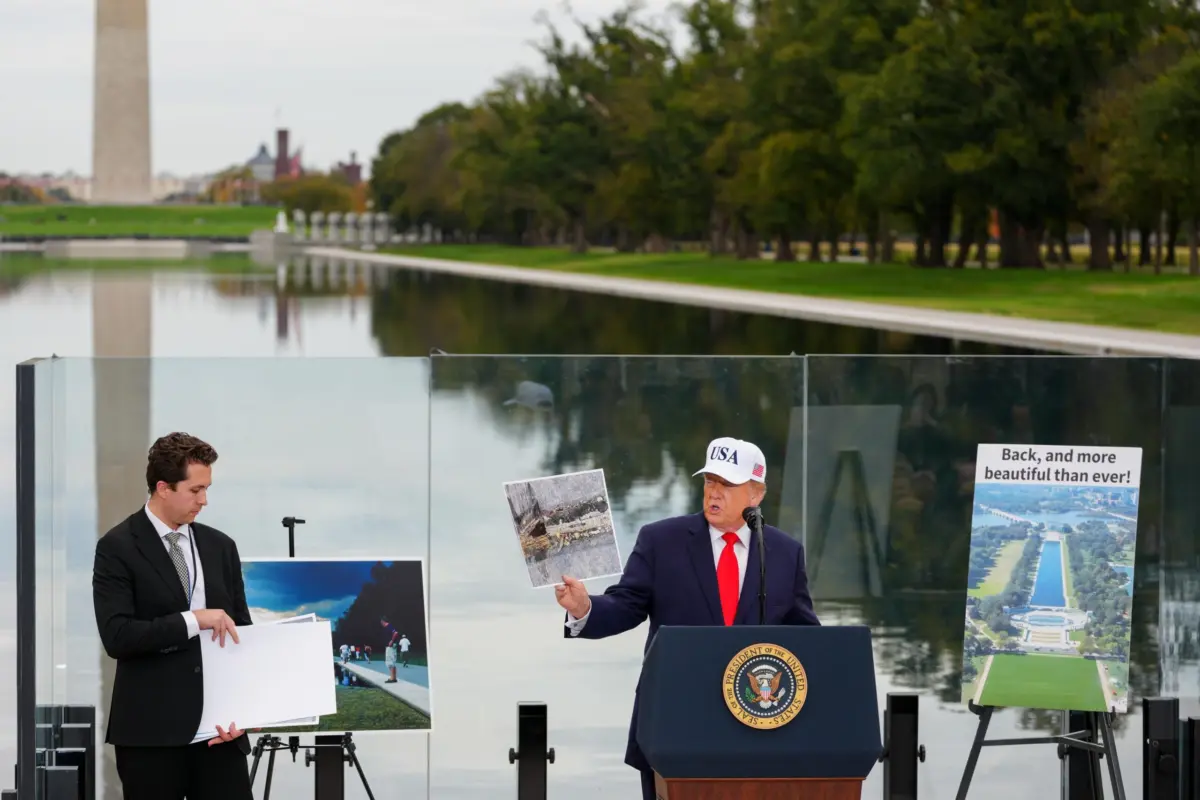
Rather than focusing exclusively on legislative defense, economic stewardship, or rallying voters in fiercely contested congressional districts, Trump’s closing arguments have ventured into unexpected territory. On Monday, during a sprawling, nearly hour-long press conference alongside Interior Secretary Doug Burgum, the president bypassed traditional stump-speech rhetoric to spotlight municipal engineering projects in the nation’s capital. The centerpiece of his closing pitch was not the balance of legislative power, but the state, history, and physical restoration of the newly reopened Lincoln Memorial Reflecting Pool.
This surreal final stretch encapsulates a broader, highly unconventional campaign season marked by disjointed rallies, unconventional public musings, and a persistent friction between the White House and vulnerable Republican candidates. While national polls—such as recent Reuters/Ipsos data placing presidential approval at historic lows—suggest that Trump’s active presence has functioned as an electoral anchor rather than a tailwind for party nominees, the administration has remained remarkably sanguine. Acknowledging the historical headwinds facing a sitting president, Trump offered a fleeting, philosophical nod to political gravity on Monday before pivoting back to the aesthetics of Washington infrastructure. As voters prepare to head to the polls, the disconnect between the existential legislative stakes for the Republican party and the administration’s localized focus highlights a surreal closing chapter to a high-stakes midterm cycle.
Read Also
Detailed Chronology: The Final Days of an Unconventional Campaign
The closing arc of the 2026 midterm election cycle has been anything but orthodox, culminating in a surreal sequence of events on Capitol Hill and across the campaign trail.
Monday’s Press Conference: Infrastructure Over Elections
With election day looming less than 24 hours away, Monday morning presented an opportunity for the White House to project disciplined messaging aimed at mobilizing the conservative base. Instead, President Trump convened a press conference alongside Interior Secretary Doug Burgum that defied traditional political playbooks.
For nearly an hour, the conversation bypassed the legislative agenda, economic metrics, and the defense of congressional seats. Instead, the administration directed the nation’s attention toward Washington, D.C., construction projects, both completed and underway. The focal point of the briefing was the recently renovated Lincoln Memorial Reflecting Pool.
Gesturing toward the national monument, Trump delivered remarks that quickly circulated across digital media platforms and cable news networks:
"This is a massive piece of pool. And it was treated with a lot of love and then it was treated with a lot of hate, and we’re going to stop the hate."
The juxtaposition of an impending legislative wipeout with an impromptu discourse on urban landscaping underscored a campaign season operating entirely on its own terms.
The Culmination of a Disjointed Season
Monday’s focus on the reflecting pool served as the climax for a campaign season defined by erratic rhetoric and unconventional public appearances. Over the preceding weeks, media analysts and political opponents alike highlighted an increase in disjointed rambling during presidential speeches and rallies. Rather than maintaining a disciplined focus on inflation, border security, or taxation, the president frequently veered into idiosyncratic tangents—including extended public musings regarding the physical attributes of incumbent Republican Senator Jon Husted, among other targets.
Throughout the autumn months, Trump sought to frame the midterms as a referendum on his leadership, repeatedly urging the American electorate to treat the ballot as though his own name were printed on it. Yet, this strategic personalization of the midterms alarmed local campaign strategists. In closely contested senate and house districts, Republican candidates quietly worked to insulate themselves from the national brand, recognizing that the president’s polarizing profile was repelling crucial suburban and independent swing voters.
A Fleeting Nod to Political Reality
Amidst the structural focus on local monuments and grievance-laden rallies, Monday offered a rare, explicit acknowledgment from the Oval Office regarding the electoral peril facing the GOP. Confronted with sobering election forecasts, Trump briefly addressed the historical odds stacked against his party:
"For some reason, the sitting president doesn’t win the midterms, but we gave this a very strong shot."
With that understated assessment, the administration effectively bracketed the high-stakes political drama, leaving candidates nationwide to navigate the final hours of a turbulent electoral cycle largely on their own.
Supporting Context & Metrics: Polling Realities and Electoral Headwinds
To understand the atmosphere surrounding the 2026 midterms, one must examine the quantitative metrics defining the political environment. For months, data analysts have tracked a compounding deterioration in public sentiment toward both the administration and the broader trajectory of congressional governance.
Plummeting Approval Ratings
As the nation approaches election night, polling data reflects deep systemic vulnerability for the incumbent administration. A landmark Reuters/Ipsos poll released in late October captured Trump’s presidential approval rating plunging to a record low of 31 percent as the midterms approached. This historic trough reflects cumulative frustrations among the electorate regarding economic management, persistent institutional friction, and fatigue over the administration’s confrontational political style.
In historical contexts, a sitting president navigating a 31 percent approval rating faces catastrophic legislative headwinds. Midterm elections traditionally serve as a referendum on the party in power, functioning as an institutional check on executive overreach. When combined with an unpopular executive, these structural dynamics create an environment where the opposition party enjoys maximal motivation and broad-based cross-party appeal.
The "Anchor" Effect: Burden Versus Boon
Throughout the campaign cycle, conventional wisdom suggested that a loyalist president could leverage his dedicated base to rescue endangered incumbents. However, post-election autopsy reporting and real-time tracking from outlets like Politico indicate that Republican candidates have increasingly pointed the finger at Trump as a primary drag on their electoral prospects.
In suburban districts across the Midwest and Sun Belt—regions that historically decide control of the House of Representatives—swing voters have signaled an intent to break sharply away from the administration. Internal party polling leaked in the final weeks of October revealed that Trump’s persistent attacks on political rivals, combined with his unpredictable campaign trail commentary, alienated moderate Republicans and independent voters who had previously supported the party’s legislative agenda. Consequently, congressional nominees locked in nail-biter races found themselves forced into defensive postures, attempting the difficult balancing act of retaining the core MAGA base while distancing themselves from the polarizing commander-in-chief.
Legislative Control on the Line
The arithmetic of the 2026 midterms points toward a potential realignment on Capitol Hill. If current polling models bear fruit, Republicans stand a significant chance of suffering a historically devastating defeat, potentially surrendering control of both the House of Representatives and the United States Senate to the opposition. Such an outcome would fundamentally transform the remainder of Trump’s presidential term, shifting the capital from an arena of legislative dominance to a theater of gridlock, investigations, and relentless institutional friction.
Official Statements and Institutional Reactions
The divergence between the White House’s messaging and the urgent concerns of congressional Republicans has generated visible friction within the conservative coalition. While leadership on Capitol Hill has labored to keep the spotlight on policy contrasts, the executive branch has maintained an idiosyncratic posture.
The Interior Department and Monument Politics
Secretary of State-level and cabinet figures, such as Interior Secretary Doug Burgum, have found themselves cast in unusual public roles during the final stretch of the campaign. Rather than deploying cabinet officials to swing states to stump for vulnerable senators, the administration utilized key departmental leaders to validate its capital infrastructure initiatives.
Burgum’s appearance alongside the president at Monday’s reflecting pool press conference highlighted an administration eager to brandish tangible, bricks-and-mortar accomplishments within the District of Columbia. To the White House, the revitalization of public spaces in Washington represents a legacy of beautification and executive action that transcends the shifting tides of congressional politics. To congressional candidates fighting for their political lives in places like Ohio, Arizona, and Pennsylvania, however, a multi-million-dollar downtown pool renovation offered little comfort against relentless opposition ad spending.
Congressional Frustrations
Behind closed doors, campaign strategists for the National Republican Congressional Committee (NRCC) and the National Republican Senatorial Committee (NRSC) have expressed private exasperation over the final weeks of the campaign. While public statements from party leaders remain diplomatic, emphasizing unity against the opposition’s legislative platform, off-the-record briefings paint a picture of profound frustration.
Lawmakers fighting to preserve razor-thin majorities argue that the president’s refusal to maintain message discipline has squandered opportunities to capitalize on voter anxieties regarding inflation and regulatory overreach. By turning campaign stops into sprawling, stream-of-consciousness grievances—ranging from administrative tangents to personal insults directed at incumbent GOP figures like Senator Jon Husted—the administration repeatedly surrendered the media narrative to its opponents in the final 72 hours before the vote.
Future Outlook: What Lies Beyond the Ballot Box
As the nation waits for the final ballots to be cast and tabulated, political analysts and Washington insiders are already mapping out the morning-after scenarios that will define American governance for the remainder of the decade.
The Immediate Aftermath: Waiting on the Returns
While polls close on Tuesday night, the definitive balance of power in Washington may not be known immediately. Given the proliferation of mail-in voting, complex legal challenges in key jurisdictions, and historically close margins in dozens of congressional districts, a protracted tabulation process is widely anticipated.
Should the night align with the worst-case projections in Republican internal polling, the party will face an immediate, intense period of internal reckoning. Blame will be apportioned between structural economic realities, candidate recruitment failures, and the overarching political shadow cast by the White House. Conversely, any unexpected victories that allow the GOP to retain even a single chamber of Congress will be framed by loyalists as a vindication of the president’s unique political instincts, proving once again that conventional polling models fail to capture the dynamics of the American electorate.
The Lame-Duck Reality and Beyond
Regardless of the precise numerical breakdown in Congress, a shift in legislative control will radically alter the dynamics of Washington. An executive branch facing a hostile legislature must pivot from a posture of offensive policymaking to one of defensive vetoes and regulatory preservation. Investigations, subpoena battles, and legislative standoffs over government funding will consume the political oxygen on Capitol Hill, making bipartisan consensus an increasingly distant prospect.
Furthermore, the events of the 2026 midterms will inevitably shape the broader trajectory of the conservative movement as it looks past the current administration. The tension between populist, personality-driven politics and traditional legislative conservatism—laid bare by the fractures between the White House and vulnerable midterm candidates—will emerge as a central battleground for the future of the party.
As the final hours of the campaign draw to a close, the nation finds itself bracing for an electoral turning point. Whether the political landscape of Washington is upended or preserved, the surreal final moments of the 2026 cycle—from rambling reflections on senatorial anatomy to impassioned defenses of the Lincoln Memorial Reflecting Pool—will long be remembered as a uniquely bizarre chapter in modern American political history.





Comments
Facebook App ID not configured. Please add it in the Customizer.