
Executive Overview
In the sprawling, tightly guarded continuity of the Star Trek universe, narrative architecture is rarely left to chance. Yet, behind the scenes of Paramount+’s critically acclaimed prequel series Star Trek: Strange New Worlds, creators operate under a constant, high-stakes operational reality: television production today guarantees nothing.
During a recent, in-depth retrospective interview with Space.com, showrunners Akiva Goldsman and Henry Alonso Myers pulled back the curtain on the show’s complex and emotionally resonant fourth season finale, titled “Tomorrow’s Enterprise.” To the casual viewer, the episode functioned as a thrilling, multi-layered narrative tour de force that played with audience expectations and franchise canon. However, startlingly, the creative team revealed that the episode was originally engineered under the shadow of potential cancellation.
At the time the writers’ room was breaking the story, the executive team had received no official greenlight for a fifth season. Faced with the stark possibility that Strange New Worlds might be abruptly pulled from the production slate, Goldsman and Myers made a calculated creative gamble: they designed the season four finale to double as a definitive series finale.
Read Also
This strategic pivot illuminates the precarious nature of modern high-budget science fiction television. It also highlights the extraordinary agility required by showrunners who must simultaneously build open-ended arcs for long-term survival while engineering tight, satisfying narrative parachutes in case the network pulls funding. As Strange New Worlds prepares for its fifth and final run, this look inside the writers’ room offers a fascinating glimpse into the mechanics of franchise preservation, the thematic weight of time travel in science fiction, and the delicate art of outrunning the canon established by Star Trek: The Original Series (TOS).
Detailed Chronology: The Anatomy of a Dual-Purpose Finale
The journey of “Tomorrow’s Enterprise” from a desperate contingency plan to a re-engineered seasonal climax provides a masterclass in modern television writing under pressure.
The Uncertainty of the Writers’ Room
When the creative team convened to plot the trajectory of Strange New Worlds Season 4, they faced a familiar industry dilemma. Streaming economics and shifting corporate priorities within media conglomerates have drastically shortened the lifespans of even prestigious, award-winning series. Goldsman and Myers were caught in a standard administrative limbo: Season 4 was locked in, but the network had not yet committed to a fifth outing.
"It was almost the episode to end the show with," Goldsman admitted during the Space.com interview. "We didn’t know whether we were going to have a season 5. So we built a thing that was going to serve as a potential season finale."
In television production, writing an ambiguous finale requires a unique structural discipline. A show cannot simply leave every narrative thread dangling—a tactic that notoriously alienates fans if a series is abruptly canceled—nor can it completely shut down the universe without painting itself into a corner if renewal miraculously occurs. The writers needed a narrative vehicle that felt weighty enough to close out the voyages of the USS Enterprise under Captain Christopher Pike, while retaining just enough elasticity to snap back into continuity if saved.
The Eleventh-Hour Reprieve and Re-Engineering
Fortuitously, as the writers were deep in the granular breakdown of the episode’s structural beats, word came down from the executive suite: Strange New Worlds had officially secured its fifth season.
This unexpected renewal triggered a frantic, high-stress period of creative re-engineering. Rather than tossing out months of conceptual development, Goldsman, Myers, and their writing staff pivoted. They dismantled the definitive closure elements of the script and rebuilt them into a seasonal cliffhanger and character developmental milestone.
"Fortunately, as we were still breaking it, we ended up with our season 5," Goldsman explained. "So we then reengineered a bunch of things to not end the show. But it was originally designed in case it was our last season."
This pivot reveals why the episode feels so densely packed with narrative velocity. It was constructed to shoulder the immense weight of ultimate resolution—a burden usually reserved for series finales that must tie up years of character arcs, thematic arcs, and universe-building in under an hour.
Supporting Context & Metrics: Time Travel as a Narrative Safety Net
The reliance on temporal mechanics in "Tomorrow’s Enterprise" is not an isolated gimmick within the Strange New Worlds writers’ room; it represents a calculated storytelling philosophy. Throughout the series, the production team has consistently treated high-concept season finales as flexible testing grounds capable of doubling as hard stops.
The Mechanics of Star Trek Time Travel
Time travel is as old as the franchise itself, dating back to classic TOS episodes like "The City on the Edge of Forever" and feature films like Star Trek IV: The Voyage Home. However, Goldsman and Myers approached the time-travel genre in Season 4 with a deliberate desire to subvert expectations.
According to Myers, the season is an anomaly because it features two distinct time-travel narratives that approach the genre from diametrically opposed angles. For "Tomorrow’s Enterprise," the creative team drew unexpected inspiration from the 2000 sci-fi thriller Frequency, starring Dennis Quaid and Jim Caviezel, which deals with cross-temporal communication.
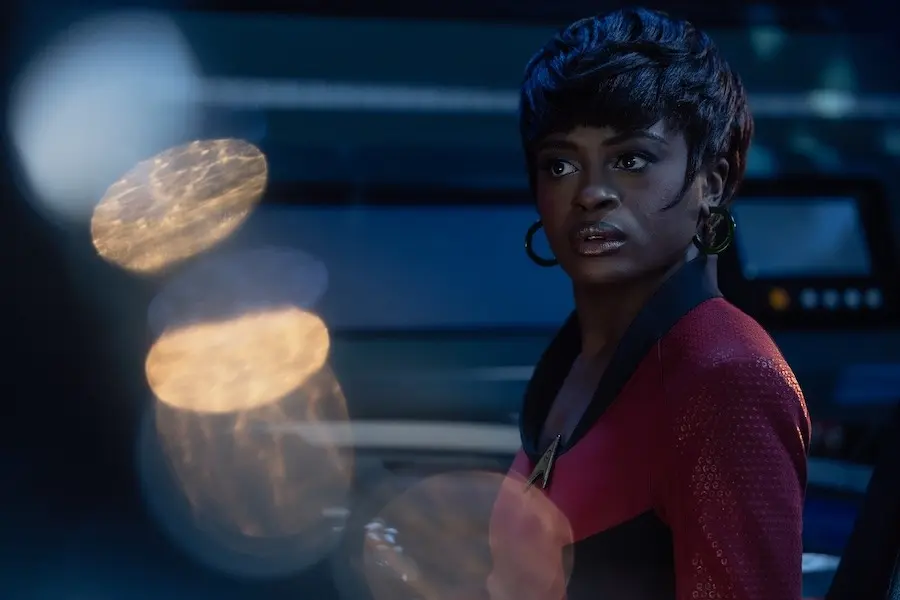
"We had the idea that it would be great if we had the communications officer have a discussion over time to herself," Myers noted. This premise allowed the writers to bypass standard chronological constraints, turning temporal distortion into an intimate psychological dialogue.
Managing the Canon Gap
Operating a prequel series set in the decade before James T. Kirk takes command of the USS Enterprise creates a rigid narrative straitjacket. The creative team knows the ultimate fates of legacy characters like Spock, Uhura, and Nurse Chapel. However, for original characters exclusive to Strange New Worlds—such as Captain Pike, La’an Noonien-Singh, and Commander Pelia—the future remains entirely unwritten.
By utilizing time-jump mechanics in potential series finales, the showrunners carved out a safe harbor to gesture toward the distant futures of these characters without officially violating canon. It is an ingenious storytelling device that bridges the chasm between the end of Strange New Worlds and the dawn of The Original Series.
Official Statements: The Philosophy of Evolution and Identity
At the heart of the "Tomorrow’s Enterprise" narrative is a deeply human thematic core. Beyond the blinking consoles, temporal anomalies, and high-stakes space battles, Goldsman and Myers emphasized that the episode was designed to force characters into a profound reckoning with their own identities.
Learning from the Future and the Past
"There was an emotional core idea there, which is that there’s always something for you to learn from who you’re going to become, and there’s always something for you to learn from the person who you used to be," Myers explained.
This philosophical underpinning serves as a mirror for the entire Star Trek ethos. Yet, as Myers pointed out, Strange New Worlds enjoys a unique structural reversal compared to traditional television:
"We felt, in some ways, that summarized Star Trek. Because everyone knows what they’re going to become, and for us we’ve got this weird reversal. We get to tell a show about who we used to be, and for that, everything’s a surprise for them. People going through this journey have no idea what they’re going to become."
This profound existential irony defines the lived experience of the Enterprise crew under Pike. They are noble, idealistic, and deeply human figures operating under the looming shadow of historical inevitability—most notably Pike’s tragic prophetic fate. By confronting future iterations of themselves through temporal disruption, the characters are forced to evaluate whether their current choices align with the legacy they will inevitably leave behind.
Future Outlook: Preparing for the Final Frontier
As the dust settles on the turbulent production cycle of Season 4, attention within the global fandom has firmly shifted toward the horizon: the fifth and final season of Strange New Worlds.
What Lies Ahead for Season 5
While Paramount+ has kept the exact plot details of the final season under strict wraps, the revelation that "Tomorrow’s Enterprise" was originally shaped as a series-ender offers intriguing hints about the showrunners’ grand design.
- Character Fates: It is reasonable to assume that the glimpses into the futures of non-legacy characters—those who do not cross over into The Original Series—may reflect Goldsman and Myers’ definitive endgame for them. Whether characters like La’an or Captain Pike find peace, tragedy, or an alternate path through timeline manipulation remains one of the most closely guarded secrets in modern television.
- The End of an Era: As the series approaches its scheduled conclusion, the production team has unique creative freedom. Knowing precisely when the curtain will fall allows the writers to craft a deliberate, uninterrupted runway to the series finale, contrasting sharply with the anxious ambiguity that birthed the Season 4 climax.
- The Legacy of Strange New Worlds: Regardless of how the final episodes unfold, Strange New Worlds has cemented its place in television history as a masterclass in episodic-serial hybrid storytelling, breathing vibrant new life into 23rd-century space exploration while honoring the foundational mythos of Gene Roddenberry’s universe.
Conclusion
The near-miss of "Tomorrow’s Enterprise" serving as a series-ender underscores the chaotic, high-wire act of modern television production. By treating seasonal climaxes as potential finales, Akiva Goldsman and Henry Alonso Myers ensured that Strange New Worlds would never be caught flat-footed. Instead, this administrative uncertainty birthed one of the most emotionally rich and intellectually stimulating episodes of the series—proving once again that in the vast expanse of the Star Trek universe, even the threat of an ending can be transformed into a brilliant new beginning.



Comments
Facebook App ID not configured. Please add it in the Customizer.