
Executive Overview
Spotify has officially rolled out a triad of transformative features aimed at reshaping how millions of users discover, navigate, and interact with audiobooks on its platform. As the streaming giant continues its aggressive expansion into the multi-billion-dollar spoken-word audio market, these latest updates—Prompted Playlists for Audiobooks, conversational AI-powered discovery, and streamlined multi-part series navigation—represent a calculated effort to bridge the gap between casual listeners and dedicated bibliophiles.
By addressing long-standing pain points in digital literature consumption, such as algorithmic fatigue, clumsy title organization, and the friction of finding the next book in a sprawling saga, Spotify is positioning itself as the definitive ecosystem for modern readers. According to company executives, audiobooks have rapidly evolved into one of the most engaging mediums on the app. These new tools are designed to slash search times, encourage deeper narrative immersion, and democratize access to literature on a global scale.
Detailed Chronology & Feature Breakdown
Spotify’s evolution into a premier audiobook destination has been swift. Following the successful introduction of the platform’s audiobook tier for Premium subscribers, the company has systematically applied its vast data infrastructure and machine-learning capabilities to the publishing sector. The rollout of these three features marks the latest milestone in this journey.
Read Also
1. Prompted Playlists for Audiobooks (Beta)
Building on the momentum of its music and podcast-centric iterations, the Prompted Playlist feature has officially crossed over into the audiobook domain. Initially launched in beta to gauge user interest in custom music and spoken-word curation, this tool allows listeners to bypass traditional, rigid genre filters.
Instead, users can type out natural-language queries detailing their exact mood, narrative preferences, or structural constraints. For instance, a user seeking contemporary buzz might input:
"Give me a list of books with adaptations from the past three years that are either beloved or critically acclaimed."
Alternatively, a planner might request a customized listening calendar:
"Curate an audiobook calendar for me. Start with this month and select one book each month, keeping it under 15 hours. Each book should align thematically with its month while also matching my listening habits."
During its initial beta phase, the feature is rolling out to eligible Premium users across the United States, Canada, the United Kingdom, Ireland, Australia, New Zealand, and Sweden. Spotify has noted that usage limits and ongoing refinements will apply as engineers gather real-world data to fine-tune the recommendation engine.
2. Conversational Discovery: "Just Ask Spotify"
Discovery in the digital age often feels like searching for a needle in a digital haystack. To combat this, Spotify has introduced a conversational AI assistant that allows users to interact with the platform as if they were speaking to a knowledgeable bookstore clerk or librarian.
By typing or speaking directly into the app, users can initiate complex dialogues. Queries can range from location-specific regional fiction requests—such as "What Scandinavian noir should I explore before my trip to Sweden?"—to deep-dive literary trivia questions like, "Where does the Cyclops first show up in The Odyssey?"
Crucially, the system supports multi-turn, follow-up questions. This means a listening session can fluidly adapt in real time, jumping across formats from music playlists to investigative podcasts and finally settling on an immersive audiobook. This conversational capability is currently available in English for eligible Premium subscribers aged 18 and older in the U.S., Ireland, and Sweden.
3. Frictionless Series Navigation
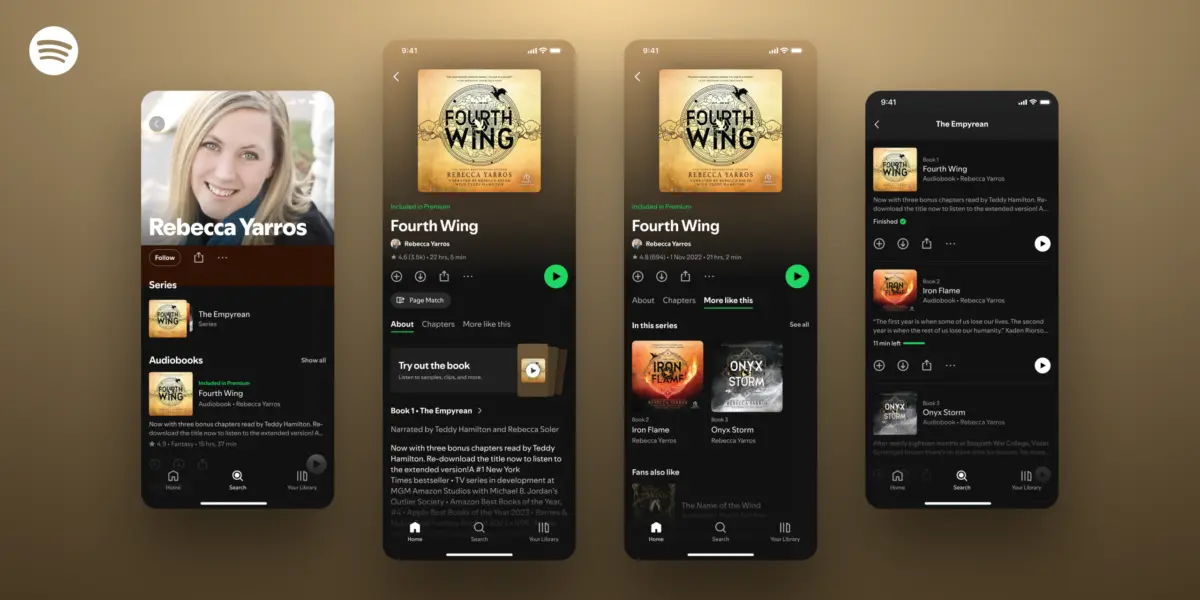
One of the most persistent frustrations for fans of epic fantasy, romance sagas, and multi-part thrillers has been tracking reading or listening orders across disjointed digital catalogs. Spotify’s third major update solves this by introducing intuitive, dedicated series architecture.
When a listener completes a book within a multi-part saga, the app instantly surfaces the next installment, ensuring zero narrative momentum is lost. Furthermore, multi-part series are now explicitly marked throughout the platform, supported by dedicated landing pages that map out the precise chronological or publication order. Listeners can also navigate directly to an author’s central profile page to view all associated series and standalone works at a glance. This feature is now live for users in the U.S., Canada, U.K., Ireland, Australia, New Zealand, and Sweden.

Supporting Context & Industry Metrics
Spotify’s aggressive push into audiobooks is far from accidental; it is a calculated diversification strategy designed to capture high-value engagement time away from competitors like Amazon’s Audible, Apple Books, and Google Play Books.
The global audiobook market has experienced explosive growth over the past half-decade, driven by the rise of smart speakers, commute listening, and the "BookTok" literary phenomenon on social media, which has revitalized interest in physical and digital reading among younger demographics. By integrating audiobooks directly into an app that users already open multiple times a day for music and podcasts, Spotify lowers the barrier to entry for prospective readers.
Internal metrics cited by the company indicate that spoken-word content yields some of the highest session completion rates and emotional engagement on the platform. By deploying generative AI and conversational discovery tools, Spotify is addressing a critical bottleneck in the digital media economy: decision fatigue. When users can simply ask for a book tailored to a specific travel itinerary or narrative trope, they are far more likely to commit to a 10-to-20-hour audiobook than if they were left scrolling through endless, static carousels of bestsellers.
Official Statements
Company leadership has emphasized that these updates are rooted in a foundational desire to honor the intimacy of storytelling while leveraging cutting-edge software engineering.
"Books have become one of the most impactful ways for users to engage with Spotify, and we’re dedicated to simplifying the process of discovering and enjoying great stories,"
— James Jacoby, Senior Director of Engineering & Insights for Audiobooks at Spotify.
Jacoby further underscored the overarching philosophy driving the engineering team:
"These innovative features are all about reducing the barriers between listeners and the books they’ll adore, allowing for more meaningful time spent within those narratives while we continue our mission to connect more people with more books."
Industry analysts view Jacoby’s remarks as a clear signal that Spotify views spoken-word audio not as an experimental side-project, but as a core pillar of its long-term retention and monetization strategy.
Future Outlook
As Spotify moves forward with the beta testing of its Prompted Playlists and expands its conversational AI infrastructure, the broader publishing landscape is watching closely.
The integration of conversational search and prompt-based curation could fundamentally alter how authors and publishers market their titles. In a traditional bookstore, visibility is dictated by front-table placement and eye-level shelf space. In an AI-mediated streaming environment, discoverability depends on how well a book’s thematic metadata aligns with the nuanced, conversational prompts generated by everyday users. This shift places a premium on rich, descriptive cataloging.
Looking ahead, users can expect Spotify to gradually roll out these features to additional geographic markets and language groups, provided the current beta phases yield stable performance and positive engagement metrics. Moreover, as generative AI models become more sophisticated, the boundary between music, podcasts, and literary storytelling on Spotify will likely continue to blur, paving the way for hyper-personalized, dynamic audio experiences that adapt dynamically to the listener’s life.
For now, book lovers across the globe have powerful new tools at their fingertips—making the journey from the first chapter to the final conclusion smoother, smarter, and infinitely more engaging.





Comments
Facebook App ID not configured. Please add it in the Customizer.