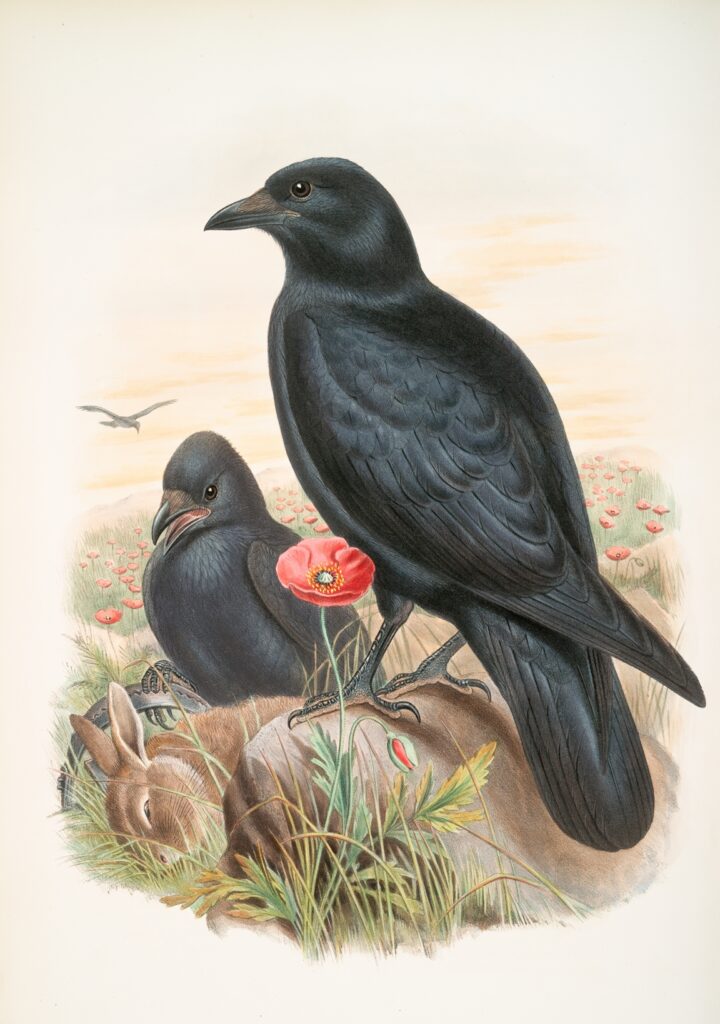
In the contemporary literary landscape, few honors capture the fleeting magic of acute poetic composition quite like the weekly spotlight awarded by leading cultural publications. For the week of November 9, 2026, that distinction belongs to Louisiana-born and Florida-based writer Steve Lambert for his mesmerizing, micro-form masterwork, "Secretaries of Grief." Accompanied historically by John Gould’s classic 19th-century ornithological illustration Corvux corone. Carrion-Crow. (1862–1873), Lambert’s poem strips language down to its barest, most rhythmic essentials. In just eight succinct lines, the piece evokes the shadowy, complex emotional world of corvids—crows, ravens, and their kin—while reflecting deeply on the human condition, mortality, and the profound paradox connecting joy and sorrow.
This analytical feature explores the structural mechanics of Lambert’s poem, contextualizes his prolific career across poetry and prose, unearths the serendipitous digital origins of the text through the author’s personal creative notes, and evaluates the broader cultural resonance of viewing animal behavior through an empathetic literary lens.
Detailed Chronology: The Genesis and Publication of "Secretaries of Grief"
Understanding the arrival of "Secretaries of Grief" requires examining the unusual, highly modern way inspiration strikes a veteran writer. Steve Lambert’s creative process rarely begins at a mahogany writing desk with a blank sheet of parchment. Instead, it frequently starts on the illuminated screen of a smartphone, inside a digital notes application acting as a repository for the ephemera of daily life.
For years, Lambert has maintained a disciplined creative habit: whenever a striking phrase, an overheard sentence in a Florida grocery store, or a sudden mental flash occurs, he types it directly into his phone. Once a week, he acts as an archivist of his own subconscious, opening the app to review accumulated linguistic fragments.
Months prior to its November 2026 publication, two disparate elements collided within that digital margin. First was a lingering fascination with corvids—intelligent, highly social birds ubiquitous across the Florida landscape where Lambert resides. Having previously read about avian mortuary practices—the well-documented phenomenon wherein crows gather around their dead in what popular science often characterizes as funerals—the concept of avian mourning was already active in his thoughts. Second was a three-word phrase captured during one of his routine note-taking sessions: secretaries of grief.
The Assembly of a Micro-Fairy Tale
Upon pairing the phrase with his knowledge of crow behavior, Lambert began importing associated terms into a working document, shuffling phrases across the digital page much like tiles in a mosaic. According to the author, the resulting composition ultimately assumed the cadence of a "micro-fairy tale or nursery rhyme."
By late 2026, the piece found a home as the featured Poem of the Week, paired intentionally with John Gould’s historical depiction of the carrion crow. This visual pairing anchored Lambert’s modern surrealism in a rich tradition of natural history illustration, bridging centuries of human fascination with the intelligent, dark-feathered creatures that share our environment.
Supporting Context & Metrics: Steve Lambert’s Literary Ecosystem
To fully appreciate the minimalist precision of "Secretaries of Grief," one must examine the broader literary output of its creator. Steve Lambert is not an overnight sensation; rather, he is a seasoned, multi-genre craftsman whose bibliography spans deeply expressive poetry, innovative book-length poems, finely tuned short story collections, and collaborative fiction.
A Career in Print and Verse
Born in Louisiana and raised in the sun-drenched, marshy expanse of Florida—a landscape that frequently bleeds into his atmospheric writing—Lambert has built a reputation as a writer’s writer. His poetry has found a welcoming home in dozens of prestigious literary magazines and journals, including:
Saw Palm
Tampa Review
Trampoline Poetry
Louisiana Literature
New World Writing
The Pinch
Porchlight: A Journal of Southern Literature
Broad River Review
Cortland Review
Emrys Journal (where he captured the Nancy Dew Taylor Poetry Prize in 2018 for his poem "Serenade for Larkin")
Comprehensive Bibliography Breakdown
Lambert’s creative range is staggering, moving fluidly between tightly metered verse and expansive prose narratives:
Year
Title
Genre
Format / Notes
2018
"Serenade for Larkin"
Poetry
Award-winning piece (Emrys Journal Nancy Dew Taylor Poetry Prize)
2020
The Patron Saint of Birds
Fiction
Short story collection exploring human fragility and nature
2021
Philisteens
Fiction
Full-length novel
2022
Mortality Birds
Collaborative Fiction
Co-written with author Timothy Dodd
2025
Dutch Ears
Poetry
Book-length poetic work
2026
Village Life and Other Stories
Fiction
Forthcoming short story collection
2026
"Secretaries of Grief"
Poetry
Featured Poem of the Week
This expansive catalog demonstrates an artist continuously probing the boundaries of how humans—and occasionally animals—process existence, mortality, and community.
Official Statements and Authorial Insight
In an exclusive author’s note reflecting on the creation of "Secretaries of Grief," Lambert provided rare transparency regarding the mechanics of his poetic inspiration:
"I have a habit of using my notes application in my phone for depositing phrases and ideas that pop into my head or that I hear people say as I go about my day. I will open up the app at least once a week and see what’s in there. One day ‘secretaries of grief’ was in there. I like birds. I particularly like Corvids. In Florida, where I live, crows are quite common. I remember reading somewhere that crows have funerals for their dead. The phrase ‘secretaries of grief’ and this factoid about crows came together shortly after I opened my notes application. I added other words and phrases. I moved these words and phrases around on the page until they became this poem, which strikes me as a micro-fairy tale or nursery rhyme. That’s all I remember about the composition of this poem."
This candid breakdown strips away the often-pretentious mystique surrounding poetry writing. Lambert presents the poem not as a product of agonizing, midnight torment, but as an act of careful curation—a collision between casual digital record-keeping and deep-seated ecological observation.
Furthermore, the title Secretaries of Grief carries profound semantic weight. In administrative terms, a secretary is one who records, manages, and organizes official business. By casting crows as the "secretaries" of grief, Lambert elevates these scavenger birds from mere urban nuisances into official record-keepers of planetary sorrow. They do not merely feel pain; they catalog it on behalf of the natural world.
Textual Analysis: Deconstructing "Secretaries of Grief"
To understand why the publication selected this specific piece for the weekly honor, one must look closely at the text itself:
Crows grieve for other crows And for the dying and the yet To live and those who never will. Grief seeps in and out of them Like the cold and they grieve For other things as well. But they Know that grief is joy’s true Work and that no one goes to hell.
The Scope of Avian Empathy
The poem immediately establishes an expansive purview of mourning. Crows do not limit their sorrow to conspecifics (other crows); their empathy extends across temporal boundaries—mourning "the dying," those "yet to live," and even "those who never will" (a haunting nod to potential lives, miscarried futures, or extinct species).
Meteorological Metaphors
The line "Grief seeps in and out of them / Like the cold" utilizes brilliant tactile imagery. Grief is not an intermittent emotion; it is atmospheric, meteorological, and ambient. It permeates feathers and bone just as a chilly winter draft penetrates an uninsulated house, highlighting Florida-based Lambert’s acute awareness of how environmental shifts affect living organisms.
The Philosophical Pivot
The poem’s final three lines deliver an unexpected philosophical payload: "Know that grief is joy’s true / Work and that no one goes to hell."
Here, Lambert subverts traditional theological anxiety. By asserting that grief is "joy’s true work," he suggests a dialectical relationship between emotional extremes: one cannot truly experience profound joy without possessing the capacity for deep sorrow. The final reassurance—"that no one goes to hell"—acts as a comforting incantation, a secular absolution delivered by black-winged arbiters. It strips away eternal damnation, replacing cosmic dread with the quiet, neutral cycle of nature.
Future Outlook: The Resurgence of Micro-Poetry and Ecological Verse
As the literary community digests Steve Lambert’s latest triumph, several broader trends emerge regarding where contemporary poetry is heading in the late 2020s.
1. The Intersection of Technology and Traditional Verse
Lambert’s reliance on his phone’s digital notes app highlights a shifting paradigm in creative writing. As mobile technology becomes deeply integrated into daily life, writers are increasingly utilizing ephemeral digital spaces as modern sketchbooks. The transition from a chaotic smartphone scratchpad to a polished, resonant poem demonstrates that technological tools can successfully birth organic, deeply emotional art.
2. The Rise of Ecological and Non-Human Narratives
In an era dominated by ecological anxiety and climate awareness, poetry is shifting away from purely anthropocentric introspection. Writers are turning their lenses toward non-human consciousness—examining the emotional inner lives of animals, trees, and ecosystems. Lambert’s positioning of crows as emotional agents aligns with growing scientific discoveries regarding animal sentience, proving that poetry can serve as a bridge between empirical biology and spiritual inquiry.
3. What’s Next for Steve Lambert?
With the publication of Village Life and Other Stories slated for later in 2026, alongside his recent book-length poem Dutch Ears (2025), Lambert is currently experiencing one of the most prolific periods of his literary career. Readers captivated by the stark, folkloric beauty of "Secretaries of Grief" will find plenty to explore across his expanding catalog of Southern-inflected fiction and verse.
Conclusion
Steve Lambert’s "Secretaries of Grief" is more than a momentary editorial highlight; it is a masterclass in economy, resonance, and ecological empathy. By transforming everyday digital notes and observations of Florida wildlife into a modern nursery rhyme about mortality and endurance, Lambert secures his place as a vital voice in contemporary American letters. As the literary world continues to navigate complex times, poems like this remind us that sorrow is universal, atmospheric, and, ultimately, the sacred labor of being alive.





Comments
Facebook App ID not configured. Please add it in the Customizer.