

Executive Overview
In the contemporary literary landscape, few honors carry the specific curatorial weight of being named Poem of the Week by prominent literary publications. For the week of October 19, 2026, that distinction has been awarded to "I Was Braver Than I Thought" by acclaimed writer W. M. Lobko.
Known for his striking imagery
, visceral lyricism, and psychologically acute explorations of memory, Lobko’s latest featured work offers a deeply atmospheric descent into childhood vulnerability, domestic fracture, and the imaginative sanctuaries we construct to survive our earliest terrors.
Published alongside a brief author’s note that reframes the poem from a straightforward domestic recollection into a broader "devotional" to coping mechanisms and myth-making, "I Was Braver Than I Thought" has quickly drawn praise from critics and readers alike.
This comprehensive review explores the anatomy of Lobko’s poem, contextualizes his impressive literary trajectory, analyzes the thematic mechanics of his childhood universe—from plastic model spaceships to the haunting sounds of familial disruption—and evaluates the broader implications of this feature for contemporary American poetry.
Detailed Chronology of the Release and Literary Context
The mid-October release of Lobko’s poem marks a significant milestone in an already distinguished publishing career, continuing a trajectory defined by appearances in some of the nation’s most prestigious literary journals.
The Evolution of W. M. Lobko’s Voice
W. M. Lobko has spent decades building a reputation as a meticulous craftsman of both verse and prose. His work has previously found homes in venerated periodicals such as the Iowa Review, the Kenyon Review, Washington Square, the Boston Review, and Guernica. His critical acumen and distinct lyric voice have also earned him widespread peer recognition, including a nomination for the Pushcart Prize and a semi-finalist placement for the competitive 92Y/Boston Review Discovery Prize.
Educated at the University of Oregon—a crucible known for nurturing sharp, environmentally and emotionally attuned lyricists—Lobko currently resides and teaches north of New York City. His dual background as a critic and a creator permeates his poetry, which often reads with an analytical precision while retaining raw emotional resonance.
The Path to "I Was Braver Than I Thought"
The selection of "I Was Braver Than I Thought" as Poem of the Week highlights a shift in Lobko’s recent output toward retrospective, deeply interior excavations of childhood. The poem acts as an artifact of a specific kind of late-20th-century domestic upbringing, where the boundaries between external safety and internal chaos were porous and constantly tested.
By releasing the poem with an accompanying author’s note, Lobko invited readers to look past the literal autobiography of the piece. As he noted:
"At first, I thought this poem was about my family, my parents, me—but I’ve come to see it more as a devotional of sorts to the stories & myths that help us make meaning, whatever they might happen to be."
This contextual framing shifts the poem from a mere exercise in trauma recovery into a universal monument dedicated to the creative mechanisms humans invent to endure the incomprehensible.
Supporting Context & Literary Analysis: Inside the Poem
To fully appreciate why "I Was Braver Than I Thought" has been elevated to this level of critical attention, one must examine its structural architecture, its sensory lexicon, and its thematic progression.
The Architecture of the Domestic Sanctuary
The poem opens with an immediate physical grounding:
“Cave of the crook of my arm. / Slick heat of my breath on the desk / Lysol would lift away.”
Right away, Lobko establishes an atmosphere of claustrophobia and clinical sterilization. The speaker is curled inward, taking shelter within their own body, while the chemical tang of Lysol signals an obsessive, anxiety-driven cleanliness designed to eradicate invisible threats.
This transitions rapidly into a paradigm shift regarding the nature of fear. The speaker realizes that the ghosts of their childhood night terrors—those phantom figures that woke them at 2:00 a.m.—were not supernatural hallucinations, but concrete, physical realities:
“germs in the chrome of the toy green motorcycle / I dropped in the toilet, say, / or the high twist in my mother’s voice / when she learned her mother was dead.”
The comparison is striking. The mundane micro-contamination of a dropped toy sits parallel to the devastating macro-trauma of generational loss. Lobko captures the exact pitch of grief by comparing it to “the high E-flat of a bough breaking,” a sound that evokes sudden, brittle catastrophe, a “song I was then decades from singing.”
The Architect of the Ice Planet
As the poem progresses, the speaker retreats deeper into creative isolation. They describe themselves as the “architect of an ice planet” and a “skull / hearing itself with every graham cracker’s / ashen reverberation.”
This synesthetic imagery—where the act of eating dry crackers becomes an acoustic echo chamber within the bone—emphasizes total isolation. The child attempts to build walls that can keep out the chaotic soundscape of the adult world:
“model spaceships in grey plastic / richly smelling of ozone under the armature light I / aimed so relentlessly, faithful / nothing would melt or erupt.”
The tactile details are exquisite: the distinct scent of ozone generated by miniature electrical setups, the clinical glare of the desk lamp, and the faith placed in plastic models as structural bulwarks against a dissolving household.
The Intrusion of Reality
No amount of ozone or armature lighting, however, can permanently seal out the adult world. The poem confronts its emotional climax in the memory of parental discord:
“The one fight / we caught my mother & father having / so heinous the sitcom characters stopped to watch, / axe through the bucket klieg lights, / axe through the snowbound door, axe through / the umbilical.”
Here, Lobko employs brilliant, surreal hyperbole. The argument is so violently disruptive that even fictional television characters break the fourth wall of their sitcoms to stare in horror. The repetition of the word “axe” acts as a percussive strike, chopping away at the safety of the household, culminating in the severing of the “umbilical”—the fundamental connection keeping the child anchored to the family unit.
The Redemption of Space
Despite the violence of the domestic interior, the poem finds a strange form of grace in its concluding lines through the motif of outer space:
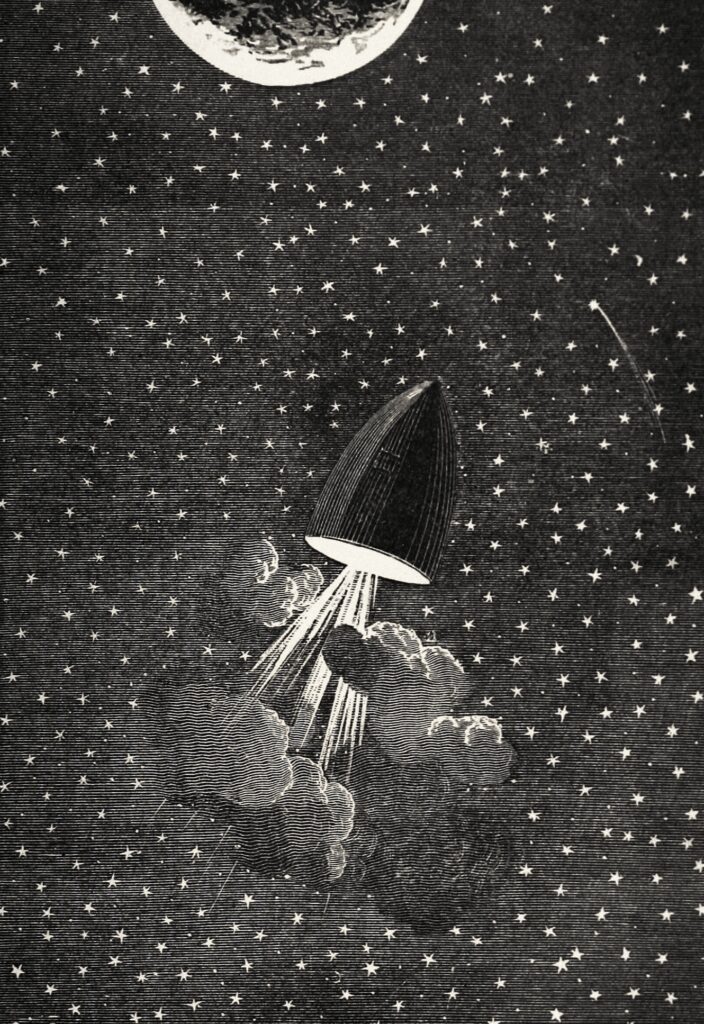
“Still, I loved space, / how inaccessible it was, its famous silence, how / the ships crisscrossing it started out pristine / then of a sudden were blast-scored, emphysemic / buckets of bolts / prayer could hold together.”
Space offers what the earthly home could not: vast, protective silence and glorious distance. Yet, Lobko refuses to romanticize it into a pristine fantasy. The spaceships traversing the void are flawed, battered, and scarred by explosive forces. They are “emphysemic buckets of bolts”—wheezing, fragile vessels held together by little more than raw prayer and desperate human will. In this final metaphor, the child recognizes that survival does not require perfection; it only requires staying functional enough to keep moving through the dark.
Official Statements and Author Insights
In reflections accompanying the release, literary critics and commentators have focused heavily on Lobko’s unique ability to blend pop-culture nostalgia with profound existential dread.
Literary analysts note that poems dealing with difficult childhoods often fall into the trap of sentimentality or unearned bitterness. Lobko avoids this pitfall by treating his younger self not as a victim of a broken home, but as an artisan, a young engineer of coping mechanisms trying to reverse-engineer safety out of raw materials: grey plastic, model glue, ozone, and imagination.
In his personal note, Lobko’s reframing of the work as a “devotional” elevates the discourse surrounding autobiographical poetry. By categorizing the poem not as a historical ledger of grievances, but as an act of reverence toward the stories we tell ourselves to survive, Lobko repositions creative expression as a primary human utility.
Future Outlook: The Legacy of Lobko’s Latest Work
As "I Was Braver Than I Thought" circulates widely through poetry communities online and in print, its long-term impact on Lobko’s career is expected to be substantial.
- Heightened Anticipation for Future Collections: Given Lobko’s established track record in premier journals, this high-profile feature will likely accelerate publisher interest in a forthcoming full-length poetry collection centered on memory, domestic architecture, and imaginative survival.
- Pedagogical Application: Due to its rich deployment of metaphor (the ice planet, the ozone-scented model ships, the acoustic reverberation of the graham cracker), the poem is well-positioned to become a staple in creative writing classrooms examining how poets handle trauma without lapsing into confessional clichés.
- Broadening the Conversation on Myth-Making: Lobko’s framing of poetry as a devotional to coping mechanisms provides a fresh theoretical lens for contemporary lyric poetry, encouraging readers and writers alike to examine the protective myths of their own childhoods.
Ultimately, W. M. Lobko’s "I Was Braver Than I Thought" stands as a masterclass in modern verse. It reminds us that long before we possess the political or physical agency to alter our circumstances, we build internal worlds out of whatever materials are at hand—turning plastic, breath, and silence into the armor that carries us into the future.





Comments
Facebook App ID not configured. Please add it in the Customizer.