
EXECUTIVE OVERVIEW
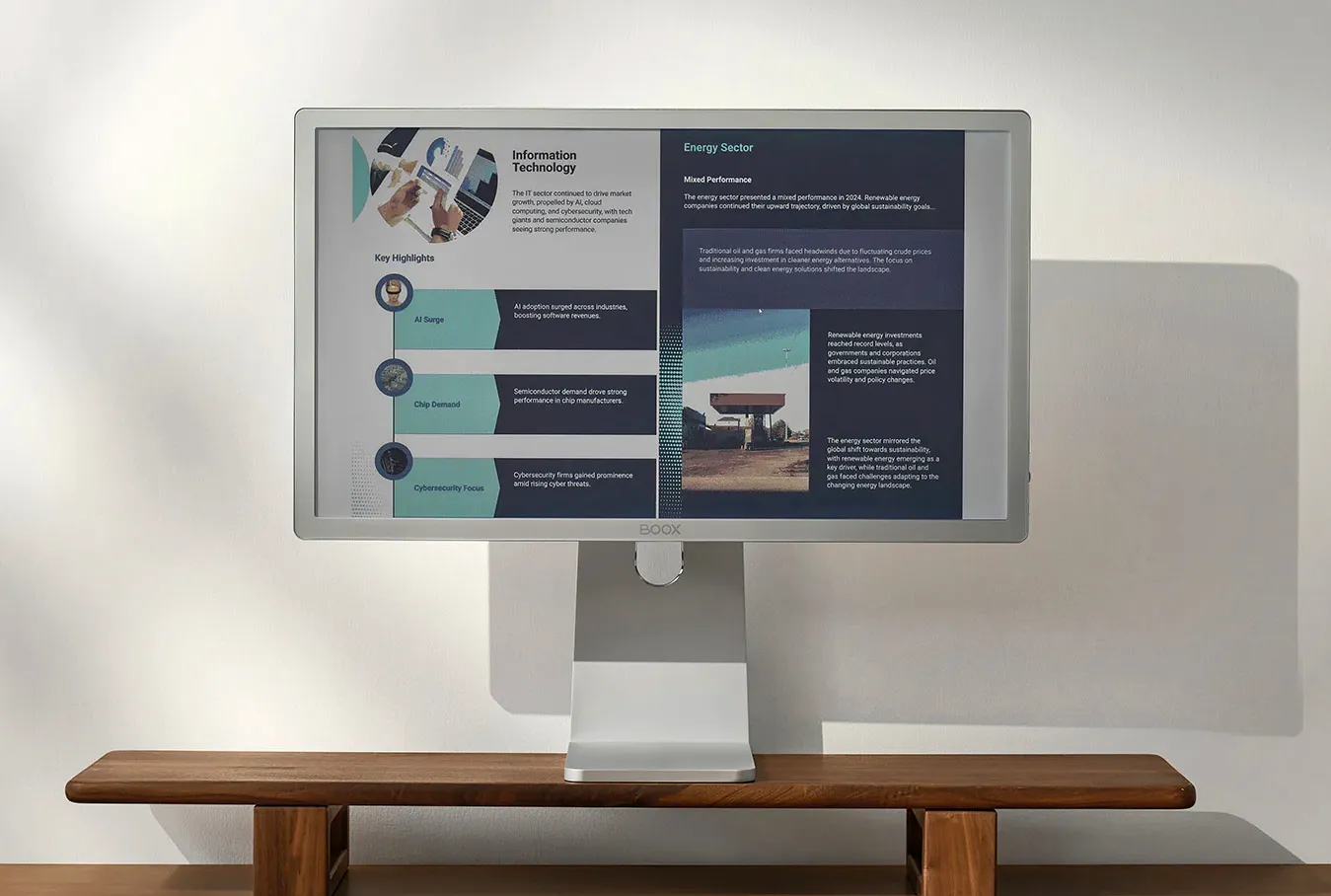
In a quiet yet significant shift for the global e-paper hardware market, Onyx International has officially phased out its pioneering line of desktop monitors, the Boox Mira and Mira Pro. For the past six months, the official Boox website has listed both the compact 13.3-inch Mira and the expansive 25-inch Mira Pro as entirely unavailable. While occasional units continue to surface via third-party vendors or as factory-refurbished stock directly from the manufacturer, production lines have ground to a definitive halt.
This development marks the conclusion of a high-profile, four-year experiment by Onyx to bridge the gap between traditional E Ink reading devices and mainstream desktop productivity displays. Launched globally in late 2021 after initial regional rollouts, the Mira series positioned itself as a premium, eye-strain-reducing alternative for programmers, writers, and office professionals seeking relief from the harsh backlighting of conventional LCD and OLED screens.
Read Also
However, the commercial journey of the Mira series was fraught with heavy economic hurdles, steep pricing barriers, and an evolving marketplace where consumer hesitation clashed with rapid technological advancements. As Onyx steps back from the E Ink monitor arena, the competitive landscape shifts dramatically. Competitors such as Dasung—a nearly decade-long veteran of the space—and Bigme now find themselves holding the reins of a niche yet resilient industry. This retrospective examines the rise and fall of the Boox Mira family, the market dynamics that sealed its fate, and what this sudden exit signals for the future of large-format e-paper desktop technology.
The Genesis and Evolution of the Boox Mira Series
To understand the sudden disappearance of the Mira monitors, it is necessary to trace their evolution from concept to commercial product. When Onyx first introduced the Mira line in late 2021, the release was met with immense curiosity and cautious optimism. For years, mobile E Ink devices like the Boox Max and Note series had proven that electronic paper was viable for document annotation and reading. Scaling that technology up to a desktop monitor size, however, presented formidable engineering hurdles—chief among them refresh rates, ghosting management, and ghost-image reduction.
Onyx rolled out the hardware globally, targeting North American, European, and Asian markets simultaneously. The portfolio initially comprised two core models:
- The Boox Mira (13.3-inch): Designed for portability and single-document viewing, matching the form factor of standard legal pads.
- The Boox Mira Pro (25-inch): A massive desktop monitor engineered to replace a traditional multi-monitor setup for text-heavy workflows.
Despite the initial enthusiasm, early iterations faced criticism regarding lighting uniformity and software optimization. To address these shortcomings, Onyx pushed forward with iterative updates. By mid-2024, the company refreshed the lineup by integrating front-lit warm and cool lighting variants, attempting to make the monitors usable in dim environments without sacrificing the reflective, paper-like benefits of ambient light.
The crowning hardware ambition arrived in April and May 2025 with the launch of the Mira Pro Color. Utilizing advanced color e-paper filter technology, this iteration sought to make spreadsheet work, color-coded programming environments, and web browsing viable on an E Ink canvas. Yet, despite these engineering milestones, the writing was already on the wall. High manufacturing overheads and limited mainstream adoption created a widening gap between development costs and commercial returns.
Economic Realities and Market Friction
The primary obstacle facing the Onyx Boox Mira series was not a lack of technological capability, but rather a severe case of economic friction. E-paper display panels, particularly at scale, are notoriously expensive to manufacture. Yield rates for large-format electrophoretic displays are significantly lower than those for mass-produced LCD panels, translating into punishing retail prices for end-consumers.
When Onyx priced the 25-inch Mira Pro at a staggering $1,899.99, it instantly positioned the device as a luxury good accessible primarily to niche enterprise buyers, wealthy developers, or individuals with severe medical conditions like photophobia or chronic digital eye strain. At nearly $2,000, consumers expected a seamless, plug-and-play user experience comparable to high-end Apple or Dell monitors.
Instead, early adopters often encountered a steep learning curve. Integrating an E Ink monitor into a modern multi-app desktop workflow required tweaking custom refresh modes, managing ghosting artifacts via software shortcuts, and adjusting to the inherent latency of electronic paper. Because these monitors were sold almost exclusively online through direct-to-consumer channels, potential buyers had virtually no opportunity to test the hardware in person. For many professionals, gambling nearly $2,000 on an unproven workflow tool proved to be a bridge too far.

Furthermore, Onyx operated in a crowded ecosystem where its core competency was traditionally Android-based E Ink tablets and e-readers. While Dasung had spent close to a decade refining its niche manufacturing processes specifically for desktop monitors, Onyx juggled multiple product lines, potentially spreading its research, development, and marketing capital too thin to sustain the aggressive iteration cycle required in the nascent e-monitor market.
Competitive Landscape: Dasung and Bigme Stepping Up
With Onyx officially vacating the E Ink monitor space, the market consolidation leaves two primary players standing: Dasung and Bigme.
Dasung: The Enduring Pioneer
Dasung remains the undisputed heavyweight champion of the E Ink monitor industry. Having spent nearly ten years dedicated almost exclusively to the research and development of electronic paper displays, Dasung has cultivated deep manufacturing partnerships and brand loyalty among hard-core text workers.
Dasung’s flagship offering, the Paperlike Color Revolutionary, directly targets the exact demographic that Onyx attempted to capture. Featuring a sprawling 25-inch screen, Dasung’s model retails at a slightly more competitive $1,698.00 and benefits from years of proprietary refresh-rate optimization technologies, such as their custom Turbo refresh algorithms that mitigate ghosting without requiring constant manual page-refreshing. Alongside their large-format displays, Dasung maintains a robust lineup of 13.3-inch black-and-white and color e-paper monitors, serving as the benchmark for reliability in the sector.
Bigme: Aggressive Innovation and High Refresh Rates
Meanwhile, Bigme has aggressively expanded its footprint in the monitor space over the last four years, carving out a reputation for technical bravado. Bigme currently offers three distinct monitor models that push the boundaries of what e-paper can achieve:
- The Bigme B13: Hailed as the world’s first 13.3-inch color e-paper desktop monitor, it utilizes E Ink’s Kaleido 3 technology. Retailing at a more accessible $679.99, it offers a glare-free viewing experience aimed squarely at long-form readers, writers, and coders seeking relief from eye fatigue.
- The Bigme B251 Pro: Perhaps the most ambitious large-format 25.3-inch color E Ink monitor on the market, the B251 Pro represents a historic technical milestone. While the original B251 model capped refresh rates at a choppy 24Hz, the Pro iteration breaks barriers by supporting refresh rates up to an astonishing 60 FPS.
By achieving 60 frames per second on a large-format color E Ink display, Bigme has effectively bridged the psychological gap between traditional LCD responsiveness and e-paper eye safety. Mouse movements, window dragging, and scrolling no longer suffer from the painful stuttering that plagued early generation devices like the original Mira Pro.
Strategic Implications for the E-Paper Industry
The departure of Onyx from the monitor sector should not be interpreted as the death of desktop e-paper, but rather as a natural market pruning. When hardware segments transition from experimental novelties to mature product categories, consolidation is inevitable. Companies with diversified product portfolios often retreat from low-margin, high-support categories when profitability fails to meet corporate thresholds.
However, the enduring presence of Dasung and Bigme proves that a dedicated consumer base values eye health over raw multimedia consumption. Modern knowledge workers spend upwards of eight to ten hours a day staring at glowing backlights. The demand for flicker-free, reflective reading and programming surfaces is growing, driven by an aging workforce experiencing digital eye strain, computer vision syndrome (CVS), and sleep disruption caused by blue-light exposure.
The technical hurdles that defeated the Mira line—specifically high production costs and sluggish refresh rates—are actively being solved by competitors. Bigme’s achievement of 60 FPS on the B251 Pro demonstrates that technological momentum has not slowed down.
Future Outlook: What Lies Ahead for Desktop E-Paper?
As we look toward the horizon of desktop display technology, several key trends are likely to shape the post-Onyx era:
- Mainstream Component Cost Reductions: As E Ink Holdings (the sole manufacturer of electrophoretic film) ramps up production of advanced color matrices like Kaleido 3 and Gallery 3, economies of scale may eventually drive down panel costs for secondary manufacturers, lowering the barrier to entry for consumers.
- Refined Software Integration: Future monitors will rely less on manual user adjustments for ghosting and rely more heavily on AI-driven screen-region optimization—automatically detecting whether a user is scrolling a webpage, watching a video, or typing in an IDE, and adjusting refresh parameters dynamically.
- Niche Enterprise Adoption: Rather than targeting the general consumer, manufacturers are increasingly pivoting toward corporate wellness programs, specialized medical procurement (for light-sensitive individuals), and high-security financial institutions where reflective displays offer security and comfort benefits.
The quiet exit of the Onyx Boox Mira and Mira Pro closes an important chapter in the history of e-paper hardware. While Onyx has chosen to focus its considerable resources elsewhere—primarily on its wildly successful Android e-reader and note-taking tablet ecosystems—the path they helped blaze remains open. Dasung and Bigme stand ready to inherit the market, proving that while individual products may fade, the quest for a strain-free digital workspace is more alive than ever.





Comments
Facebook App ID not configured. Please add it in the Customizer.