
Executive Overview
The contemporary art museum exists at an uncomfortable intersection: it is simultaneously envisioned as a public sanctuary for cultural enrichment and operated as a high-security vault for immense financial capital. At the center of this duality lies an unyielding institutional boundary—the strict prohibition against physical contact. While security apparatuses, floor tape, and vigilant gallery attendants enforce a rigid "Do Not Touch" regime to preserve physical artifacts for posterity and protect market valuations, the human impulse to engage art through tactile sensory input remains a powerful counterforce.
Recent observations and critical reflections by art critics, conservators, and visitors highlight a systemic tension within top-tier institutions such as the San Francisco Museum of Modern Art (SFMOMA) and The Metropolitan Museum of Art (The Met). The enforcement of traditional gallery etiquette often induces an environment of heightened surveillance and sterile formality, alienating patrons and framing art as a commodity isolated from the public it was created to move.
This report examines the operational, financial, and philosophical dynamics of art presentation. By analyzing documented gallery incidents, behind-the-scenes conservation practices, the financialization of canonical works, and radical counter-movements—from Gordon Matta-Clark’s "Anarchitecture" to modern climate protests—this investigation explores how physical contact threatens institutional capital while remaining essential to authentic artistic experience.
Read Also
Detailed Chronology: From Gallery Incidents to Unscripted Touch
The tension between institutional control and tactile engagement unfolds across a series of documented encounters within major cultural spaces and educational environments, tracing a continuum from severe disciplinary enforcement to unscripted audience participation.
+-----------------------------------------------------------------------------------+
| CHRONOLOGY OF GALLERY INTERACTION AND TACTILE CONFLICT                            |
+-----------------------------------------------------------------------------------+
| 1. SFMOMA Photography Wing Incident                                               |
|    - Visitor interacts physically with Meghan Riepenhoff's "Littoral Drift #209"  |
|    - Security intervention leads to public admonishment and visitor retreat          |
+-----------------------------------------------------------------------------------+
| 2. The Met Conservation Studio Tour                                               |
|    - Behind-the-scenes inspection reveals microscopic restoration techniques       |
|    - Restorers confirm minute physical flaws drastically degrade market valuation    |
+-----------------------------------------------------------------------------------+
| 3. Campus Installation of Dougherty's "So Inclined"                               |
|    - Ephemeral, open-air stick sculpture invites direct physical touching             |
|    - Community self-policing replaces security infrastructure without vandalism     |
+-----------------------------------------------------------------------------------+
| 4. SFMOMA "Calder in Motion" vs. Unscripted Visitor Touch                         |
|    - Staged demonstration uses "push sticks" to induce artificial kinetic motion      |
|    - Spontaneous child interaction triggers genuine, unmediated kinetic response     |
+-----------------------------------------------------------------------------------+
1. The SFMOMA Photography Wing Incident
During a extended research residency at SFMOMA, poet and art critic DS Waldman accompanied his mother—an old-process photographer—through the museum’s cameraless photography wing. The gallery showcased works emphasizing material process, including Man Ray’s rayographs, Allison Rossiter’s photograms on expired paper, and Meghan Riepenhoff’s large-scale cyanotype grid, Littoral Drift Nearshore #209.
Riepenhoff’s piece, created by casting seawater and silt from Washington’s Fletcher Bay directly onto cyan-exposed paper, evoked an immediate, visceral connection to coastal geography. Driven by an innate photographic curiosity and a personal connection to the ocean, the visitor stepped past implicit boundaries, lifted a corner of one of the cyanotypic squares, and inspected the unexposed reverse side of the paper.
A nearby gallery attendant immediately intervened, shouting forcefully at the visitor to step back and threatening ejection from the premises. Though the piece suffered no material damage, the public reprimand altered the visitor’s behavior for the remainder of the visit: she retreated into rigid compliance, remaining far behind floor tape lines with her hands held firmly behind her back.
2. Behind the Scenes at The Met Conservation Department
During a specialized study of institutional conservation, a cohort of art historians gained private access to The Metropolitan Museum of Art’s painting conservation studios prior to public opening hours. Led by conservator Sarah, the tour revealed the delicate mechanics required to maintain art objects.
Inside the studio—a sunlit workspace equipped with easels, wooden workbenches, and magnification devices—Sarah demonstrated the removal of discolored varnish, the re-gilding of abrasions, and retouching flaking pigment on an un-framed Renaissance fresco. However, the technical masterclass consistently referenced market consequences. Pointing to a nearly imperceptible irregularity in the paint, the conservator emphasized that failing to treat minor blemishes—or treating them incorrectly—could instantly erase tens or hundreds of thousands of dollars in asset value. She cited a previous incident involving a dropped 19th-century American portrait where the breaking of an original frame was characterized not merely as a physical accident, but as an economic "horror story."
3. The Ephemeral Counterpoint: Patrick Dougherty’s So Inclined
In contrast to indoor museum protocols, an outdoor installation commissioned at a Vermont college campus provided an alternative model of engagement. Sculptor Patrick Dougherty constructed So Inclined, a multi-story architectural installation built entirely from woven tree saplings and branches.
Designed without physical barriers or guard surveillance, the structure invited students and visitors to walk through its hollow interior and directly handle the woven walls. Despite complete physical vulnerability and the total absence of security personnel, the public refrained from vandalizing the work. The community collectively accepted the artist’s premise: to experience the piece through touch and allow environmental exposure to gradually weather the installation over time.
4. Controlled Kinetic Art vs. Spontaneous Interaction
At SFMOMA’s exhibition Dissonant Harmony, featuring the mobile sculptures of Alexander Calder, the conflict between kinetic intent and institutional stasis became fully visible. Designed historically to swing in ambient air currents—such as a mobile Calder gifted to Piet Mondrian, which hung outdoors catching breezes off the Gulf of Lion—the museum’s mobiles hung motionless in climate-controlled, glass-enclosed galleries.
To address this artificial stasis, SFMOMA organized a ticketed event titled "Calder in Motion." Museum staff utilized a custom "push stick"—a long rod tipped with soft cotton resembling an oversized swab—to gently contact the outer wires of the suspended structures and induce a brief, controlled whirl.
[ Ambient / Free-flowing Environment ]
  ---> e.g., Mondrian's Garden / Outdoor Installation
  ---> Result: Unscripted, continuous motion via natural air currents

[ Traditional Museum Display ]
  ---> e.g., Standard SFMOMA Gallery Setting
  ---> Result: Total kinetic stasis; art preserved as rigid, static asset

[ Sanctioned Institutional Activation ]
  ---> e.g., SFMOMA "Calder in Motion" Program
  ---> Result: Highly controlled kinetic motion via specialized "push sticks"

[ Unsanctioned Public Engagement ]
  ---> e.g., Spontaneous touch by gallery visitors
  ---> Result: Authentic physical activation; triggers institutional panic over asset integrity
This orchestrated presentation stood in sharp contrast to an unsanctioned incident observed weeks earlier. A young boy named Julian broke away from his mother, ran up to a low-hanging Calder mobile, and struck a red metal spade along its outer edge. The mother, standing within arm’s reach, chose not to restrain the child. The physical contact instantly activated the sculpture, sending it into a natural, slow-whirling arc through the morning light before the pair exited the gallery.
Supporting Context & Metrics: The Political Economy of Art Preservation
The rules governing visitor conduct in modern museums are directly tied to financial valuation, operational risk management, and the spatial dynamics of elite cultural spaces.
Financialization and the Cost of Access
High-art institutions are increasingly concentrated in primary financial centers, creating steep economic entry barriers that dictate who can interact with canonical works.
| Institution / Context | Location | Access Cost / Economic Framework | Primary Preservation Paradigm |
|---|---|---|---|
| SFMOMA | San Francisco, USA | High ticket prices; specialized press/member passes | Rigid floor lines, security guards, controlled activation events |
| The Metropolitan Museum of Art | New York City, USA | High mandatory/suggested admission; corporate patronage | Climate control, specialized conservation studios, monetary valuation tracking |
| Public Archaeological Sites | Sofia, Bulgaria | Free public access; integrated into urban infrastructure | Unprotected public utility; democratic engagement over capital preservation |
| Outdoor Site Installations | Educational Campuses | Free public access | Ephemeral lifecycle; community stewardship without physical barriers |
Beyond direct ticketing fees, financial valuation databases (such as Appraiser, which costs upwards of $1,000 annually for professional access) demonstrate how tightly art conservation is integrated into private wealth management. When art functions as an asset class, the museum’s role shifts from public educator to vault custodian.
Spatial Security and Psychological Impact
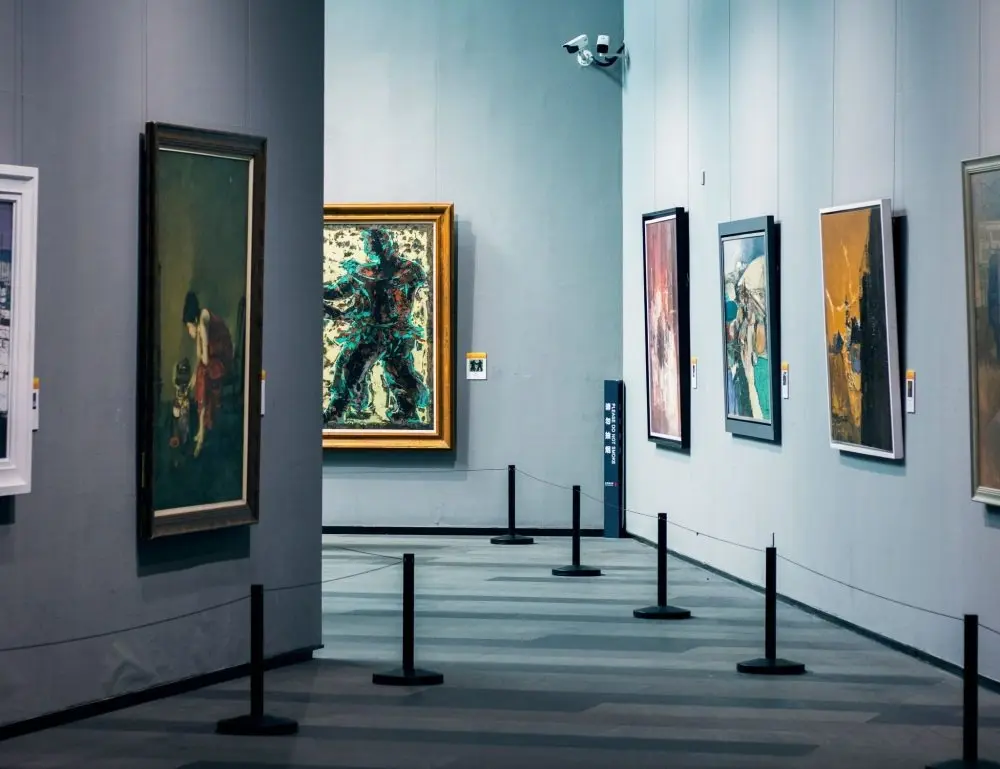
The enforcement of distance through floor tape, stanchions, surveillance cameras, and armed or uniform guards creates a distinct psychological environment. Visitors report that the constant threat of scolding transforms aesthetic contemplation into performative compliance. Art educators note that this environment can create a sense of physical restraint, making visitors feel hyper-visible and uncomfortable within the museum space.
       +-------------------------------------------------------+
       |             THE SURVEILLANCE FEEDBACK LOOP            |
       +-------------------------------------------------------+
                                   |
                                   v
             +-------------------------------------------+
             | Financial Asset Valuation & Risk Hedging  |
             +-------------------------------------------+
                                   |
                                   v
             +-------------------------------------------+
             | Physical Infrastructure & Guard Network   |
             |  (Tape lines, cameras, stanchions, glass) |
             +-------------------------------------------+
                                   |
                                   v
             +-------------------------------------------+
             | Visitor Inhibition & Environmental Tension|
             |   (Anxiety, hyper-vigilance, alienation)  |
             +-------------------------------------------+
                                   |
                                   v
             +-------------------------------------------+
             | Suppression of Direct Sensory Engagement  |
             +-------------------------------------------+
Direct Physical Action and Climate Activism
The sacred monetary value assigned to untouched canonical art has made high-profile museum pieces prime targets for political protest. Activists exploit the institutional horror of surface contamination to draw global attention to ecological crises.
- Picasso’s L’Hétaïre: Targeted in early 2025 by Last Generation Canada, who threw bright pink paint across the surface.
- Van Gogh & Degas Works: Subjected to soup and liquid dousing by UK coalition Just Stop Oil.
- Klimt’s Death and Life: Targeted in August 2024 by Last Generation Austria, whose activists poured black crude oil over the protective glass casing while one demonstrator glued their hand directly to the outer frame.
These acts rely on the extreme contrast between the near-sacred protection granted to high-value art objects and the perceived societal neglect of environmental crises.
Official Statements & Philosophical Frameworks
The tension between preserving physical art objects and facilitating genuine human experience has sparked ongoing debate among conservators, conceptual artists, and literary critics.
The Institutional Conservation Stance
Museum conservators maintain that absolute restrictions on physical contact are essential to prevent irreparable damage over time.
"Even a blemish like this—if not tended to, or tended to poorly—could drastically impact valuation. Tens, hundreds of thousands of dollars can vanish from a single improper touch or physical flaw."
— Sarah, Conservator at The Metropolitan Museum of Art
Museum administrators argue that without strict enforcement, human skin oils, accidental friction, and environmental wear would reduce masterpieces to degraded artifacts within generations, depriving future audiences of the original visual experience.
The Conceptual Counter-Perspective: Anarchitecture
Conceptual artist Gordon Matta-Clark offered a direct challenge to the commercial preservation model through his short-lived "Anarchitecture" movement in the 1970s. Working outside institutional networks, Matta-Clark made dramatic architectural modifications to abandoned or scheduled-for-demolition buildings.
   [ TRADITIONAL MUSEUM MODEL ]               [ ANARCHITECTURE / EPHEMERAL MODEL ]
+---------------------------------+        +---------------------------------+
| • Climate-Controlled Protection |        | • Open to Public Manipulation   |
| • Protected Capital Asset       |        | • Decoupled from Private Capital|
| • Rigid Security & Protocols    |        | • Temporary / Destructive Nature|
| • "Do Not Touch" Mandate        |        | • Direct Physical Access        |
+---------------------------------+        +---------------------------------+
In his 1975 intervention Day’s End at Pier 52 in Manhattan, Matta-Clark cut massive industrial apertures through the walls and floor of an abandoned warehouse. Visitors were invited to walk through the space without tickets, security, or safety barriers, looking directly down into the Hudson River through sliced steel and concrete.
Because he operated without municipal permits, New York City authorities issued a warrant for Matta-Clark’s arrest, and the structure was quickly demolished. While the physical artwork was intentionally allowed to perish, the secondary documentation—specifically photographs capturing the cuts—was later commodified, selling for high sums within the private art market Matta-Clark originally sought to evade.
The Democratization of Historical Artifacts
In his novel Cleanness, author Garth Greenwell illustrates an alternative, non-capitalist relationship with physical history through a scene set in a public square in Sofia, Bulgaria:
"…you’re still such an American," the former student teases, after an American teacher reacts with shock when a carton of orange juice is set atop an ancient marble pillar. "We have stuff like this everywhere."
This perspective suggests that when historical artifacts are integrated into daily public life—rather than isolated behind protective barriers—they regain a democratic utility, functioning as shared community space rather than speculative private capital.
Future Outlook: Re-imagining Exhibition Paradigms
As institutions face growing criticism over high entry costs, environmental footprints, and rigid security measures, the museum sector is under increasing pressure to re-evaluate how visitors interact with art.
+-----------------------------------------------------------------------------------+
| EMERGING MODELS OF ART EXHIBITION AND ENGAGEMENT                                  |
+-----------------------------------------------------------------------------------+
| STRATEGY                 | MECHANISM                      | OBJECTIVE             |
+--------------------------+--------------------------------+-----------------------+
| Ephemeral Commissions    | Materials chosen for decay     | Remove fear of damage;|
|                          | (e.g., Dougherty installations)| foster physical touch |
+--------------------------+--------------------------------+-----------------------+
| Kinetic Re-activation    | Supervised or mechanical       | Honor kinetic design  |
|                          | activation of static works     | without risk to asset |
+--------------------------+--------------------------------+-----------------------+
| Digital Twin Offloads    | Tactile replicas & haptics     | Satisfy touch impulse |
|                          | displayed beside originals     | while shielding work  |
+--------------------------+--------------------------------+-----------------------+
| De-capitalized Spaces    | Non-traditional public sites   | Eliminate financial   |
|                          | lacking commercial barriers    | barrier to access     |
+-----------------------------------------------------------------------------------+
Potential Institutional Shifts
- Separation of Tactile and Archival Displays: Museums may increasingly commission works specifically designed for physical interaction, establishing dedicated touch-permitted zones alongside traditional, hyper-secured archive galleries.
- Acceptance of Material Ephemerality: Following the legacy of Patrick Dougherty and Gordon Matta-Clark, institutions may expand support for ephemeral installations that accept natural decay, shifting focus from permanent asset preservation to transient public experience.
- Re-evaluating the Economics of Touch: The underlying fear that physical touch degrades financial value reflects a commercial view of cultural heritage. If institutions prioritize public resonance over market valuation, the strictness of gallery surveillance could give way to more open, accessible forms of engagement.
Conclusion
The prohibition against touching art remains a central pillar of modern museum operations, protecting valuable works while insulating them from the public. While security protocols prevent physical damage, they can also suppress the immediate, sensory connections that draw people to art in the first place.
As the boundaries between cultural stewardship, financial markets, and public access continue to be re-examined, museums face a fundamental choice: remain rigid vaults for high-value assets, or create spaces that honor both the preservation of physical objects and the natural human desire to connect with them.




Comments
Facebook App ID not configured. Please add it in the Customizer.