
Executive Overview
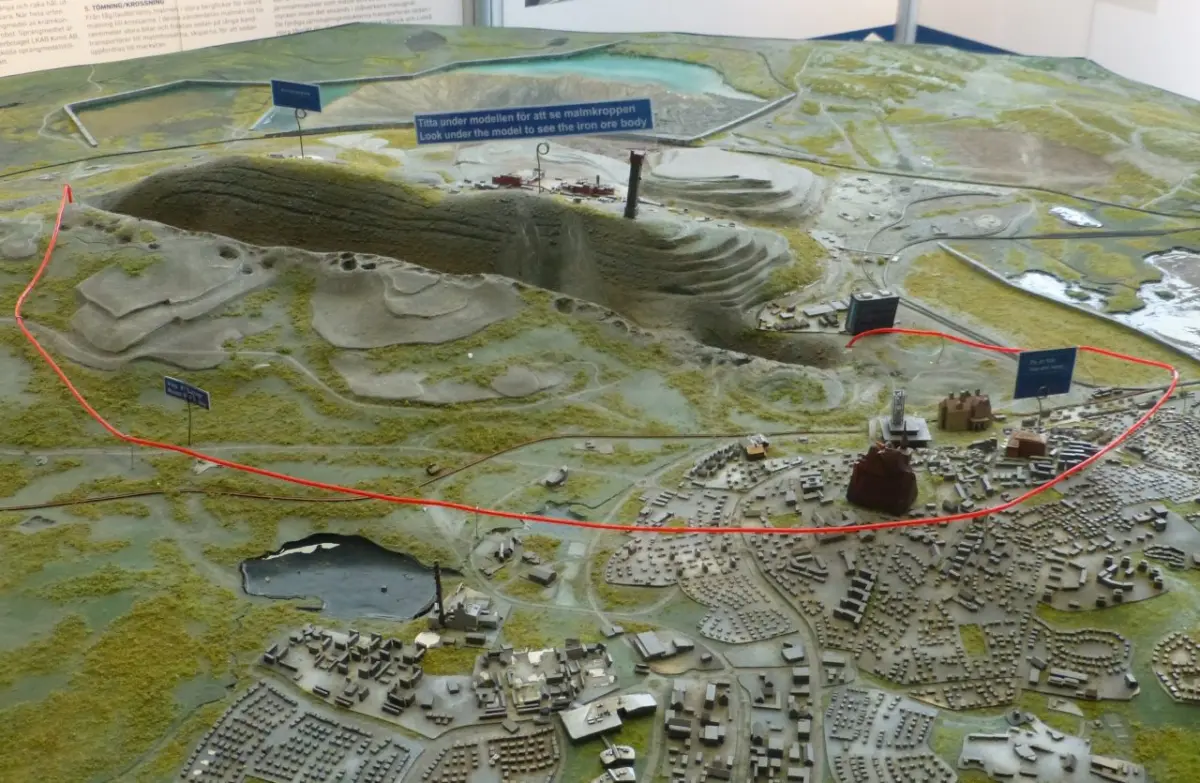
Every morning, precisely between 1:15 and 1:45 AM, the earth shakes in Kiruna. Situated ninety miles north of the Arctic Circle in Sweden’s northernmost reaches, the city sits adjacent to the largest underground iron ore mine on the planet. For nearly seventy-five years, relentless sub-level caving operations by the state-owned mining giant LKAB (Luossavaara-Kiirunavaara AB) have hollowed out the foundations of the municipality. The resulting surface deformations—manifested as massive ground fractures, structural shifting, and a slow, irreversible sinking of the town center—have forced an unprecedented urban intervention: the wholesale migration of an entire city.
Beginning in 2004, when LKAB formally notified the municipal council that continued extraction required the destruction of central Kiruna, the city embarked on a multi-decade relocation project. Roughly two miles to the east, a new civic center has risen from the sub-Arctic scrubland. Over the past twenty years, this "urban transformation" has evolved from a speculative engineering challenge into a grueling exercise in crisis management. Schools, hospitals, commercial blocks, and thousands of residents are being uprooted to accommodate a corporate titan that accounts for roughly a third of local employment and generates enough iron ore daily to construct six and a half Eiffel Towers.
Yet, this monumental relocation is far more than a logistical triumph of modern engineering. It is a deeply complex sociological disruption, highlighting the acute paradoxes of an industrial mono-economy. To survive economically, Kiruna must allow its old core to die; to preserve its cultural memory, its residents must navigate a painful psychological schism between a fading past and a sterile, corporate-sponsored future.
Read Also
Detailed Chronology: From Industrial Boom to Urban Evacuation
1. The Foundation and the Impossibility of Refusal (Early 20th Century)
The history of modern Kiruna is inextricably tied to the extraction of iron. Following the expansion of railways by the Swedish state to connect the region to the Gulf of Bothnia port of Luleå, industrial mining operations at the Kiirunavaara and Luossavaara mountains commenced around the turn of the twentieth century. Workers flocked north for high wages, and in 1910, LKAB established a model industrial settlement on lands historically used by Indigenous Sámi reindeer herders.
In exchange for local tax exemptions, LKAB financed foundational municipal infrastructure, including a fire station, a hospital, and the iconic red wooden Kiruna Church. Over subsequent decades, the Swedish government steadily acquired shares in LKAB, achieving full nationalization by 1957. Anthropologist Elisa Maria López has aptly characterized the local dynamic as an "impossibility of refusal." To live in Kiruna is to exist in a permanent relationship with LKAB—a corporate entity that not only provides employment for a third of the population but now dictates the literal geography of where citizens are permitted to live.
2. The 2004 Ultimatum and the Creeping Fracture Line
For decades, the extraction happened beneath the horizon, out of sight and largely out of mind. However, by the early 2000s, the cumulative effects of deep underground mining caught up with surface stability. In 2004, LKAB dropped a five-sentence bombshell on the Kiruna Municipal Council: the city center sat directly atop the "forecasted influence" zone of future mining operations.
The proposal was stark. Approximately six thousand residents—amounting to a third of the city’s population at the time—would need to evacuate. Schools, commercial buildings, and civic hubs were slated for demolition, while historic structures, including the monumental timber church, were slated for relocation. What followed was a prolonged period of administrative ambiguity. Timelines shifted, expansion plans accelerated, and residents were left suspended between the creeping physical danger of ground fissures and the slow administrative machinery of urban reconstruction.
3. The 2014 Migration and the Demolition Phase
By 2014, physical construction of "New Kiruna" two miles east was officially underway. Billed by architects at White Arkitekter as an unprecedented exercise in building a city from scratch, the project quickly revealed its darker, more pragmatic underpinnings. It was not a utopian experiment, but a race against geological time.
By August 2023, the city entered a period of heavy, psychological demolition. Leaving Old Kiruna intact was no longer an option; expanding ground deformations and structural cracks made the old core a severe safety hazard. The physical tearing down of 1960s apartment blocks, local nightspots like the Royal, and familiar neighborhood streets served a dual purpose: it eliminated hazardous structures while forcing residents to abandon the liminal space between the old city and the new.
Supporting Context & Metrics: The Scale of Disruption
To fully grasp the magnitude of the Kiruna relocation, one must examine the raw metrics of extraction and urban engineering:
- Geographic Scale: Kiruna Municipality spans vast Arctic wilderness, but the urban center functions within a tight, triangular footprint bordered by the E10 highway and the towering mass of the Kiirunavaara mountain.
- The Ore Extraction Process: LKAB employs a method known as sub-level caving. Remote-controlled drilling rigs cut long holes upward into the ore body, packing them with explosives. Detonations occur daily between 1:15 and 1:45 AM, sending seismic ripples through the ground that can be felt in damaged structures across Old Kiruna.
- Production Volume: LKAB mines enough high-grade iron ore daily to build six and a half Eiffel Towers. The processed ore is transformed into concentrated black pellets and transported via four daily freight trains to the coastal port of Luleå.
- Demographic Impact: Initially affecting six thousand residents in 2004, subsequent expansion plans announced in recent years have pushed that figure upward. By the mid-2020s, up to two-thirds of Kiruna’s total population of roughly 22,000 faces mandatory relocation.
- The Church Relocation: Weighing approximately 670 tons, the historic Kiruna Church—modeled after traditional Sámi architecture at the request of the town’s founding mine manager—was engineered to be lifted 4.3 feet off its original foundation and transported in 2025 across a specially widened road network on a massive 224-wheel trailer.
Official Statements and Corporate-Municipal Synergy
The governance of Kiruna represents a unique fusion of municipal leadership and corporate underwriting. Because LKAB is state-owned and legally responsible for the damages caused by its subterranean extractions, the mining conglomerate funds the vast majority of the relocation costs.
Mats Taaveniku, the chairman of the municipal council, has aggressively marketed the move as a long-overdue cultural and economic modernization. Operating out of his office in New Kiruna, Taaveniku’s administration has set an ambitious target of growing the city’s population to 25,000 by 2030. Yet, this bullish administrative optimism often clashes with infrastructural realities. For instance, when questioned about the newly established hospital’s lack of a maternity ward—forcing residents to travel hours south for emergency surgeries or specialized care—Taaveniku admitted the facility was still under construction, noting bluntly: "We have to build it right now… We can’t wait anymore. This crack line moves very fast."
Corporate messaging from LKAB strikes a similarly urgent, promotional tone. Banners hung across construction fences—bearing slogans like "It’s not the end of the world. It’s way beyond"—attempt to reframe corporate-mandated displacement as a civic rebirth. Yet, for local residents like high school history teacher and resident Timo Vilgats, the corporate narrative often papers over profound emotional loss. Speaking at memorial events for the old city, Vilgats has consistently urged his community to reject the reduction of their displaced homes into mere financial transactions: "A lady there… was so sad because people said to her, ‘Oh no, you have a lot of money because you sold your flat!’ … She said, ‘No, I don’t talk about money. I don’t need money. I just want to live here.’"
Future Outlook: Critical Minerals and the Unending Horizon
As Kiruna settles into its new, eastern footprint, the horizon remains fraught with ecological, economic, and existential challenges. The town’s foundational paradox—that the economic life of the community depends entirely on an industrial process fundamentally incompatible with human habitation—shows no signs of abating.
In recent years, LKAB announced a discovery that guarantees Kiruna’s status as a critical node in European industrial strategy: the identification of Europe’s largest known deposit of rare earth minerals. Crucial for the manufacturing of electric vehicle batteries and wind turbines, these minerals represent the next frontier of European green energy independence. However, extracting them will extract yet another heavy toll, threatening surrounding reindeer migration routes and setting the stage for further environmental disruption.
For residents navigating the transition, the future requires an uneasy balancing act between grief and adaptation. Teachers unpacking cardboard boxes in newly constructed school cubicles, locals tracking the slow, wheeled crawl of the historic church past their front porches, and municipal leaders racing against the eastward march of ground fractures all share a common reality. Kiruna is a city caught in perpetual motion—a monument to the mineral hunger of modern civilization, built upon shifting earth that refuses to stand still.



Comments
Facebook App ID not configured. Please add it in the Customizer.