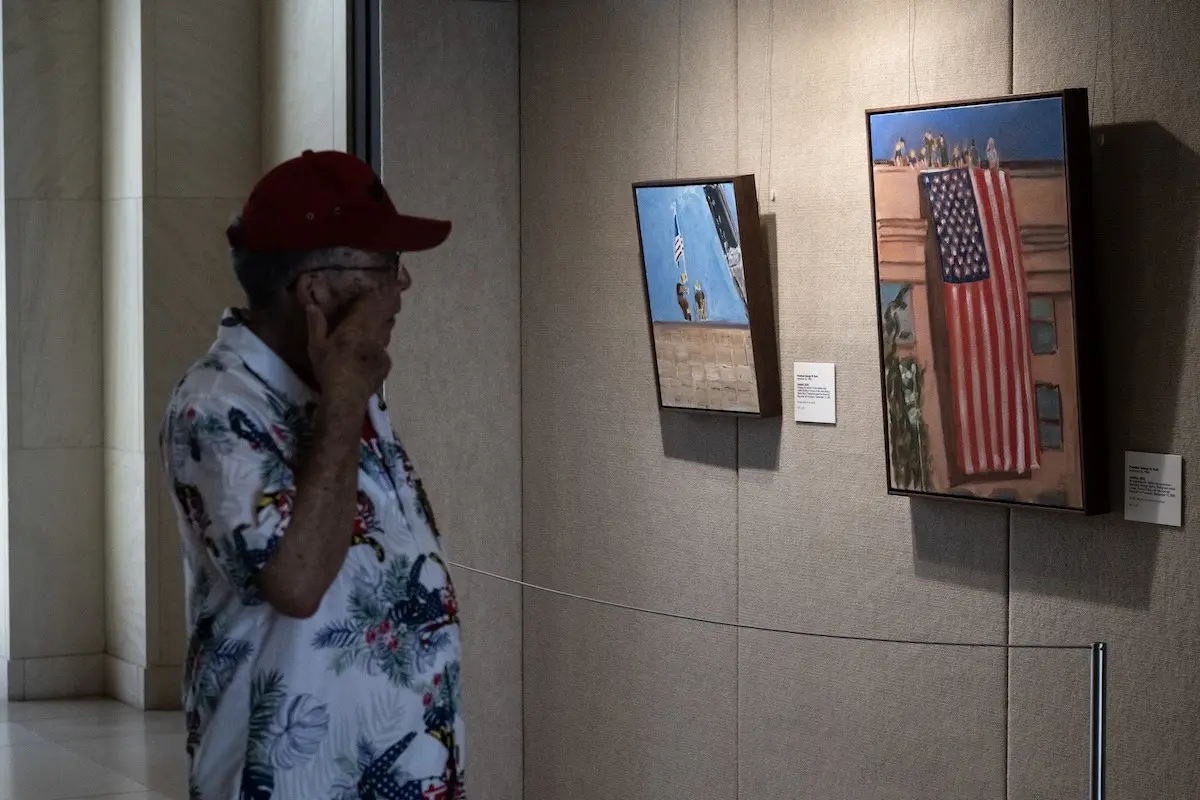
Marking the profound, sobering 25th anniversary of the terrorist attacks on September 11, 2001, former United States President George W. Bush has officially debuted a deeply personal and politically charged series of paintings. Titled “Remembering 9/11,” the collection is currently on public display at the George W. Bush Presidential Center in Dallas, Texas. The exhibition offers an intimate visual exploration of the historic crisis, the immediate collective shock, and the protracted socio-political fallout that transformed the American geopolitical landscape over the past quarter-century.
The collection features poignant iconography: the sweeping folds of the American flag, the stark vulnerability of grieving citizens, and self-referential renderings of Bush himself addressing a traumatized nation during the dark days of late 2001. According to official curatorial statements released by the Bush Presidential Center, the works seek to “reflect on the courage, sacrifice, and resilience that emerged from one of the most defining moments in American history.” The exhibition is slated to remain open to the public through September 30.
Yet, as the nation pauses to look back, this artistic endeavor has sparked renewed debate among historians, art critics, and political commentators. Notably absent from the canvas are depictions of the catastrophic kinetic events themselves—the crashing planes and the collapsing towers—continuing a long-standing pattern where visual artists have largely avoided directly rendering the horrors of that morning. Furthermore, the exhibition neatly sidesteps the immense criticism leveled at the Bush administration’s ensuing “Global War on Terrorism.” Critics and policy experts argue that the post-9/11 military interventions and legislative overreaches set off a quarter-century of misgovernment and systemic instability within the United States.
This comprehensive report examines the genesis of Bush’s latest artistic undertaking, details his personal reflections during appearances in Dallas, contextualizes the broader cultural avoidance of depicting the attacks, and evaluates the complex, enduring legacy of an era that continues to define contemporary American life.
Detailed Chronology
The Genesis of the Crisis: September 2001
To fully understand the emotional and political weight of the “Remembering 9/11” collection, one must revisit the turbulent timeline of September 2001. On the morning of September 11, 190rd-floor hijacked commercial airliners struck the World Trade Center towers in New York City, the Pentagon in Arlington, Virginia, and a field in Shanksville, Pennsylvania. The ensuing loss of nearly 3,000 lives created an instantaneous paradigm shift in domestic security, foreign policy, and the American national psyche.
For President George W. Bush, who was visiting an elementary school in Sarasota, Florida, when the first plane hit, the unfolding tragedy thrust his administration into an immediate wartime footing. Over the following days, Bush’s public appearances—including his iconic bullhorn address from the rubble of Ground Zero and his solemn address to a joint session of Congress—cemented his image as a wartime leader confronting an unprecedented, stateless enemy.
The Legislative and Geopolitical Fallout
Following the attacks, the Bush administration moved swiftly, enacting sweeping domestic and foreign policies that would dominate the next twenty-five years. On October 26, 2001, Bush signed the USA PATRIOT Act, vastly expanding government surveillance and law enforcement powers. Internationally, the administration launched Operation Enduring Freedom in Afghanistan in October 2001, followed by the invasion of Iraq in March 2003 under the controversial premise of eliminating weapons of mass destruction.
While these early military and legislative actions enjoyed broad bipartisan support in the immediate wake of the trauma, they rapidly generated deep ideological divisions. The protracted, multi-trillion-dollar conflicts in the Middle East resulted in thousands of American military casualties, hundreds of thousands of civilian deaths, and profound destabilization across the region.
The Evolution of George W. Bush as an Artist
Years after leaving the Oval Office in January 2009, George W. Bush sought a post-presidential outlet that surprised many political observers: painting. Lacking any formal art education or traditional training, Bush began studying under art instructors in Texas, initially focusing on landscapes and pets before graduating to more ambitious human subjects.
His early artistic endeavors included a 2014 exhibition titled Portraits of Courage, which honored the military veterans who served under his command. He also famously produced a series of self-portraits—including memorable depictions of himself in the bathtub and the shower—which received an unexpected, nuanced defense from prominent art critic Jerry Saltz back in 2013. Saltz noted that while Bush’s technical skills were unrefined, the paintings possessed a raw, unpretentious psychological honesty.
Now, a quarter-century after the events that defined his presidency, Bush has turned his brush toward the trauma of 9/11, culminating in the "Remembering 9/11" exhibition currently drawing crowds in Dallas.
Supporting Context & Metrics
The Visual Silence of 9/11 in American Art
One of the most striking aspects of the "Remembering 9/11" collection—and one highlighted by art critics tracking the cultural response to the tragedy—is what is not shown. The actual destruction of the World Trade Center towers, the iconic plummeting figures, and the immediate visual violence of the crashes are entirely missing from Bush’s canvases.
This omission is not unique to the former president. As critic Jason Farago observed in a comprehensive 2021 essay for The New York Times, visual artists have struggled far more than expected to directly address the physical horrors of 9/11. Unlike historical catastrophes like Guernica or the Holocaust, which inspired immediate, visceral graphic representations from major artists, the events of September 11 have largely eluded direct visual capture in high art.
Farago and other cultural historians attribute this phenomenon to the sheer ubiquity and hyper-mediation of the original television footage. The cascading collapse of the towers was broadcast live to billions, viewed repeatedly in endless loops. Consequently, high art has often felt redundant or inadequate when attempting to compete with the photographic record. Instead, artists—including Bush—have gravitated toward allegorical representations: flags, grief-stricken crowds, and quiet memorials that bypass the graphic violence in favor of emotional resonance.
The Shadow of Post-9/11 Misgovernment
While the Bush Center’s promotional materials frame the exhibition as a celebration of American “courage, sacrifice, and resilience,” the collection’s silver-lining narrative exists in tension with contemporary historical retrospectives.
Coinciding with the 25th anniversary, political analysts and historians have published extensive evaluations of the post-9/11 era. In an interview with The Guardian on the anniversary, a prominent adviser to former President Bill Clinton pulled no punches, characterizing the post-9/11 policy framework as a catalyst that “set off a quarter-century of misgovernment in the United States.”
The metrics of this quarter-century are staggering:
Financial Cost: According to studies by the Watson Institute at Brown University, the post-9/11 wars have cost U.S. taxpayers upwards of $8 trillion.
Human Toll: Over 7,000 U.S. service members lost their lives in Iraq and Afghanistan, alongside tens of thousands of contractors and allied personnel. Conservative estimates place civilian casualties in the hundreds of thousands.
Domestic Erosion: The institutional normalization of mass surveillance, the indefinite detention protocols at Guantanamo Bay, and the polarization of civil liberties remain enduring structural consequences of the legislative reactions rushed through Congress in late 2001.
By focusing strictly on domestic unity, personal grief, and resilience, Bush’s new paintings consciously bypass these complex policy failures, keeping the viewer’s gaze fixed firmly on the emotional solidarity of the immediate aftermath rather than the long-term geopolitical wreckage.
Official Statements
During his appearance in Dallas this week to unveil the exhibition and mark the milestone anniversary, former President Bush delivered remarks reflecting on the national character he witnessed during his administration’s greatest trial.
"When America is in trouble, Americans respond," Bush stated to attendees at the presidential center. "I got to see it firsthand… It’s an amazing country."
Bush also used the anniversary to address one of the darker domestic fallout elements of the tragedy: the immediate and violent spike in Islamophobia that targeted Muslim Americans and Arab Americans across the United States. In a gesture widely noted by historians, Bush visited the Islamic Center of Washington just six days after the attacks—on September 17, 2001—to publicly denounce the harassment of Muslim women wearing hijabs.
Reiterating the philosophy behind that historic visit in a written statement released this week, Bush remarked:
"It became clear to me that if this was an ideological struggle—which is what I viewed it as—and we forgo one of the most important parts of our ideology, which is the freedom to worship the way you want to worship, all of a sudden, the enemy has won a victory."
While critics frequently note the deep contradictions between this inclusive rhetorical stance and the aggressive foreign military interventions launched against Muslim-majority nations in the years that followed, defenders maintain that Bush’s early denunciation of domestic bigotry prevented widespread state-sanctioned pogroms against American Muslims.
Future Outlook
As the "Remembering 9/11" exhibition opens its doors to the public in Dallas through September 30, it serves as a powerful artifact of how political leaders attempt to curate their own historical legacies. George W. Bush’s transition from Commander-in-Chief to amateur painter provides him with a unique medium to distill a catastrophic chapter of American history into personal, digestible expressions of sorrow and endurance.
Looking ahead, the cultural and political appraisal of the post-9/11 era will undoubtedly continue to evolve. As generations born after 2001 enter adulthood, their relationship with the events of that Tuesday morning is increasingly mediated through history textbooks, museum exhibits, and artistic interpretations rather than living memory.
Whether Bush’s paintings will endure as significant historical documents or be viewed primarily as curious personal footnotes to a turbulent presidency remains to be seen. What is certain, however, is that a quarter-century later, the psychic geography of September 11 continues to cast a long, complex shadow over the American experiment—a shadow that artists, politicians, and citizens will spend decades more trying to fully capture and understand.





Comments
Facebook App ID not configured. Please add it in the Customizer.