
By the Investigative Desk
Published in partnership with Today, Explained
Executive Overview
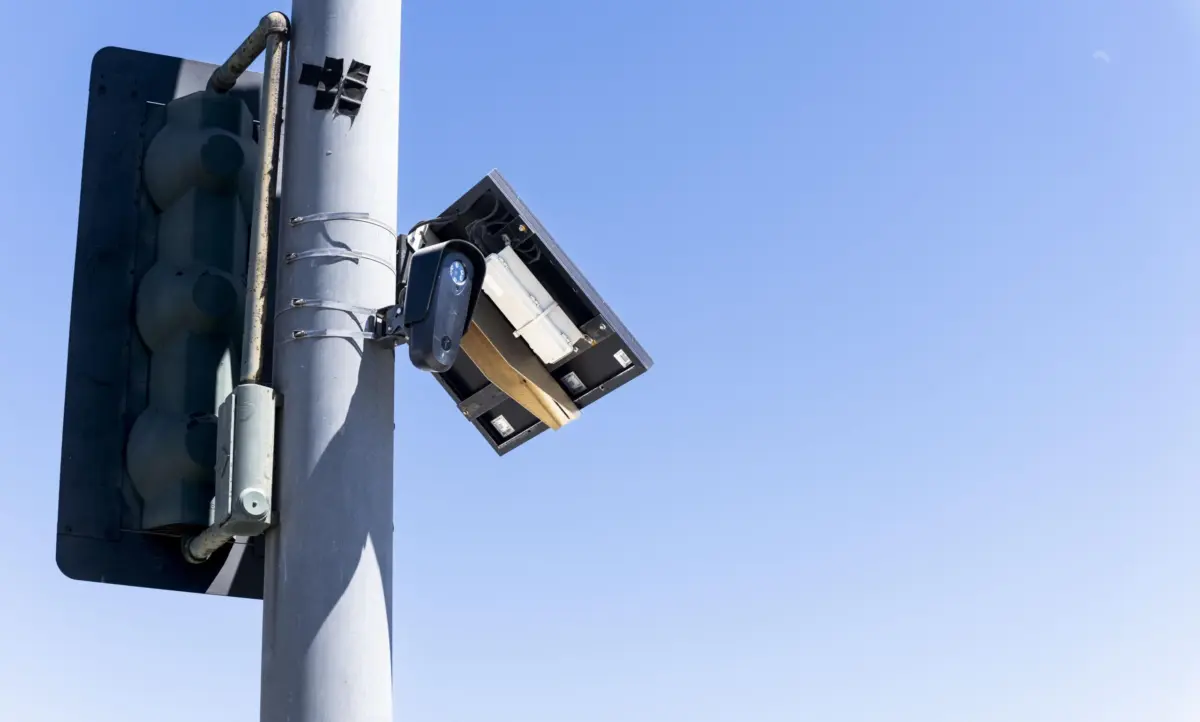
For most Americans, the morning commute is a mundane ritual of coffee, traffic reports, and shifting lanes. Yet, silently embedded along the urban and suburban landscape, an invisible digital net is capturing every movement. On a standard drive to work, an average motorist might pass half a dozen AI-powered license plate readers without a second glance. Over the past several years, these devices—predominantly manufactured by the tech company Flock Safety—have metastasized on light poles, traffic signals, and roadside posts across the United States.
They have quietly constructed a vast, nearly invisible national database of vehicle movements. This infrastructure grants law enforcement agencies unprecedented, sweeping access to real-time and historical travel data with remarkably few federal restrictions.
What happens to this data? Who ultimately has access to it, and for how long is it retained? For years, these questions lingered in a regulatory grey area. Today, however, that silence is breaking. A profound political realignment is taking shape as lawmakers on both the extreme right and the progressive left find themselves locked in rare, synchronized agreement: the rapid proliferation of private-public mass surveillance has grown entirely out of hand.
The political backlash reached a boiling point when Senate Republicans formally opened a rigorous congressional inquiry into Flock Safety’s data collection, retention, and dissemination practices. This move marks a crucial initial step toward potential federal regulation. Simultaneously, state executives, ranging from Florida’s firebrand Republican Governor Ron DeSantis to progressive firebrand Senator Bernie Sanders of Vermont, are sounding identical alarms.
As public anxiety morphs into genuine fury—evident in crowdsourced mapping initiatives, fierce protests at corporate headquarters, and weaponization of the issue in high-stakes midterm elections—the debate over Flock Safety cameras has transformed from a localized zoning dispute into a national referendum on privacy, corporate power, and the boundaries of the surveillance state.
Detailed Chronology: From Local Police Tech to a National Surveillance Grid
To understand how American roads became mapped by automated eyes, one must trace the rapid evolution of automatic license plate reader (ALPR) technology from municipal experiment to national omnipresence.
Phase 1: The Incubation of Automated Tracking
For decades, traditional license plate readers were bulky, expensive, and largely restricted to major federal border crossings, highway patrols, or specialized toll-collection lanes. However, the founding of Flock Safety marked a paradigm shift. By coupling high-definition cameras with sophisticated machine-learning artificial intelligence, the company offered a radically cheaper, highly efficient, and easily deployable alternative.
Rather than merely snapping a photo of a speeding car, Flock’s proprietary hardware and software began cataloging more than just license plates. The systems record make, model, color, specific vehicle body types, bumper stickers, roof racks, and temporary tags. Crucially, the technology indexes all of this visual metadata into searchable cloud databases.
Phase 2: The Hyper-Growth Era
Over the last half-decade, local police departments, county sheriff offices, homeowners’ associations, and municipal governments rushed to adopt the technology. Marketed as an invaluable tool for recovering stolen vehicles, locating missing children, and solving violent crimes, Flock cameras spread like wildfire.
With minimal pushback from cash-strapped local councils, the network expanded exponentially. Today, an estimated 120,000 Flock cameras blanket United States roadways. Motorists can track this proliferation themselves using crowdsourced defensive maps like DeFlock, which highlight the dense clusters of cameras tracking everyday traffic in both major metropolitan hubs and quiet rural towns.
Phase 3: The National Awakening and Congressional Inquiries
The turning point from silent acceptance to fierce public backlash arrived as civil liberties groups, investigative journalists, and privacy advocates began uncovering the secondary uses of this data. Because Flock contracts primarily with local municipalities and police departments, the data gathered is frequently shared across jurisdictional boundaries through regional information-sharing networks, sometimes accessible to federal immigration and law enforcement agencies without a warrant.
The realization that an ordinary citizen’s daily routines—driving to a reproductive health clinic, visiting a mental health professional, attending a place of worship, or participating in a political protest—were being systematically logged and stored triggered a cascade of political reactions:
- Early 2026: Grassroots protests escalate. Activists swarm Flock Safety’s corporate headquarters in Atlanta, Georgia, bearing massive banners warning against the normalization of mass surveillance tools as instruments of political persecution.
- Mid-2026: Progressive and conservative politicians break their usual partisan deadlock to condemn the technology. Senator Bernie Sanders uses social media and legislative platforms to warn the public that Flock cameras are recording intimate details of daily American life.
- August 2026: Senate Republicans officially launch a sprawling congressional investigation into Flock Safety’s corporate data practices, aiming to uncover the exact scope of information retention and third-party data sharing.
- Late August 2026: Florida Governor Ron DeSantis declares the state of camera surveillance to be "out of control" during a high-profile press conference, urging immediate state-level legislative action to curb the deployment of unvetted optical sensors.
Supporting Context & Metrics: The Anatomy of the Flock Network
The debate over automated surveillance is not merely philosophical; it is driven by hard data, systemic vulnerabilities, and unprecedented corporate scaling.
The Scale of the Database
With 120,000 active units deployed nationwide, the density of the Flock network creates a continuous tracking loop. Unlike stationary security cameras covering a single storefront, interconnected ALPR networks can stitch together an individual’s entire travel history across state lines.
Security researchers and digital rights organizations have repeatedly pointed out that the aggregation of this data transforms it into something far more sensitive than simple traffic notes. When matched with commercial data brokers, vehicle location histories can easily be reverse-engineered to identify specific individuals, exposing their medical histories, personal associations, and daily habits.
Public Backlash and Radicalization of Discourse
The intensity of the public reaction to Flock Safety is virtually unprecedented in the modern tech landscape. While major data centers and massive artificial intelligence server farms routinely draw environmental and zoning protests, they rarely elicit the visceral, personal animosity directed at roadside cameras.
This backlash occasionally crosses the line into extreme rhetoric. During a heated local government debate in Tennessee, a conservative county commissioner publicly suggested that Flock’s Chief Executive Officer ought to be subjected to public hanging—a shocking escalation that underscores how deeply personal and invasive citizens perceive these devices to be.
Similarly, progressive advocacy groups view the cameras through the lens of systemic discrimination. Activists argue that automated surveillance disproportionately impacts marginalized communities, exacerbating historic biases in policing while providing authoritarian tools that could easily be weaponized by future administrations against political dissidents, undocumented immigrants, or women seeking reproductive healthcare.
Official Statements and Bipartisan Alignment
The political landscape surrounding automated surveillance features some of the most striking ideological crosswinds in contemporary American politics. The issue has effectively collapsed the traditional left-right paradigm.
The Conservative Critique: Government Overreach and "Big Brother"
For right-leaning critics, the opposition to Flock cameras is rooted in classic anti-statist philosophies, constitutional privacy rights, and a deep distrust of governmental expansion.
As veteran tech reporter Jason Koebler explained in a recent analysis for Vox, conservative critics frame the issue in terms of direct personal intrusion:
"This is invasive government. This is Big Brother. Don’t surveil me."
This perspective has empowered figures like Florida Governor Ron DeSantis to challenge a technology that many local law enforcement agencies previously championed. By framing unregulated license plate readers as an affront to personal liberty and property rights, conservative leaders are putting police chiefs and municipal governments on notice.
The Progressive Critique: Corporate Surveillance and Social Justice
Conversely, the progressive wing approaches the technology through an intersectional framework, linking automated readers to systemic inequality, corporate overreach, and the erosion of fundamental civil liberties.
Progressive organizers emphasize that mass surveillance systems do not exist in a vacuum; they function as force multipliers for systemic bias. At an April protest outside Flock’s Atlanta headquarters, a prominent activist summarized the movement’s broader concerns:
"This protest is about more than license plate readers. It’s about mass surveillance as a tool for fascism and political persecution."
Senators like Bernie Sanders have echoed these warnings, emphasizing that the untrammeled collection of movement data threatens union organizers, civil rights advocates, and everyday citizens who value privacy as an essential pillar of a free society.
The Midterm Political Battleground
Unsurprisingly, this potent issue has quickly bled into the 2026 midterm elections. Candidates across states like Florida, Ohio, and Michigan are using stances on Flock cameras as a wedge issue to define their opponents’ records on privacy and crime.
In Michigan, for instance, Democratic Senate candidate Abdul El-Sayed released a campaign video targeting his opponent’s historical ties to technology legislation, suggesting voters hold political figures accountable for the unchecked spread of surveillance infrastructure. While questions of direct political responsibility remain complicated—given that Flock typically signs contracts directly with municipal police departments and city councils rather than federal lawmakers—the political fallout is entirely real. Voters are demanding to know where their representatives stand.
Future Outlook: Regulating the Invisible Panopticon
As the Senate inquiry presses forward and state legislatures prepare upcoming legislative sessions, the policy debate has crystallized around several tangible, corrective measures. Lawmakers who wish to rein in the surveillance state are no longer asking if action should be taken, but how fast the guardrails can be erected.
Potential Regulatory Interventions
- Warrant Requirements: Mandating that law enforcement agencies secure a probable-cause warrant signed by a judge before querying historical or real-time ALPR databases.
- Strict Data Retention Limits: Establishing mandatory, short-term expiration dates for captured data, automatically purging records of innocent motorists after a matter of days rather than storing them indefinitely in searchable private-cloud repositories.
- Geographic Exclusions: Enacting statutory bans on placing automated cameras within specified radiuses of sensitive locations, including schools, houses of worship, reproductive healthcare clinics, and political headquarters.
- Corporate Transparency Audits: Requiring third-party technology vendors like Flock Safety to submit to rigorous federal oversight regarding data security, third-party data sharing agreements, and vulnerability disclosures.
Conclusion
The rapid, unchecked expansion of AI-powered license plate readers represents one of the most significant quiet transformations of public space in modern American history. By trading convenience and localized crime-fighting tools for a nationwide web of automated tracking, communities have inadvertently constructed a digital panopticon.
Yet, the unprecedented bipartisan backlash—bridging the gap between conservative advocates of limited government and progressive defenders of civil liberties—signals a growing national consensus. Americans of all political stripes are signaling that they want their privacy back. Whether federal lawmakers and state legislators possess the political will to dismantle the digital net before it becomes entirely permanent remains the defining privacy question of our time.





Comments
Facebook App ID not configured. Please add it in the Customizer.