
Executive Overview
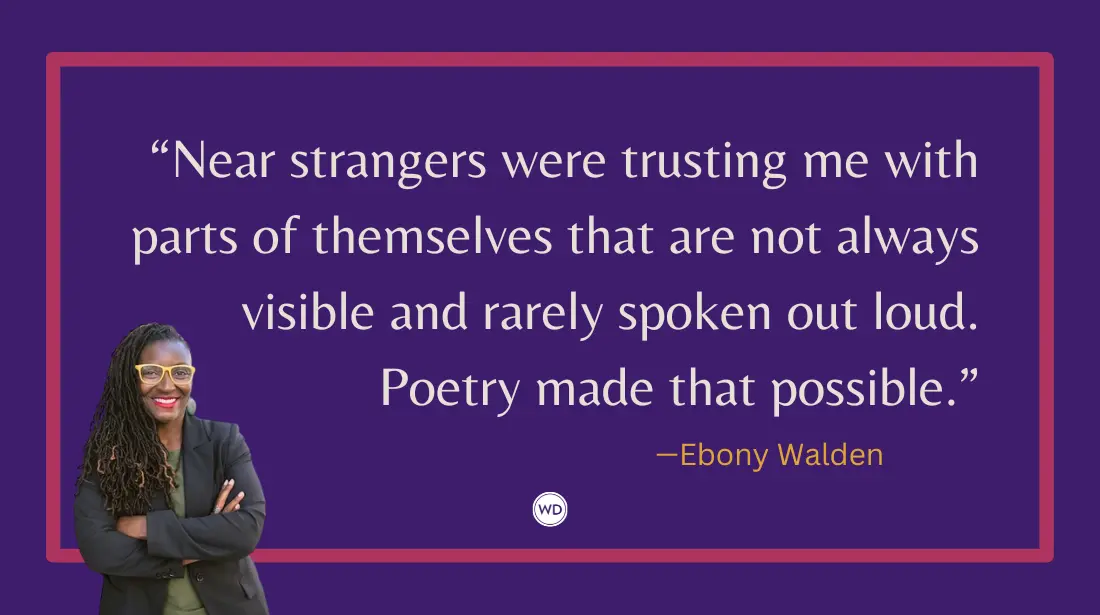
In an era increasingly fractured by geopolitical polarization, digital echo chambers, and cultural division, the simple act of listening has become a radical pursuit. Long before the global village became a metaphor for digital anxiety, authors and artists sought tangible ways to bridge the divides separating human communities. For Ebony Walden, a writer, community organizer, and cultural strategist, the antidote to isolation began not in a corporate boardroom or a diplomatic summit, but under the warm, expectant lights of a packed Charlottesville, Virginia restaurant in 2009.
What started as a modest local assignment—coordinating promotional efforts for a community poetry reading—blossomed into a transformative social experiment. By stepping up to the microphone to host, Walden unlocked a profound civic and artistic truth: human beings across every demographic, socioeconomic tier, and geographic boundary possess an innate, unfulfilled hunger to be witnessed.
This realization catalyzed an ambitious undertaking: the Poetic Justice World Tour, an eight-month, five-continent odyssey designed to collect, honor, and co-create human narratives through a deceptively simple literary framework: the seven-line, fill-in-the-blank “Where I’m From” poem.
Read Also
Walden’s subsequent memoir, Where I’m From: A Poetic Journey Across Five Continents, chronicles this profound experiment in cross-cultural empathy. Moving far beyond the conventional travelogue, the work investigates how vulnerability, creative expression, and active listening can dismantle preconceived biases. From the post-earthquake echoes of Antigua, Guatemala, to the neon-lit shrines of Kyoto, Japan, and the resilient informal settlements of Mathare in Nairobi, Kenya, Walden’s journey serves as a masterclass in global citizenship. This report examines the genesis, evolution, and lasting philosophical implications of her global endeavor, offering an authoritative look at how poetry functions as a bridge across the divides of the human experience.
Detailed Chronology: From Charlottesville to the Global Stage
The Spark: Charlottesville, Virginia (2009)
The trajectory of Walden’s life shifted on an ordinary evening in 2009. Residing in Charlottesville, Virginia, she was approached by a local civic leader with a straightforward request: help promote an upcoming poetry event. Walden agreed on a singular condition—that she be permitted to host.
Weeks later, she stood before a diverse, standing-room-only crowd in a local restaurant. The room was a microcosm of societal strata: established community leaders mingled with college students, seasoned spoken-word artists stood shoulder-to-shoulder with shy first-time listeners, and neighbors of varying racial, generational, and socioeconomic backgrounds shared the physical space. As individuals stepped to the microphone to articulate personal triumphs and private griefs, Walden observed a profound psychological alchemy. The room transformed from a collection of strangers into a cohesive, empathetic ecosystem.
Sensing the urgent necessity for such spaces, Walden institutionalized the gathering, turning it into a recurring monthly open mic. This regular immersion in communal storytelling yielded two critical developments:
- The Cultivation of Empathy: Walden learned the nuanced mechanics of active listening, discovering firsthand the psychological relief communities experience when given a safe space to voice their truths.
- The Birth of the Poet: Encouraged by the courage of the participants, Walden began writing and performing her own verse, discovering an artistic voice that would soon demand a broader canvas.
Within months, the local initiative evolved into a global vision. Walden resolved to embark on an international journey—not merely as a tourist documenting foreign landscapes, but as an active listener intent on co-creating art with individuals across the globe.
Stop One: Grief and Gratitude in Antigua, Guatemala (2010)
In 2010, the Poetic Justice World Tour officially commenced. Walden’s first major stop brought her to Antigua, Guatemala, where she boarded with her host father, Oscar. Their mornings were spent conversing in Spanish over breakfast, gradually laying the groundwork for a collaborative “Where I’m From” poem.
As Oscar recounted his life story, the narrative was defined by stark emotional contrasts. He spoke with devastating clarity about the catastrophic earthquake of the 1970s that reduced his home and neighborhood to rubble. Moments later, his voice filled with radiant pride as he described the births of his three children—his life’s crowning achievement. Devastation and profound joy existed mere sentences apart.
For Walden, this exchange triggered a powerful internal reckoning. Growing up without a steady, attentive paternal figure, Walden confronted the reality of her own father’s absence through Oscar’s steadfast embodiment of care. The juxtaposition of Oscar’s paternal pride with her own lifelong paternal void generated a complex emotional response: gratitude for the intimacy of the moment intertwined with grief for what she had lacked. Poetry served as an emotional conduit, bridging the generational, cultural, and personal chasm between host and guest.
Stop Two: Cultural Immersion and Mutual Vulnerability in Kyoto, Japan
Moving across continents, Walden’s journey eventually landed her in Kyoto, Japan, during the sacred New Year season. There, she formed a deep connection with her local guide, Naoko.
The two navigated bustling local markets, where Walden was introduced to hoshigaki—vibrant orange, air-dried persimmons hanging delicately from strings, a culinary tradition she never would have discovered independently. Naoko subsequently led Walden to a vibrant Shinto shrine festival. Amidst thousands of worshippers carrying traditional amulets (omamori) and wooden prayer plaques (ema), a Shinto priest in immaculate white robes waved a purification wand over their heads, offering a traditional blessing.
Following days of shared exploration, culinary discovery, and patient cultural translation, Walden invited Naoko to write a “Where I’m From” poem. The resulting creative session captured the full spectrum of human vulnerability. Naoko beamed with unbridled joy when reflecting on her inaugural trip to the United States, yet visibly winced as she recounted the untimely death of her closest friend.
When Naoko read the finished piece aloud—beginning with the familial names Sateshi and Takamis, traversing through her cultural diet of “sushi, sashimi, and rice,” and concluding with the poignant refrain, “That’s where I’m from”—the exchange transcended tourism. It solidified an enduring cross-cultural friendship forged in the crucible of poetic honesty.
Stop Three: Re-defining Narrative in Mathare, Nairobi, Kenya
The final crucible of Walden’s international tour unfolded in the informal settlement of Mathare in Nairobi, Kenya. Often internationally stigmatized and flattened by the reductive label of a “slum,” Mathare is frequently defined strictly by its systemic deficiencies: a lack of running water, absent indoor plumbing, and precarious infrastructure.
Refusing to accept this single, deficit-based narrative, Walden facilitated a poetry workshop for local children at a community center. She challenged the young participants to describe a color using all five senses, bypassing materialistic frameworks to tap into profound emotional reservoirs.
Among the participants was a young boy named Lawrence, whose poetic output defied the socioeconomic limitations of his environment:
"Black is the color of Africa.
It’s sweeter than honey.
It looks like an angel coming down from heaven to earth.
It smells as fresh as the roses in a garden…”
Lawrence’s verse, alongside the contributions of his peers, demonstrated a fierce intellectual and creative self-determination. Rather than viewing themselves through the prism of scarcity, these children utilized poetry to author their own identities, proving that imagination and human dignity cannot be legislated or constrained by poverty.
Supporting Context & Metrics: The Mechanics of the “Where I’m From” Framework
At the structural core of Walden’s project is George Ella Lyon’s famous literary template, the “Where I’m From” poem. This fill-in-the-blank, seven-line framework acts as a psychological leveling tool, allowing individuals to bypass intellectual defenses and access core memories, sensory details, and emotional truths.
Global Tour Demographics & Reach
While exact participant headcounts fluctuated across the diverse environments—ranging from one-on-one living room sessions in Central America to large group workshops in East African community centers—the metrics of the tour reveal a deliberate, intimate methodology:
- Duration: 8 months of continuous fieldwork.
- Geographic Footprint: Spanning 5 distinct continents.
- Setting Diversity: Private living rooms, remote classrooms, international hostels, children’s homes, and open-air public spaces.
- Core Instrument: A standardized, culturally adaptable poetry prompt translated across multiple languages and dialects.
Psychometric Impacts of Shared Vulnerability
Field reports and qualitative feedback gathered during the Poetic Justice World Tour highlight several recurring emotional themes among participants:
- Universal Dualism: Across every culture, participants invariably paired accounts of systemic or personal trauma (earthquakes, poverty, bereavement, familial estrangement) with moments of transcendent joy (childbirth, cultural festivals, culinary traditions).
- The Reduction of Otherness: By focusing on sensory anchors—such as the smell of garden roses, childhood foods, or familial refrains—participants realized that their internal emotional landscapes mirrored those of strangers thousands of miles away.
- Restoration of Agency: Marginalized populations, such as the youth in Mathare, leveraged the poetic medium to reclaim narrative sovereignty, shifting cultural discourse from what communities lack to what they create.
Official Statements & Authorial Insights
Reflecting on the philosophical implications of her global journey, Ebony Walden has consistently emphasized that poetry functions not as a political weapon, but as an essential human bridge. In interviews and essays surrounding the release of Where I’m From: A Poetic Journey Across Five Continents, Walden has articulated the foundational ethos of her work:
"I named my eight-month, five-continent, around-the-world trip The Poetic Justice World Tour because I wanted to bring a bit of justice to people who are often overlooked by listening to and sharing their stories through poetry. I did not know how much this experience would help me connect to people all over the world and to my story, to where I’m from."
Addressing the universal nature of human desires uncovered during her travels, Walden noted:
"Across these moments, I began to understand that poetry can be a bridge. It does not erase difference, distance, or disparity, but it creates a way to step into someone else’s world, even if only briefly. Though we come from different cultures, countries, and circumstances, we all carry stories shaped by where we’re from—our favorite foods, our family music, our joys, and our grief. Again and again, I found that people wanted the same things: to be seen, to be heard, and to know that their story matters."
Future Outlook: The Enduring Legacy of Poetic Diplomacy
As contemporary societies grapple with the psychological fallout of digital hyper-connectivity coupled with profound social isolation, the methodologies pioneered during the Poetic Justice World Tour offer a timely blueprint for cultural healing.
The success of Walden’s memoir and the ongoing resonance of her workshops suggest that traditional diplomatic channels—often bogged down by bureaucracy, political posturing, and economic pragmatism—must be supplemented by cultural and artistic exchanges. By prioritizing deep, unhurried listening, communities can disrupt cycles of polarization and xenophobia.
Moving forward, the principles embedded within Where I’m From are increasingly being integrated into alternative educational curricula, community-building initiatives, and restorative justice programs worldwide. The project demonstrates that global understanding does not require massive institutional overhauls to begin; rather, it can start with a blank page, a listening ear, and the courage to ask a stranger a simple question: Where are you from?

Comments
Facebook App ID not configured. Please add it in the Customizer.