
Executive Overview
In the contemporary landscape of world literature, the transmission of poetic voice across linguistic boundaries remains an act of both delicate excavation and profound reinvention. This dynamic is vividly illustrated in a newly released pair of translated poems by the acclaimed Spanish writer Luis Muñoz. Rendered into English by the celebrated collaborative team of Idra Novey and Garth Greenwell, the poems—originally titled “Lupa” and “Mercado,” and presented in English as “Magnifying Glass” and “Market”—offer readers a masterclass in economy, perception, and philosophical inquiry.
Functioning almost as literary miniature paintings, these short texts compress expansive meditations on existence, ephemerality, and visual perception into tight, carefully structured stanzas. Muñoz, known for his rigorous attention to craft and his ability to charge everyday observations with existential weight, finds ideal interlocutors in Novey and Greenwell. Both translators are established literary figures in their own right—Novey as an acclaimed poet and novelist, and Greenwell as a celebrated novelist and critic. Their collaborative translation captures not merely the semantic meaning of Muñoz’s Spanish lines, but their rhythmic cadence, spatial breathing room, and ontological ambivalence.
This article provides an in-depth examination of this poetic release, exploring the mechanics of the translation, the thematic architecture of the poems themselves, the broader literary context of Muñoz’s oeuvre, and the implications of this transnational exchange for contemporary poetry in translation. Through a detailed analysis of both the English renditions and the Spanish originals, we trace how these miniature verses manage to encapsulate vast questions about the nature of the self, the weight of the material world, and the paradoxes of perception.
Read Also
Detailed Chronology and Editorial Background
The journey of these poems from the desk of Luis Muñoz in Spain to the English-speaking literary sphere represents a carefully orchestrated act of cultural translation. While the exact genesis of "Lupa" and "Mercado" stems from Muñoz’s ongoing engagement with short-form lyric poetry, their recent presentation to English audiences highlights the intricate timelines of literary collaboration.
The Translation Partnership: Novey and Greenwell
The collaboration between Idra Novey and Garth Greenwell is rooted in a shared commitment to lyric precision and psychological depth. Novey, whose previous translations include works by Clarice Lispector and Alejandra Pizarnik, brings a keen ear for the shifting borders of language. Greenwell, celebrated for his prose works such as What Belongs to You and Cleanness, brings a novelist’s sensitivity to interiority and sensory detail.
The process of translating Muñoz’s work required iterative drafts that respected the minimalist architecture of the original Spanish. In "Lupa," the challenge lay in rendering the verb troquela—traditionally associated with stamping, die-cutting, or embossing—into an English equivalent that retained the tactile quality of the air pressing against consciousness. Novey and Greenwell selected "debossed," a technical term from printmaking that suggests an indentation or impression left in a surface, perfectly capturing Muñoz’s imagery of the air being marked by fleeting visual stamps.
Similarly, "Mercado" presented structural and rhythmic hurdles. The poem’s middle section cascades down the page in a staggered spatial arrangement:
nada
           or all of it
                        or nothing
is detail.
Maintaining this architectural choreography in English was vital to preserving the poem’s thematic hesitation—a visual stutter that mimics the eye weighing and dismissing the objects on a marble counter.
Publication and Reception
The appearance of these translations marks a significant moment for readers of contemporary European poetry. Released through arrangement with the author, the dual-language presentation allows readers to witness the transformation of Muñoz’s Spanish text into Greenwell and Novey’s English iterations. The publication underscores a growing appetite in the Anglophone market for poetry that rejects bombast in favor of ontological intimacy.
Textual Analysis: The Poems in Translation and Original Spanish
To fully appreciate the achievement of these translations, one must examine the texts side by side, observing how the translators navigated the nuances of Muñoz’s vocabulary and syntax.
Part I: Lupa / Magnifying Glass
Original Spanish:
LUPA
Soy de vez en cuando
—el aire se troquela
con estampas—,
de vez en cuando dejo
frescamente de ser.
English Translation by Idra Novey and Garth Greenwell:
Magnifying Glass
I am occasionally
—the air debossed
with images—
occasionally I let go
refreshingly of being.
Thematic Exploration of "Magnifying Glass"
The title Lupa (Magnifying Glass) establishes an optical framework. A magnifying glass alters scale, drawing minute details into sharp relief while blurring the periphery. Yet, in the poem, the speaker does not merely use a magnifying glass; the speaker is the instrument, or at least subject to a similar optical displacement.
The opening line, "I am occasionally / —the air debossed / with images—," establishes a porous sense of identity. The self is not a solid, immutable entity, but a medium through which the world passes. The use of "debossed" implies that the air is impressed upon, stamped, or marked by the external world. Vision is not passive; it leaves an indentation.
The poem pivots in its final two lines: "occasionally I let go / refreshingly of being." Here, Muñoz introduces a radical ontological lightness. The Spanish frescamente—rendered brilliantly as "refreshingly"—infuses the cessation of existence not with tragedy or existential dread, but with a cool, restorative breeze. To "let go / refreshingly of being" is to step outside the exhausting labor of continuous self-assertion. It is a moment of mystical dissolution, framed with modern, understated irony.
Part II: Mercado / Market
Original Spanish:
MERCADO
Una abundancia en lo mínimo
donde—como en la fruta expuesta
en los mostradores de mármol—
nada
o todo
o nada
es detalle.
English Translation by Idra Novey and Garth Greenwell:
Market
A bounty in minuteness
where—as in fruit displayed
on marble counters—
nothing
or all of it
or nothing
is detail.
Thematic Exploration of "Market"
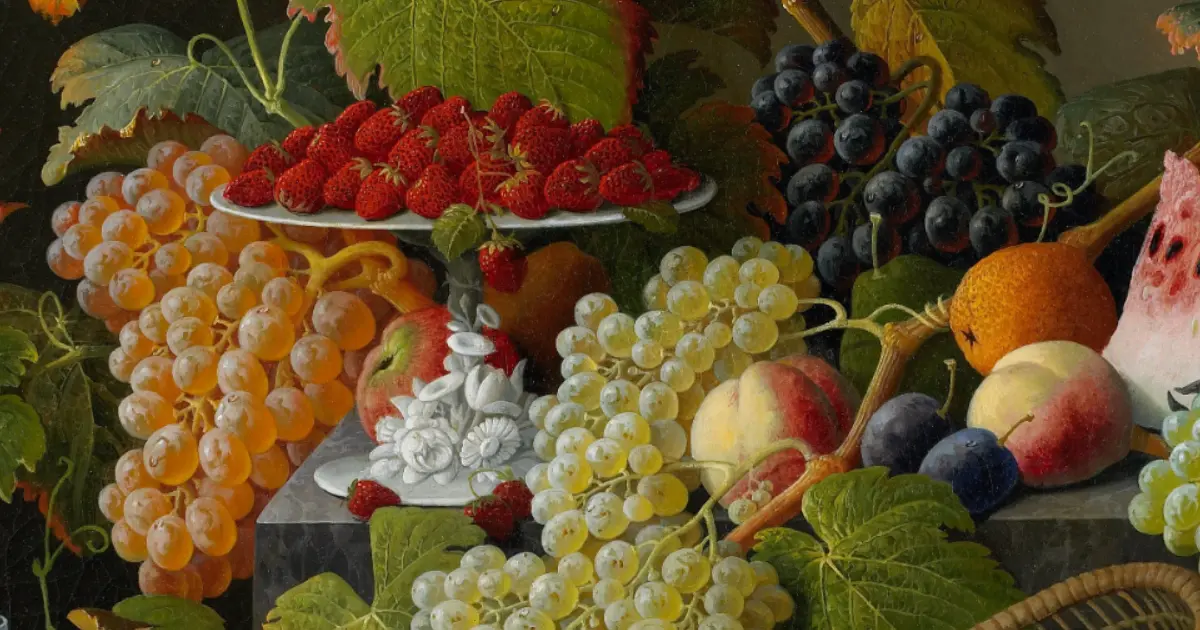
Where "Magnifying Glass" explores the interior dissolution of the self, "Market" turns outward to the material world, examining the chaotic abundance of the marketplace. The poem opens with an oxymoron: "A bounty in minuteness" (Una abundancia en lo mínimo). The market is a site of overwhelming sensory data—mountains of fruit, gleaming surfaces, individual textures—yet this vastness is composed entirely of small, discrete units.
The simile introduces the setting: fruit displayed on "marble counters" (mostradores de mármol). The marble introduces a classical, cold permanence that contrasts with the perishable, organic nature of the fruit. Against this backdrop, the poem’s middle lines perform a perceptual hesitation:
nothing
or all of it
or nothing
is detail.
This rhythmic oscillation addresses the fundamental dilemma of attention. In a market, every single piece of fruit demands to be seen as a unique detail; yet, viewed collectively, the individual fruit blurs into a general wash of color and abundance, rendering every specific detail meaningless—or conversely, elevating the entire scene into an overwhelming totality where everything is significant. The speaker’s oscillation between "nothing" and "all of it" captures the dizzying vertigo of modern visual consumption.
Supporting Context, Metrics, and Literary Lineage
To understand the weight of Luis Muñoz’s miniature poems, it is necessary to contextualize his work within the broader traditions of Spanish and European lyric poetry.
The Miniature as a Modern Mode
Muñoz belongs to a lineage of poets who understand that compression is a form of amplification. While epic poetry relies on narrative momentum and expansive scope, the minimalist lyric operates on the principle of maximum pressure. By restricting the poem to a few lines, the writer forces every word to bear immense semantic and emotional freight.
| Poetic Element | "Magnifying Glass" (Lupa) | "Market" (Mercado) |
|---|---|---|
| Core Theme | Ephemerality, self-dissolution, optical perception | Material abundance, attention, the philosophy of detail |
| Key Imagery | Debossed air, stamped images | Marble counters, displayed fruit |
| Translators’ Strategy | Preserving rhythmic flow and tactile verbs ("debossed") | Maintaining spatial choreography and ontological hesitation |
| Tonal Register | Meditative, detached, contemplative | Observational, philosophical, rhythmic |
The Influence of Spanish Modernism and Contemporary Realism
Born in Granada, Spain, Luis Muñoz has emerged as one of the most significant voices of his literary generation. His work frequently navigates the space between everyday realism and metaphysical speculation. Unlike poets who rely on dense mythological allusions, Muñoz anchors his poems in ordinary phenomena—the air, a market counter, an optical lens—and uses them as springboards for profound philosophical reflection.
The translation of his work by Greenwell and Novey reflects an increasing cross-pollination between Anglophone and Hispanic literary scenes. As translation studies scholar Lawrence Venuti has often argued, foreignizing translation—one that preserves the distinct cultural and syntactic rhythms of the original text—enriches the receiving language by introducing unfamiliar modes of thought and phrasing. Novey and Greenwell achieve precisely this balance, offering English readers a version of Muñoz that is both idiomatically natural and unmistakably foreign in its intellectual rigor.
Official Statements and Critical Commentary
While formal press releases regarding standalone poem translations are rare, the artistic choices behind this collaborative release speak volumes about the evolving nature of contemporary literary translation. In previous essays and interviews discussing their translation philosophies, both Idra Novey and Garth Greenwell have emphasized the ethical imperative of fidelity not just to literal meaning, but to the "music" of a text.
Greenwell has frequently noted that translation is the ultimate form of close reading—a process of inhabiting another writer’s syntax until the translator can feel the physical pressures that generated the line breaks. Novey, whose bilingual background deeply informs her translational sensibility, has similarly stressed that translating poetry requires an ear for silence as much as for sound. The negative space in Muñoz’s "Market"—the vast white spaces surrounding the words nada / or all of it / or nothing—functions as a musical rest, a moment of silence where the reader’s mind must leap across the semantic void.
Literary critics reviewing Muñoz’s translated output have consistently praised his ability to merge classical poise with contemporary anxiety. These two poems, short as they are, encapsulate that dual heritage: they possess the polished, marble-like finish of classical epigrams, yet their internal hesitation (nothing / or all of it / or nothing) reflects the fractured, over-stimulated consciousness of the twenty-first-century subject.
Future Outlook: The Expanding Horizon of Translated Poetry
The publication of "Magnifying Glass" and "Market" points toward an encouraging future for translated poetry in the digital and print spheres. As literary journals and cross-cultural platforms continue to champion collaborative translation models, works that might otherwise remain confined to regional markets are finding immediate, resonant audiences across the globe.
For Luis Muñoz, these translations further solidify his international reputation, ensuring that English-language readers can engage with the subtle shifts of his poetic universe. For Idra Novey and Garth Greenwell, this collaboration demonstrates the vitality that emerges when master prose writers and poets turn their considerable talents toward the collaborative art of linguistic transfer.
As readers continue to navigate an era defined by visual overload and fragmented attention spans, Muñoz’s meditations on the "bounty in minuteness" and the refreshing release of "letting go of being" offer a timely counterweight. They remind us that poetry, at its finest, does not seek to conquer the world with volume, but to illuminate it with the quiet, devastating clarity of a magnifying glass held up to the ordinary air.





Comments
Facebook App ID not configured. Please add it in the Customizer.