
Executive Overview
By the spring and summer of 2025, the modern smartphone had effectively completed its transformation from a utility device into an omnipresent digital harness. For millions of urban professionals, students, and citizens, it functioned as an inescapable portal: a map, a library, a slot machine, a leash, and an alarm clock rolled into one continuous stream of notifications. Yet, beneath the veneer of frictionless connectivity, a quiet cultural rebellion began to take root. In New York City, an eclectic coalition of artists, writers, tech workers, and Gen Z activists coalesced into what is now widely known as the "neo-Luddite scene."
Far from the cartoonish stereotype of anti-technology hermits, this movement represents a sophisticated, prefigurative political and cultural project. United not by a blanket hatred of machinery, but by a deep-seated resistance to the social erosion wrought by Big Tech, these contemporary Luddites are working to reclaim public space, foster unmediated human connection, and challenge the relentless extraction of human data. Through spontaneous public events, theatrical performances, decentralized organizing, and low-tech manifestos, New York’s neo-Luddites are asking a fundamental question that two decades of warp-speed technological acceleration have largely sidelined: What does it mean to live a common life together, and who decides how our attention is spent?
Detailed Chronology: From Digital Fatigue to the Streets
The Spark: Autumn 2025
The writer’s personal reckoning with digital saturation began in late 2025, a year characterized by personal strain and an unbreakable, symbiotic tether to the phone. By November, whispers of a "neo-Luddite scene" in New York City began to pierce the noise of mainstream trend pieces about Gen Z "dumbphone" parties.
The entry point for this subterranean world was a panel discussion titled "Should We Get Off?", advertised on the hyper-local listings site RedCal and held in the fluorescent-lit basement of a Midtown mall. Attendees were required to cover their phone camera lenses with stickers before entering. The event featured a moderated debate among young speakers spanning the spectrum from tech-thoughtful to outright tech-eschewing.
However, the true revelation occurred after the formal panel. Organizers divided the crowd into small circles, inviting participants to discuss honestly how technology functioned in their daily lives. For an immigrant attuned to cultural signifiers, the quality of listening and mutual vulnerability was startling. The evening concluded with participants exchanging contact information in physical notebooks or Notes apps, followed by a startling realization for the author: six hours had passed without looking at a screen.
Winter 2025–2026: S.H.I.T.P.H.O.N.E. and the Cube
As winter deepened, the movement’s tactics grew bolder and more theatrical. The author attended S.H.I.T.P.H.O.N.E. #3: GNOME ON THE CUBE—an acronym standing for Scathing Hatred of Information Technology and the Passionate Hemorrhaging of Our Neo-liberal Experience.
Initially expecting a protest inside the Fifth Avenue Apple store (the "Cube"), participants instead found ordinary consumers waiting for Genius Bar appointments, alongside a dancing, cowboy-hat-clad robotic demo from a Chinese tech firm mobbed by a sea of recording smartphones. Across the street, however, the neo-Luddites had established a vibrant basecamp. Attendees were handed handmade paper gnome hats—a historical nod to the Polish anti-authoritarian resistance movement, The Orange Alternative.
Activities ranged from whimsical to cathartic: individuals publicly deleted social media and AI applications in improvised ceremonies, while others mapped out romantic locations across New York City or took turns speaking on soapboxes about the hidden costs of Big Tech. The climax arrived when a brass band, the Rude Mechanical Orchestra, struck up a raucous, impish Slavic tune. Hundreds of participants, adorned in paper gnome hats, formed a massive circle and danced maniacally around the glass Apple Cube. It was an exercise in collective effervescence—an electrifying release that pulled participants out of their digital isolation and directly into the physical world.
Spring and Summer 2026: The "Summer of Ludd"
By May 2026, the scene’s key figures had established institutional touchpoints, including the bi-weekly newsletter NYC Off Tech and a prominent artist-activist wing represented by pseudonymous figures like Captain Ludd, General Ludd, Skeleton Ludd, and Lighthouse Ludd—alongside their spokes-puppet, "Gowanus," constructed from salvaged materials in a Brooklyn dumpster.
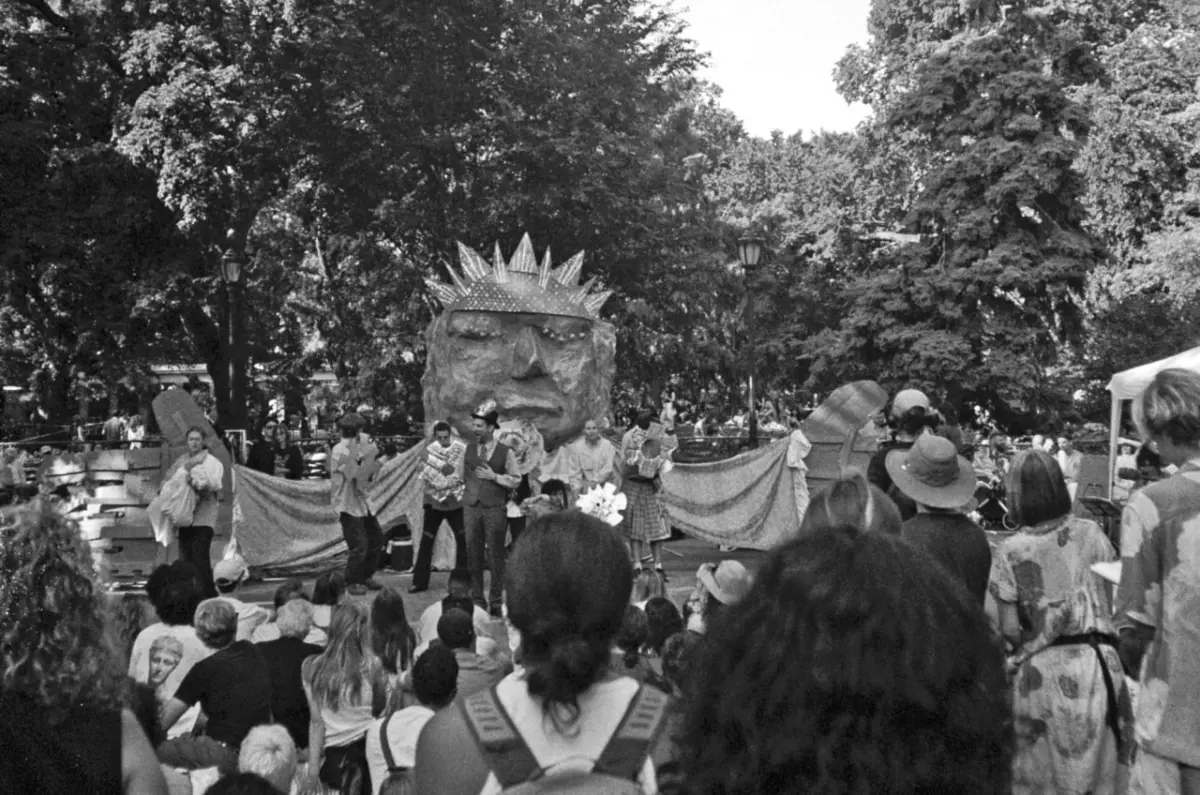
The culmination of these organizing efforts arrived at the end of June with the launch of the "Summer of Ludd" festival in Tompkins Square Park. Featuring more than 120 free, public events advertised entirely through wheatpasted flyers, physical zines, and a dedicated telephone hotline rather than social media algorithms, the festival’s opening day showcased an original play by filmmaker Amanda Hanna-McLeer.
The production dramatized the historical struggles of early 19th-century English textile workers alongside modern tech oligarchs, featuring a papier-mâché baby fed into factory cogs and a gleaming foil-wrapped sledgehammer. For the author, standing in the crowd of four hundred people—and being gently reminded by an organizer to put away a smartphone recording device—crystallized the central paradox: the tools of digital capture are so deeply ingrained that even in the heart of a neo-Luddite uprising, the impulse to document remains a hard habit to break.
Supporting Context & Metrics: The Architecture of Digital Capture
To understand the urgency of New York’s neo-Luddite movement, one must examine the staggering macroeconomic and psychological metrics of modern digital consumption.
- Screen Time Realities: Global data indicates that the average TikTok user consumes upwards of 100,000 videos annually. In the United States, adults spend an average of 50 hours a week staring at screens, with 16 of those hours dedicated exclusively to social media platforms. Demographers project that an American born in 2025 will spend approximately 21 cumulative years of their life looking at digital displays.
- The Data Center Backlash: Public resistance to the physical infrastructure of Big Tech has reached a boiling point. A 2026 Gallup poll revealed that seven in ten Americans actively oppose the construction of AI data centers in their local municipalities, citing environmental degradation and resource strain.
- The Neoliberal Subject: Cultural theorists argue that modern platforms have successfully transformed users into debtor-addicts, bound by compulsion and disciplined through private shame. As philosopher Anton Barba-Kay posits in A Web of Our Own Making, the internet functions in the modern psyche much like heaven and hell once did for early Christians—a spectral realm entered hourly that fundamentally rewrites physical behavior, geopolitics, and human neurology.
Official Statements and Perspectives from the Movement
The Activists: Beyond Anti-Tech
Speaking at an East Village café, the core organizers of the neo-Luddite scene clarified that their ideology is frequently misunderstood.
"We are standing still and they’re pushing shit onto us," remarked Skeleton Ludd, capturing the sentiment of involuntary technological saturation.
Captain Ludd, a 22-year-old writer, emphasized that the movement is rooted in historical continuity rather than simple technophobia:
"The idea is to be connected to a historic tradition, a lineage of people who took a stand against technological exploitation. We oppose the social costs and fascist alignment of Big Tech, not technology qua technology."
The Connectors: Re-enchanting Public Life
Nick Plante, founder of the NYC Off Tech newsletter and the individual who handed out the symbolic blade of grass at the initial panel, views the phenomenon as a profound renegotiation of urban sociality.
"What’s happening is a much wider-scale renegotiation of what it means to be with each other in this city," Plante explained in Tompkins Square Park. "It is kind of this shared project in being re-enchanted with each other, the time we spend with each other, and the rest of nature that we share."
The Technologists: Rebuilding the Infrastructure
Damian Thomas, a technologist and writer who developed the "Unplatform" interactive guide to help users exit social media, argues that the crisis is fundamentally structural rather than personal.
"People aren’t on Instagram because they love it as a social media platform. They were there because their friends, shows, events, political updates, artists, and creative communities had all been pushed there," Thomas noted. Rather than waiting for federal antitrust action from Washington, Thomas and his peers focus on rebuilding independent physical and low-tech infrastructure—such as alt-weeklies, event calendars, and grassroots distribution networks—to give cultural producers viable alternatives to algorithmic serfdom.
Future Outlook: Can the Luddiverse Scale?
As New York’s neo-Luddite movement matures, it faces critical strategic crossroads. Unlike traditional political lobbying groups that pursue legislative carve-outs or antitrust enforcement in Washington—though some members actively support political figures addressing adolescent smartphone use—the Luddites place their faith in prefigurative politics. By demonstrating that joyous, unmediated, and unpredictable human connection is possible without a smartphone screen acting as an intermediary, they hope to shift cultural norms one public event at a time.
Yet, significant challenges remain. Critics and cautious observers frequently question whether a movement centered on ephemeral, physical gatherings can achieve scale without alienating the time-poor, the socially anxious, or individuals with disabilities for whom digital tools provide vital lifelines. Furthermore, as the movement gains mainstream media attention—sparked by interviews with their cardboard spokes-puppet, Gowanus—there is an ongoing tension between maintaining radical authenticity and avoiding dilution by the very corporate culture industries they seek to subvert.
Ultimately, the neo-Luddites are not attempting to turn back the clock to the 19th century. Instead, they are offering an existential clarion call: an invitation to recognize that technology should serve human flourishing rather than dictating its terms. In an era where human attention is systematically mined, packaged, and monetized, the simple act of putting down the phone, touching grass, and dancing around a glass cube with a paper hat may be the most revolutionary act left available.




Comments
Facebook App ID not configured. Please add it in the Customizer.