
LONDON — In what has become a landmark annual fixture for the global literary calendar, The Poetry Society has officially launched the National Poetry Competition 2026. Widely regarded as one of the most prestigious accolades in the world for a single, unpublished poem, the competition opens its doors to writers from every corner of the globe today, welcoming entries until October 31, 2026.
Carrying a lucrative prize pool and a storied legacy of unearthing extraordinary literary talent, this year’s installment is anchored by a formidable, award-winning panel of judges: Niall Campbell, Malika Booker, and Luke Kennard. With an anonymised judging process that levels the playing field for debutants and established masters alike, the 2026 competition promises to be a rigorous, thrilling celebration of contemporary verse.
Executive Overview: A Global Stage for Unpublished Verse
Since its inception in 1978 by The Poetry Society, the National Poetry Competition has functioned as a crucial catalyst for literary careers. For nearly five decades, it has served as a crucible where raw, undiscovered brilliance meets international acclaim.
Read Also
The stakes for the 2026 competition are high, backed by a significant financial prize structure designed to support working writers. The overall winner will take home £5,000, alongside publication in The Poetry Review—one of the world’s leading poetry journals. Generous monetary awards are also secured for runners-up: £3,000 for second place, £2,000 for third place, and £500 for each commended poet.
However, beyond the monetary rewards, the competition is legendary for its transformative effect on a poet’s trajectory. Past victors have gone on to shape the canon of modern literature, turning an anonymous submission into a springboard for international recognition, publication deals, and lifelong literary careers.
Detailed Chronology and Historical Legacy: From 1978 to the Present
To understand the weight of the National Poetry Competition, one must look back at its rich, nearly fifty-year history. Established during a period of shifting artistic paradigms in the late 1970s, the competition was envisioned as a democratic arena—a place where poems would be judged strictly on their artistic merit, devoid of the author’s reputation, CV, or institutional backing.
Over the decades, this egalitarian vision has yielded an extraordinary roster of alumni. The competition’s historical archive reads as a roll call of modern literary royalty. Past winners and major figures who cut their teeth in the contest include:
- Carol Ann Duffy, who would later serve as the United Kingdom’s Poet Laureate.
- Tony Harrison, renowned for his fierce, socially conscious verse and theatrical poetry.
- Helen Dunmore, celebrated across both fiction and poetry for her lyrical precision and emotional depth.
- Ruth Padel, a fellow of the Royal Society of Literature known for her critically acclaimed, formally inventive collections.
- Jo Shapcott, a multiple-award-winning poet celebrated for her distinct voice and fearless explorations of identity and nature.
In recent years, the competition has continued to adapt to a rapidly globalizing literary landscape, drawing massive international participation. The 2025 competition shattered previous benchmarks, drawing over 9,500 entrants who submitted a staggering 21,500 poems hailing from 113 different countries.
The reigning champion, Partridge Boswell, claimed the 2025 crown with his magnetic poem "The Gathering." The piece captivated the previous judging panel, who noted that they were "blown away" and compelled to return to it repeatedly, discovering new layers of philosophical depth and emotional resonance with every read. Boswell joined a lineage of recent innovative voices—including Eric Yip, Lee Stockdale, Imogen Wade, and Fiona Larkin—who have pushed the boundaries of form, language, and subject matter in contemporary poetry.
Supporting Context & Metrics: The Mechanics of an International Literary Giant
The sheer scale of the National Poetry Competition requires an administrative and logistical apparatus capable of processing tens of thousands of deeply personal, radically diverse works of art.
The Anonymised Process
At the heart of the competition’s integrity is its strict anonymisation policy. When entrants upload their work, identifying markers are stripped away before the manuscripts reach the judges’ desks. This blind evaluation ensures that a teenager submitting their very first poem is read with the exact same gravity, open-mindedness, and neutrality as a heavily decorated, multi-published professor of literature.
Global Reach and Demographics
Reflecting its borderless appeal, the competition draws submissions from every inhabited continent. While the UK remains a strong hub of participation, vibrant poetic communities from North America, the Caribbean, South Asia, Australasia, and Europe routinely flood the portal. This cross-cultural exchange transforms the competition into a panoramic snapshot of global anxieties, joys, linguistic experimentations, and aesthetic trends in the mid-2020s.
Resources and Artistic Collaboration
Recognizing that the blank page can be an intimidating expanse, The Poetry Society has committed to lowering barriers to entry. Between now and the October 31 deadline, the organization will roll out a series of free writing resources and digital content. Crafted by some of the UK’s leading poets, these materials are designed to demystify the creative process, offer prompt-based inspiration, and guide emerging writers through the nuances of drafting and revising single poems.
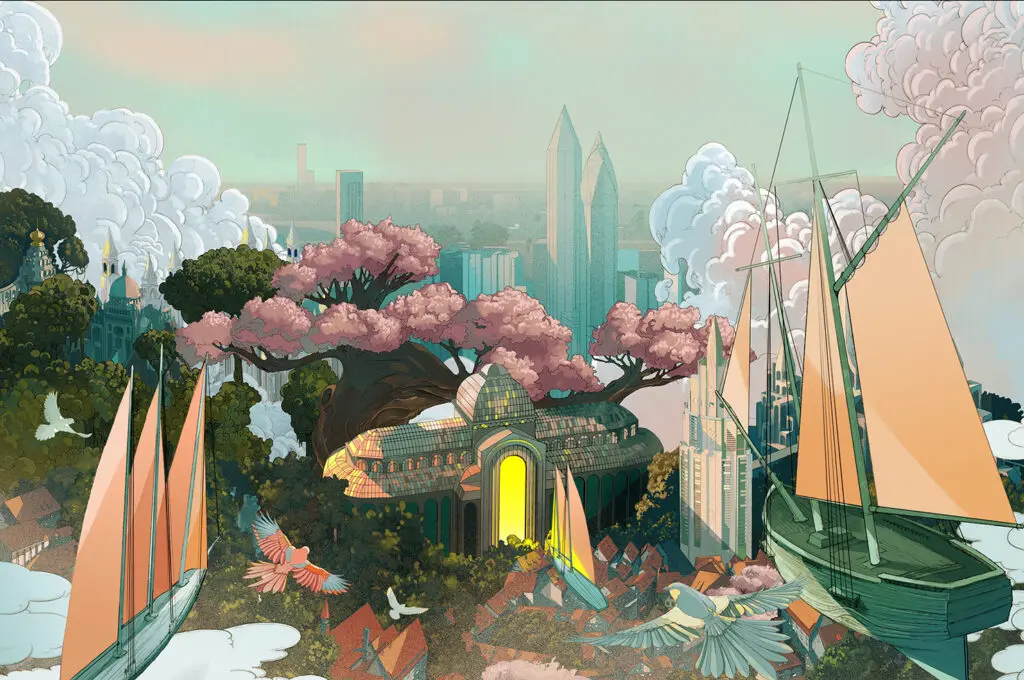
Furthermore, to visually and philosophically anchor the 2026 campaign, The Poetry Society has commissioned acclaimed artist Shan Jiang to create a bespoke, fantastical artwork. Jiang’s piece captures the elusive, mysterious aura of the creative process—a visual metaphor for the alchemy that occurs when raw thought is forged into rhythm, imagery, and meter.
Official Statements: Inside the Minds of the 2026 Judges
The selection of the judging panel is always a meticulous process, curating voices that represent technical mastery, boundary-pushing experimentation, and deep critical insight. The 2026 panel—Niall Campbell, Malika Booker, and Luke Kennard—brings an extraordinary breadth of experience across performance, academia, editing, and publishing.
Luke Kennard on the Search for Flawed Humanity
Luke Kennard, whose sixth collection Notes on the Sonnets captured the prestigious Forward Prize in 2021, brings his characteristic wit and academic rigor to the table. As a professor of literature and creative writing at the University of Birmingham, Kennard has spent decades reading and dissecting verse, yet he approaches this blind competition with refreshing humility.
"It’s a privilege to be one of the judges for the National Poetry Competition," Kennard reflects. "Because it’s open and anonymised, you get to encounter a huge number of poems directly with no preconceptions. It would be foolish to have an advance sense of what I’m looking for, but I suppose I gravitate towards poems that celebrate our idiosyncratic, flawed personalities rather than just trying to sound the way a poem should sound."
Kennard emphasizes the importance of transparency in the creative act—the visible footprint of the author’s mind at work:
"Poems where you can see the thinking and sense of discovery. But most things I could say here would be contradicted by half the poems I like. I enjoy intense and inventive imagery, but I also like a flat, straightforward tone when the poem calls for that. I like complexity and ideas, and I also like writers who can directly channel an emotion into my brain."
Niall Campbell on Lyric Momentum and Inherent Song
Niall Campbell, an esteemed librettist, editor of the influential journal Poetry London, and winner of the Edwin Morgan Poetry Award for his debut collection Moontide, views the competition through the lens of momentum and musicality.
"It’s an honour to judge such an important prize in the UK poetry calendar," Campbell states. When asked about his criteria for a winning manuscript, he cuts straight to the heart of poetic form: "What am I looking for? I love poems where you can feel their trajectory right from the start—where there is a sense of a lyric momentum that flows through the poem. And doesn’t let up. Give me any topic or idea—but make it sing."
The Collective Expertise of Malika Booker
Rounding out the trio is Malika Booker, a visionary force in contemporary letters. As a lecturer at Manchester Metropolitan University (MMU) and co-founder of the influential writing collective Malika’s Kitchen, Booker has dedicated much of her career to mentoring and championing diverse literary voices.
Her own collection, Pepper Seed, earned critical shortlists for both the Ocm Bocas Prize and the Seamus Heaney Centre Prize. Notably, Booker made history by becoming the first woman to win the Forward Prize for Best Single Poem twice—first for "The Little Miracles" in 2020, and subsequently for "Libation" in 2023. Her inclusion on the panel ensures an uncompromising eye for emotional authenticity, rhythmic innovation, and narrative power.
Future Outlook: What to Expect Leading Up to October 31, 2026
As the entry portal swings wide open, the global poetry community enters a months-long period of intensive composition, workshopping, and refinement. Poets from remote rural outposts to bustling urban centers will spend the summer and early autumn hours laboring over line breaks, syllable counts, metaphorical resonance, and emotional truths.
For aspiring entrants, the path forward is clear:
- Explore the Resources: Visit the official Poetry Society hub to utilize the free writing guides and digital tools released throughout the coming months.
- Refine the Craft: Focus on what Campbell terms "lyric momentum" and what Kennard describes as "flawed personality"—eschewing tired poetic clichés in favor of genuine discovery.
- Submit Anonymously: Ensure all identifying information is scrubbed from the manuscript files before uploading.
- Beat the Deadline: Submit work well in advance of the hard deadline on October 31, 2026.
Following the closure of submissions, the monumental task of reading thousands of anonymised entries will fall to Campbell, Booker, and Kennard. Shortlists will be announced in the winter, culminating in an awards ceremony that will crown the next great voice in world poetry.
Full details, terms and conditions, writing resources, and submission portals are now live online at poetrysociety.org.uk/npc.

Comments
Facebook App ID not configured. Please add it in the Customizer.