
Executive Overview
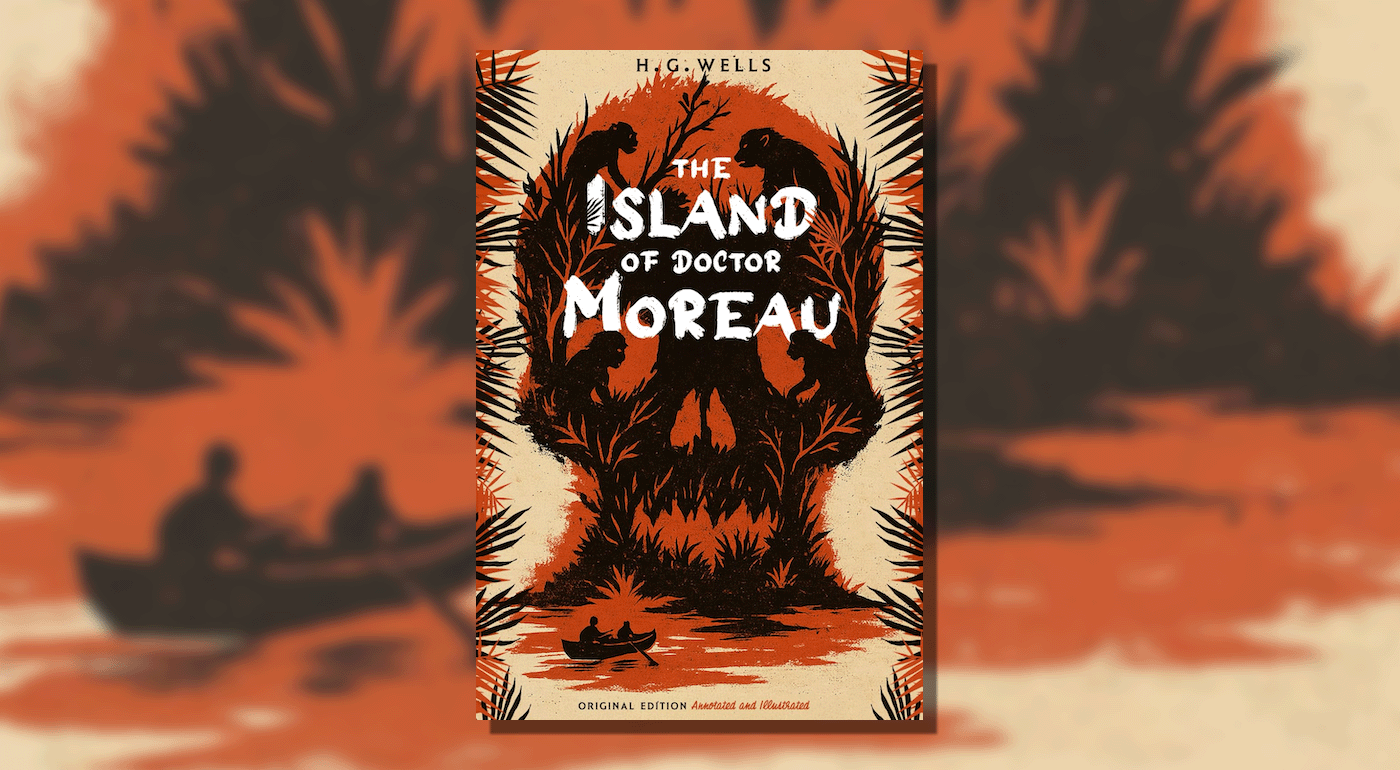
The intersection of science, ethics, and cosmic horror has long served as a fertile testing ground for speculative literature. In this latest installment of Reading the Weird, our ongoing critical retrospective of H.G. Wells’ seminal 1896 novel, The Island of Doctor Moreau, we delve deep into Chapters 7 through 9. This segment marks a critical narrative pivot: protagonist Edward Prendick transitions from a bewildered castaway to a captive observer trapped within a waking nightmare of bio-ethical transgression.
Set against the backdrop of late-Victorian anxieties surrounding vivisection, evolutionary biology, and moral degeneration, these chapters expose the machinery of a mad scientist working at the absolute fringe of human understanding. As Prendick navigates locked doors, the agonizing cries of a captive puma, and unsettling encounters with the island’s uncanny denizens, the narrative invites readers to confront historical and ongoing questions regarding the limits of scientific inquiry. Through the dual lenses of literary analysis and historical contextualization, this report examines the mechanics of Wells’ world-building, the real-world historical figures who inspired the monstrous Dr. Moreau, and the dark legacy of institutionalized cruelty that continues to haunt modern science.
Detailed Chronology: Chapters 7 Through 9
The narrative progression of Chapters 7 through 9 accelerates Prendick’s descent from tentative guest to targeted fugitive within Moreau’s domain.
Read Also
Chapter VII: The Locked Door
Arriving at the island’s sole stone enclosure, Prendick finds his sensory faculties overloaded by an environment where the bizarre has become mundane. Montgomery urges him to remain outside the inner compound, while a mysterious, white-haired man approaches, eager to resume work with his "new stuff." Deeming Prendick an uninvited variable who cannot yet be trusted with their secrets—though insisting these secrets are "nothing dreadful to a sane man"—they assign him temporary quarters.
Prendick is ushered into a room equipped with a hammock, a chair, a table, and a barred window overlooking the exterior. As Montgomery departs, Prendick overhears him address the white-haired man as "Moreau." The name triggers a latent memory: a sensationalist pamphlet he read a decade prior titled The Moreau Horrors. Authored by a journalist who infiltrated a prominent physiologist’s laboratory to expose brutal vivisection practices, the pamphlet described a public uproar that drove Moreau out of Europe following the escape of a mutilated dog. Observing the pointed ears and animalistic features of Montgomery’s servant, Prendick realizes that the cargo-boat scientists and the notorious vivisector are one and the same.
Chapter VIII: The Crying of the Puma
During luncheon, which Moreau is too busy to attend, Prendick lets slip his recognition of the doctor’s name, prompting Montgomery to curse his own loose tongue and the alcohol that fueled it. When pressed about his servant’s unnatural, pointed ears, Montgomery evades the question. Suddenly, the silence is shattered by the agonizing, unmistakable cry of a suffering puma echoing from the locked inner enclosure.
Overwhelmed by the "exquisite expression of suffering" and unable to penetrate Montgomery’s evasions concerning the monstrous islanders, Prendick flees the compound entirely, seeking refuge in the dense, silent vegetation of the island’s interior.
Chapter IX: The Thing in the Forest
Deep within the jungle, Prendick attempts to calm his nerves beside a freshwater stream. His peace is abruptly broken by a horrifying sight: a man dressed in blue, moving awkwardly on all fours, desperately lapping water like an animal. Upon spotting Prendick, the creature scrambles upright with an expression of deep guilt and flees into the undergrowth.
Driven forward by residual echoes of the puma’s wails, Prendick discovers a decapitated rabbit hidden beneath a fern bed, heightening his sense of dread. Further exploration brings him face-to-face with a trio of "pinkish-drab," fat-faced, chinless grotesques chanting in a degenerate gibberish—a chilling manifestation of the "mark of the beast." Realizing he is being stalked by the stream-drinker, Prendick constructs a primitive weapon by wrapping a stone in his handkerchief.
In a heart-pounding footrace through the dark jungle toward a distant point of light, the creature ambushes him. Prendick strikes it down with his makeshift club, bypassing the motionless body to flee back toward the enclosure, guided by the moaning puma and a voice calling his name.
Supporting Context & Metrics
To fully appreciate the weight of Wells’ narrative choices in The Island of Doctor Moreau, one must examine the cultural, legal, and literary ecosystems of the late 19th century.
The Anti-Vivisection Movement and Real-World Parallels
Published in 1896, The Island of Doctor Moreau arrived at the height of public and legislative uproar surrounding animal experimentation in Great Britain. The National Anti-Vivisection Society, founded in 1875, actively mobilized public sentiment against institutionalized cruelty, mirroring the "howling" crowds that drove Moreau into exile.
Literary historians have long noted the striking parallels between Dr. Moreau and Emanuel Edward Klein (1844–1925), a pioneering Hungarian-born British microbiologist. Klein’s notorious testimony before the 1875 Royal Commission on Vivisection established him as a chilling archetype of unfeeling scientific pragmatism. When questioned about his use of anesthetics, Klein openly stated that he used them solely "for convenience’ sake" on dogs and cats, and "never" on frogs or lower animals. When asked if he held any regard for animal suffering, Klein famously replied: "No regard at all… His [the experimenter’s] only purpose is to perform the experiment, to learn as much from it as possible, and to do it as quickly as possible."
Analytical Breakdown of Narrative Themes
| Theme / Motif | Literary Manifestation in Chapters 7–9 | Real-World / Historical Correlate |
|---|---|---|
| The Uncanny Valley | Montgomery’s servant and the "pinkish-drab" islanders exhibit distorted human and porcine traits. | Late-Victorian anxieties regarding human evolution, degeneration, and racial taxonomy. |
| Amoral Science | Moreau’s insistence that his laboratory horrors are "nothing… to a sane man." | Emanuel Klein’s 1875 Royal Commission testimony dismissing animal suffering in favor of experimental expediency. |
| Epistemic Isolation | Prendick finds only surgical texts and classical Greek/Latin volumes in his quarters. | The total severing of the intellectual protagonist from modern, compassionate human discourse. |
| Complicity Through Evasion | Prendick flees the sound of the puma rather than investigating or intervening. | The historical complicity of the scientific establishment in turning a blind eye to unethical research protocols. |
Official Statements & Expert Commentary
The complexities of Wells’ text have continually drawn deep critical engagement from contemporary scholars of weird fiction and Victorian literature.
Ruthanna Emrys, analyzing the psychological and ethical dimensions of Prendick’s journey, notes the stark progression of scientific oversight:
"The Island of Doctor Moreau came out a year before even the first known consent forms… The anti-vivisection movement, however, was in full swing… Even more upsetting, early anesthetics were invented in the mid-nineteenth century. Moreau is making some choices with that puma. I can understand Prendick not wanting to get himself set adrift sans food again, but he’s also making a choice when he flees out of earshot rather than intervening."
Emrys further emphasizes how Prendick’s reaction to the islanders reflects an era on the cusp of modern anthropology and evolutionary science:
"This is still a time when fantasy could populate distant realms… but science was starting to get a sense of the limits of human variation. Prendick’s ‘huh, don’t recognize that race’ reaction is informed if essentialist… And this week it finally clicks: these guys remind him of pigs. Literal pigs."
Anne M., focusing on the systemic secrecy and the shadow of Emanuel Klein, highlights the casual arrogance of institutional authority embodied by Moreau:
"Montgomery’s boss remains the ‘white-haired man’ through the first pages of Chapter VII… Nor does Montgomery introduce the person who’s obviously the ultimate authority on the island. This strikes me as a lapse of common courtesy. Could White-Haired Man’s identity be one of the secrets that must not be disclosed… Secrets that, Prendick must understand, are ‘nothing very dreadful, really, to a sane man’?"
Connecting this directly to historical documentation, Anne points to the chilling resonance between Moreau’s ethos and Klein’s admissions before the 1875 Royal Commission:
"The ‘cynical brute’ to whom Huxley refers is Emanuel Edward Klein… Klein showed the ‘brutal directness’ that Prendick recalls as Moreau’s trademark… Prendick might have gotten an earful of the kind of outrage Huxley poured out… declaring that he would willingly agree to any law sending such a man to the treadmill."
Future Outlook & Next Steps
As Reading the Weird continues its deep dive into the historical and thematic roots of cosmic horror, our trajectory moves from the isolated surgical chambers of Moreau’s island toward broader manifestations of the strange and unsettling in contemporary weird fiction.
In our next installment, we will transition from the Victorian dread of biological transmutation to modern Americana with a road trip to an unusual roadside attraction: Alison Littlewood’s "Elmer’s Bottle Tree Ranch." Readers wishing to follow along can find this featured work in Remains Magazine (Issue 3) or Michael Kelly’s acclaimed anthology Best Weird Fiction of the Year, Volume 2.
As H.G. Wells reminds us through Prendick’s harrowing encounters in the jungle, the monsters we fear in the dark are frequently those engineered by human hands, operating under the cold, unblinking banner of progress without empathy.




Comments
Facebook App ID not configured. Please add it in the Customizer.