
Executive Overview
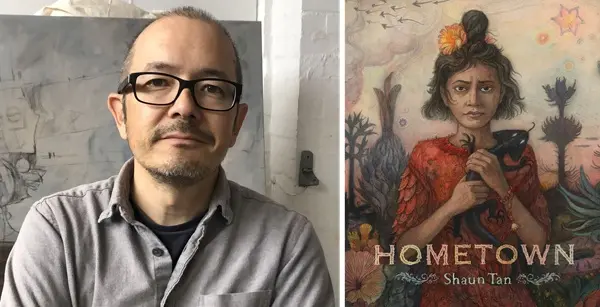
For an artist whose works have continuously redefined the boundaries of contemporary visual storytelling, Shaun Tan’s latest release represents both a profound artistic departure and a return to his core thematic preoccupations. Hometown, published by Levine Querido, marks the celebrated author, illustrator, and Astrid Lindgren Memorial Award laureate’s first new book in four years. Known for cinematic graphic novels like The Arrival and The Red Tree, Tan has once again crafted a visually immersive narrative that challenges readers to reconsider their understanding of belonging, dogma, and familial love.
At its core, Hometown introduces an unconventional domestic setting. The narrator—a perceptive, brown-skinned girl—shares her life with a father possessing retracting tentacles, a mother with multiple arms, and siblings bearing fangs. This strange yet profoundly cozy universe is abruptly disrupted when a spacecraft crash-lands near their home. The sole survivor, a human boy, emerges from the wreckage with an absolute and uncompromising message: the girl is also human, and she fundamentally belongs in his world, not this one.
Her unexpected response forms the emotional and philosophical crux of the novel. Rather than serving as a simple sci-fi adventure, Hometown utilizes Tan’s dense, intricate watercolor spreads to explore the collision of incompatible worldviews. Speaking from his studio in Melbourne, Tan recently sat down to discuss the panicked origins of the project, his unexpected fascination with religious zealotry and missionaries, his four-decade hiatus from watercolor painting, and the surprising generational divide the story has already provoked.
Read Also
Detailed Chronology: From a 20-Day Panic to a Seven-Year Masterpiece
The genesis of Hometown stretches back to 2017, rooted in a tight deadline and an unexpected creative constraint. The project did not begin as an expansive graphic novel; rather, it was born out of an invitation from a peer curating an anthology centered on the thematic intersection of machines and emotions.
The 2017 Catalyst
When initially approached for the anthology, Tan admits he had no fully formed concept ready. However, he had been quietly nursing a nascent mental image: a young girl encountering a fellow human from another universe for the very first time. His friend expressed interest in the concept but imposed an unforgiving boundary: the story needed to span exactly 20 pages, and it had to be completed in roughly a month.
For an artist who meticulously paces his creative output—often spending up to two weeks on a single illustrated page—the proposition induced immediate panic. Operating under severe time constraints, Tan bypassed his usual deliberate planning phases. He sketched the narrative as rapidly as his hands could move, forcing himself into a rigid, sequential rhythm: panel, panel, panel, panel.
The Creative Benefit of Panic
Reflecting on that high-stress incubation period, Tan notes that the panic was paradoxically beneficial to the project’s development. By removing the luxury of over-thinking, the tight deadline prevented him from second-guessing narrative choices or getting bogged down by minor structural inconsistencies. He was forced to trust his raw artistic instincts.
Yet, as the frantic sketching sessions concluded, Tan realized he had stumbled upon something far larger and more resonant than a short-form anthology contribution. He had fallen deeply in love with the world he had conjured. He found himself captivated by the domestic warmth of the family, the distinct personalities of the citizens, and, above all, the narrator herself—a character he describes as feisty, innocent yet profoundly wise, and refreshingly blunt.
Recognizing the rich narrative potential of the universe he had sketched in a frenzy, Tan abandoned the quick-turnaround anthology mindset. He embarked on a meticulous, seven-year journey of continuous plotting, revision, and artistic refinement that would eventually culminate in Hometown.
Supporting Context & Metrics: Themes of Dogma, Subterfuge, and Artistic Evolution
The Psychology of Belief and Dogma
Beyond its imaginative science-fiction premise, Hometown serves as a poignant exploration of colliding worldviews and ideological fundamentalism. Tan reveals that a primary thematic catalyst for the book was an unexpected source of inspiration: a viewing of The Book of Mormon. Stumbling upon a promotional poster on the side of a tram while living in Melbourne with his wife, the artist went into the production completely blind.
While struck by the humor and irreverence of the musical, Tan found himself intellectually arrested by a deeper, more serious question: What drives human beings to embrace belief systems that are fundamentally unbelievable? His conclusion became central to Hometown‘s antagonist—the human boy who arrives with an unshakeable, dogmatic book of absolute facts. Tan observed that belief is rarely sustained by cold logic alone; instead, it is anchored in love, community, and the intoxicating sensation of sharing a "secret thing" that makes individuals feel uniquely special while separating them from the rest of the world.
Whether the boy represents a fundamentalist rationalist scientist or a religious zealot remains intentionally ambiguous. What matters is his absolute certainty. To combat this rigid worldview, Tan weaves in historical motifs of subterfuge and cultural survival. He draws a direct parallel to an account he heard in Mexico, where enslaved builders were forced to construct Catholic churches out of the stones of destroyed Aztec temples. As an act of silent resistance, these builders hid sacred images within the church walls, allowing them to secretly pay homage to their ancestral gods while participating in forced worship.
This act of tactical duplicity manifests within Hometown, where the young narrator makes a complex, morally ambiguous choice—involving a form of necessary deceit—to ensure that both she and the visiting boy can ultimately find happiness without destroying their respective truths.
The Rediscovery of Watercolor
From an aesthetic standpoint, Hometown represents a major technical shift for Tan. The artwork possesses an ethereal, fluid quality that distinguishes it from his previous publications. Remarkably, the book marks Tan’s return to watercolor painting after a hiatus of nearly forty years.
For decades, Tan’s artistic practice relied heavily on opaque media such as acrylics and oils. Working primarily from dark to light, he utilized a dark or medium ground and applied highlights last, effectively "drawing the images up" from the shadows. Long viewing watercolor as a notoriously fussy medium that offers zero margin for error or revision, Tan initially kept his distance from it.
However, preliminary experiments for Hometown disproved his long-held assumptions. He discovered that watercolor possessed a surprising degree of flexibility. Mistakes could not only be corrected, but the accidental bleeds and unpredictable runs often yielded superior artistic results. This organic unpredictability proved ideal for rendering a whimsical, twisting world defined by fluid forms and non-Euclidean architecture.
Historical and Artistic Inspirations
To achieve the intricate, layered aesthetic of Hometown, Tan immersed himself in the works of master illustrators from the 19th and early 20th centuries, including Arthur Rackham and Gustave Doré. He marveled at their patience, meticulous composition, and fine detail—qualities that appear effortless to the casual viewer but reveal immense technical pain upon closer inspection.
Particular inspiration was drawn from Samuel Palmer, the 19th-century British romantic landscape painter. Tan frequently returned to Palmer’s drawing Early Morning. Despite depicting a seemingly mundane British pastoral landscape featuring a simple path and a tree, Palmer’s heavily textured, monochromatic style utilized knotted, swirling lines that rendered the familiar environment alien, mystical, and seemingly extraterrestrial—an effect Tan actively channeled into the otherworldly landscapes of Hometown.
Official Statements & Public Reception
The Generational Divide
Long before Hometown hit bookstore shelves in its final printed form, the narrative underwent an unexpected real-world theatrical test. A local theater company approached Tan after viewing his early sketches and sought permission to adapt the story into a puppet show. Amused by the prospect, Tan gave them full clearance, noting that his own glacial pace of completion meant the book wouldn’t be finished for years.
The stage adaptation provided Tan with invaluable sociological data regarding how audiences process the narrator’s ultimate dilemma. The theatrical run revealed a stark generational divide in audience reactions:
- Children and Parents: Younger audience members and parents overwhelmingly shouted responses from the audience such as, "Don’t go, don’t go!"—instinctively urging the protagonist to remain within the safe, loving confines of her eccentric family and familiar world.
- Teenaged Girls: Conversely, teenage girls in the audience reacted with immediate, fervent encouragement, shouting, "Go!"—signaling a strong desire for the protagonist to break free, explore the unknown, and embrace a broader, albeit frightening, horizon.
This organic audience feedback profoundly influenced Tan’s final revisions for the book. He consciously chose to elevate the emotional stakes, ensuring the narrator’s decision remains profoundly difficult and heavy with consequence. Even as the creator of the narrative, Tan admits that experiencing the final emotional pivot still delivers a distinct psychological jolt.
Future Outlook
With Hometown officially launched into the literary ecosystem, Shaun Tan shows no signs of slowing his creative momentum. Looking ahead, the artist is preparing for a major comprehensive exhibition of the original illustrations from Hometown, slated to open in Melbourne this November.
Concurrently, Tan is curating a companion collection consisting of preliminary sketches, marginalia, and process notes that trace the seven-year evolution of the book. As for what lies beyond the exhibition, Tan likens his creative process to baking a cake that is currently missing a critical, elusive ingredient. His sketchbooks remain heavily populated with fragments of ideas waiting for the right moment of convergence. For Tan, the ongoing challenge is simply finding the time to sit down and do the rigorous, foundational work required to push disparate concepts into cohesive, breathtaking new realities.





Comments
Facebook App ID not configured. Please add it in the Customizer.