
Executive Overview
For millions of immigrants, cultural identity is not a static heritage preserved in amber; it is an active, often improvised construction built from fragments of memory, geography, and inherited mythologies. This dynamic is explored through the lifelong relationship with soccer maintained by an Ecuadorian-American writer, whose journey maps a shifting emotional landscape across decades. What begins as a childhood fabrication—a convenient fiction used to anchor an identity in small-town Ohio—matures into a visceral, therapeutic tether during times of profound family trauma, ultimately culminating in a multigenerational pilgrimage to a World Cup group-stage match in Kansas City.
This journalistic feature examines the intersection of sports fandom and the immigrant experience. It traces how televised broadcasts, stadium spectacles, and diasporic enclaves serve as surrogate homelands. By analyzing the structural mechanics of belonging, the psychological function of sports as a balm for grief, and the unique socio-cultural ecosystem of the Latin American diaspora in the United States, this piece uncovers how a simple game on a glowing screen can bridge decades of estrangement, reconcile fractured family histories, and offer a tangible manifestation of home.
Detailed Chronology
I. The Invented Lineage: Childhood in Ohio
Growing up in Perrysburg and later Bexley, Ohio, during the 1980s and 1990s, the narrator’s connection to Ecuador was tenuous at best. Having emigrated as a young child with a distinctly non-Latino surname and losing fluency in Spanish, the author faced the classic dilemma of the early-wave immigrant child: how to claim a heritage that felt simultaneously vital and inaccessible.
Read Also
Soccer provided the solution. Although he had not played the sport in Ecuador beyond casual street games, the narrative of a rich soccer lineage was constructed using the faint, romanticized fact that older male relatives—a grandfather living in Ohio and his distant brothers—were rumored to like the sport. In the absence of televised matches or a local Hispanic community, this ancestral claim was accepted at face value by American peers, creating a functional, self-invented cultural identity.
[Childhood in Ohio (1980s-90s)]
       │
       ▼ (Invention of Soccer Lineage)
[Adolescent Soccer Player / Bexley Prodigy]
       │
       ▼ (Tendonitis & Arrival of Goggins Brothers)
[Transition to "Soccer Guy" / Cultural Isolation]
       │
       ▼ (Post-College Journey to Ecuador)
[Reconciliation Attempt with Estranged Father]
The athletic reality of this identity proved fleeting. Peaking as a high-school freshman where his ball-control skills marked him as a regional prodigy, the author’s limitations were exposed upon the arrival of more talented players from his former hometown. Chronic tendonitis eventually forced him to hang up his boots by his senior year. Yet, the persona of the "soccer guy" persisted. In 1990s America, maintaining this identity required little more than quiet derision toward dominant domestic sports and catching rare, fuzzy glimpses of international matches on television. It was an act of deliberate differentiation—a way to keep a flickering Ecuadorian flame burning behind a Serbian surname.
II. The Estrangement and the Stroke: Quito, Ecuador
The dormant metaphor transformed into an immediate, physical reality the year after college, when the author saved enough money to return to Ecuador for the first time since childhood. The primary objective was deeply personal: to confront and make peace with his biological father, an abusive and violent figure who had been estranged since the author was eight years old.
The structured plan—two weeks of lighthearted rapport-building followed by hard questions regarding years of abandonment and financial neglect—was derailed abruptly on the day the reckoning was scheduled to begin. Upon calling his father in San Antonio (near the Mitad del Mundo monument), the author was greeted not by Spanish, but by halting, garbled German.
The underlying medical emergency was rooted in a turbulent, cinematic past. As a fourteen-year-old in Yugoslavia, the father had fought as a machine gunner alongside his older sister in the partisan resistance against the Nazis. Later, caught in the bureaucratic drafts of Tito’s regime and refusing to complete a full year of mandatory post-war military service, he famously stole his sister’s pistol, fled across borders through Vienna and Naples, secured passage to Panama and Chile, and finally drifted into Ecuador. True to a lifelong rejection of official systems, he avoided doctors entirely—a stubbornness that years later turned a leg infection gangrenous, necessitating an emergency amputation by a Chilean physician orchestrated by his Serbian expatriate friends. The stroke that now paralyzed him was a direct manifestation of lingering blood clots from this chaotic physical history.
III. The Domestic Sanctuary: Soccer as Homeopathic Relief
Confronted with an incapacitated father, a hostile young stepmother suspected of medical negligence, and the collapse of any hope for emotional closure, the author found himself shattered by the daily realities of caregiving.
It was within this crucible of slow-motion familial catastrophe that televised soccer transitioned from a casual interest into a vital psychological anchor. Each evening, returning exhausted to his cousins’ home in Quito, the author would sit before the television as Mexican, Argentinian, and domestic league matches flickered in saturated green tones.
Deprived of agency in the waking world of hospital corridors and family politics, the author discovered in the televised pitch a homeopathic remedy: pure witnessing stripped of consequence. The glowing rectangular screen provided a boundaryed reality where life unfolded simply, predictably, and entirely outside his control. It was both an acceptance of his circumstances and a momentary rejection of them—a ritualistic surrender that would govern his psychological well-being for decades to come.
IV. The Pilgrimage: Kansas City and Jackson Heights
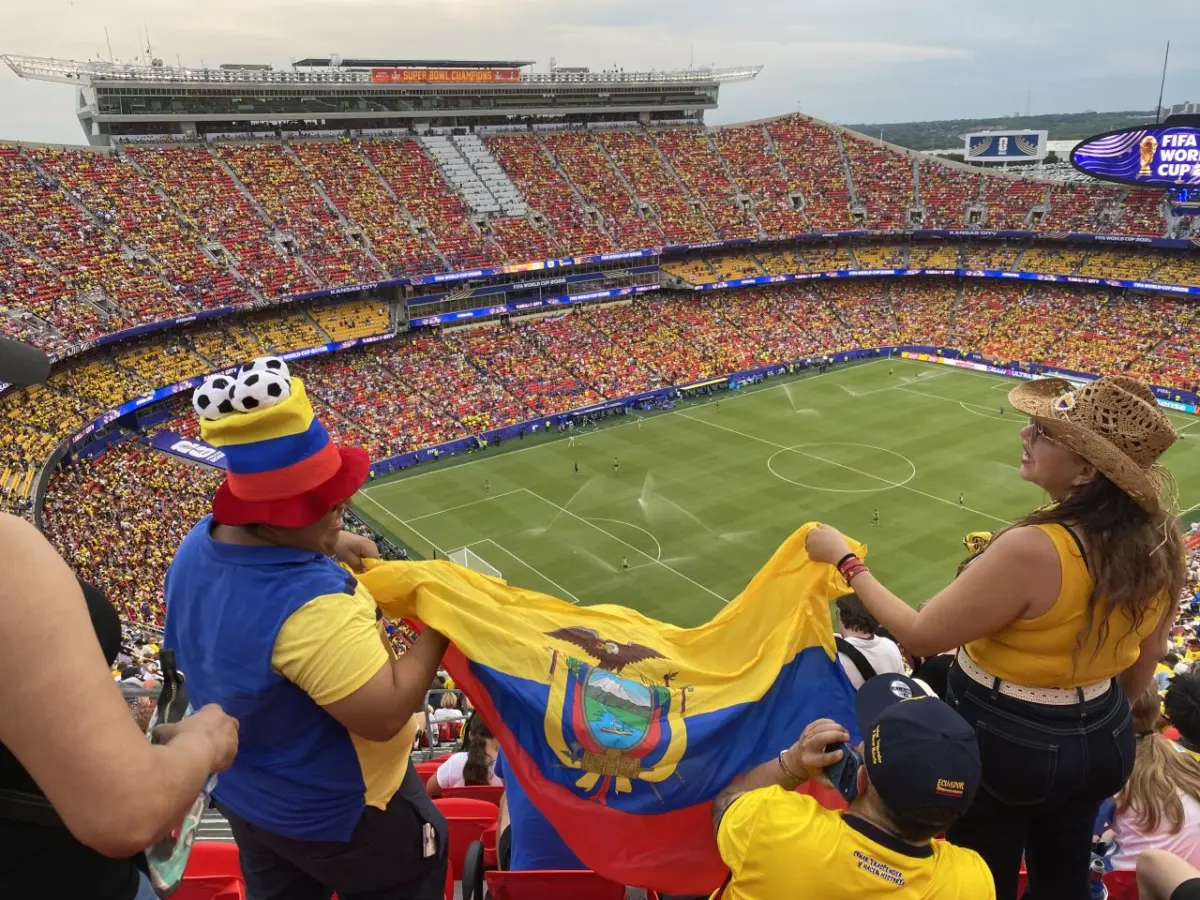
Decades later, living in Nebraska, the author’s private ritual scaled up dramatically when his mother funded a surprise, multigenerational trip for him and his brother to attend a World Cup group-stage match between Ecuador and Curaçao in Kansas City.
The journey transformed into a profound cultural homecoming. Arriving in Kansas City, the author encountered a diasporic explosion: a hotel lobby and city streets flooded with a sea of bright yellow jerseys, families wrapped in flags, and spontaneous choruses of "Vamos, carajo!" For a man who had spent decades in small-town Ohio entirely isolated from the sights, sounds, and tropical fruits of his homeland, the gathering was an emotional shock—an oasis in a cultural desert.
┌─────────────────────────┬──────────────────────────┬─────────────────────────┐
│     THE DIASPORA        │    THE STADIUM REALITY   │     THE RESOLUTION      │
│  (Kansas City Hotel)    │   (Arrowhead/Stadium)    │  (Jackson Heights, NYC) │
├─────────────────────────┼──────────────────────────┼─────────────────────────┤
│ • Sea of yellow jerseys │ • Scorched under sun     │ • Elite social setting  │
│ • Spontaneous choruses  │ • Dominant possession    │ • Stunned disbelief     │
│ • Intergenerational     │ • Frustrating 0-0 draw   │ • Historic upset over   │
│   family bonding        │ • Post-match exhaustion  │   Germany               │
└─────────────────────────┴──────────────────────────┴─────────────────────────┘
The match itself offered a mixed athletic spectacle. Playing against Curaçao—a tiny island nation with a population of 156,000—Ecuador dominated possession from the opening whistle but failed to convert, repeatedly shooting directly into the goalkeeper’s hands. Pinned at the sun-scorched apex of the stadium without adequate hydration or sunscreen, the brothers endured a physical ordeal that ended in a frustrating 0-0 draw, perceived by the passionate Ecuadorian contingent as a catastrophic defeat.
Yet, the emotional arc completed itself weeks later in New York City’s Jackson Heights. Squeezed into an ultra-modern, high-end lounge filled with distracted social-media models, the author watched in stunned disbelief as Ecuador overturned expectations to defeat the mighty European powerhouse, Germany. Stepping out onto the chaotic, horn-blaring streets of Queens amidst cheering compatriots, the circle closed. The decades-long journey from an invented identity in Ohio to the hospital beds of Quito and the vibrant immigrant enclaves of New York had found its ultimate validation.
Supporting Context & Metrics
The narrative reflects broader demographic and socio-economic shifts within the Ecuadorian diaspora in the United States:
- Migration Waves: Early Ecuadorian migration to the United States during the late 1970s and early 1980s frequently deposited families not into traditional gateway enclaves like New York’s Jackson Heights or Chicago’s neighborhoods, but into Midwestern industrial and rural outposts like small-town Ohio. This resulted in profound cultural isolation.
- Economic Impact of Major Tournaments: The financial commitment required for working- and middle-class families to participate in international sporting events underscores the cultural value placed on diasporic gatherings. Ticket prices scaling from $400 to $600, paired with last-minute airfare and lodging inflation, highlight how major sporting events function as modern secular rituals for identity reinforcement.
- The Psychology of Sports Viewing: Psychologists note that televised sports viewing during periods of acute trauma acts as an emotional regulatory mechanism. The predictability of the game’s boundaries juxtaposed with the unpredictability of its outcomes offers cognitive rest to individuals navigating complex family estrangement and caregiving burnout.
Official Statements
While the narrative is deeply personal and reflective rather than institutional, the cultural resonance of such sporting events is echoed by community organizers and cultural commentators:
"When a national team plays abroad, they are not merely contesting a sporting fixture; they are carrying the geographic, emotional, and political weight of millions who live between two worlds. For diasporic communities, the stadium becomes sovereign territory."
— Dr. Elena Vasquez, Institute for Transnational Cultural Studies"The economic sacrifices made by families to attend these fixtures demonstrate that cultural continuity is treated as an essential human need, comparable to education or healthcare within immigrant households."
— Community Outreach Desk, Ecuadorian-American Civic League
Future Outlook
As global sports broadcasting continues to fragment across streaming platforms, YouTube channels, and paywalled digital networks, the accessibility of international soccer is undergoing a structural transformation. For the next generation of the diaspora, the mode of consumption may shift from the living-room television or illegal web streams to mobile devices and social-media highlights.
However, the foundational psychological and cultural functions of these rituals remain immutable. Whether viewed on a high-definition home projector, a glowing smartphone screen in a quiet Midwestern suburb, or amidst the roaring, yellow-clad crowds of a Kansas City stadium, soccer will continue to serve as a vital bridge for transnational families. It remains an enduring architecture through which descendants of immigrants can honor their ancestors, process inherited grief, and claim a tangible, undeniable sense of home.

Comments
Facebook App ID not configured. Please add it in the Customizer.