
Executive Overview
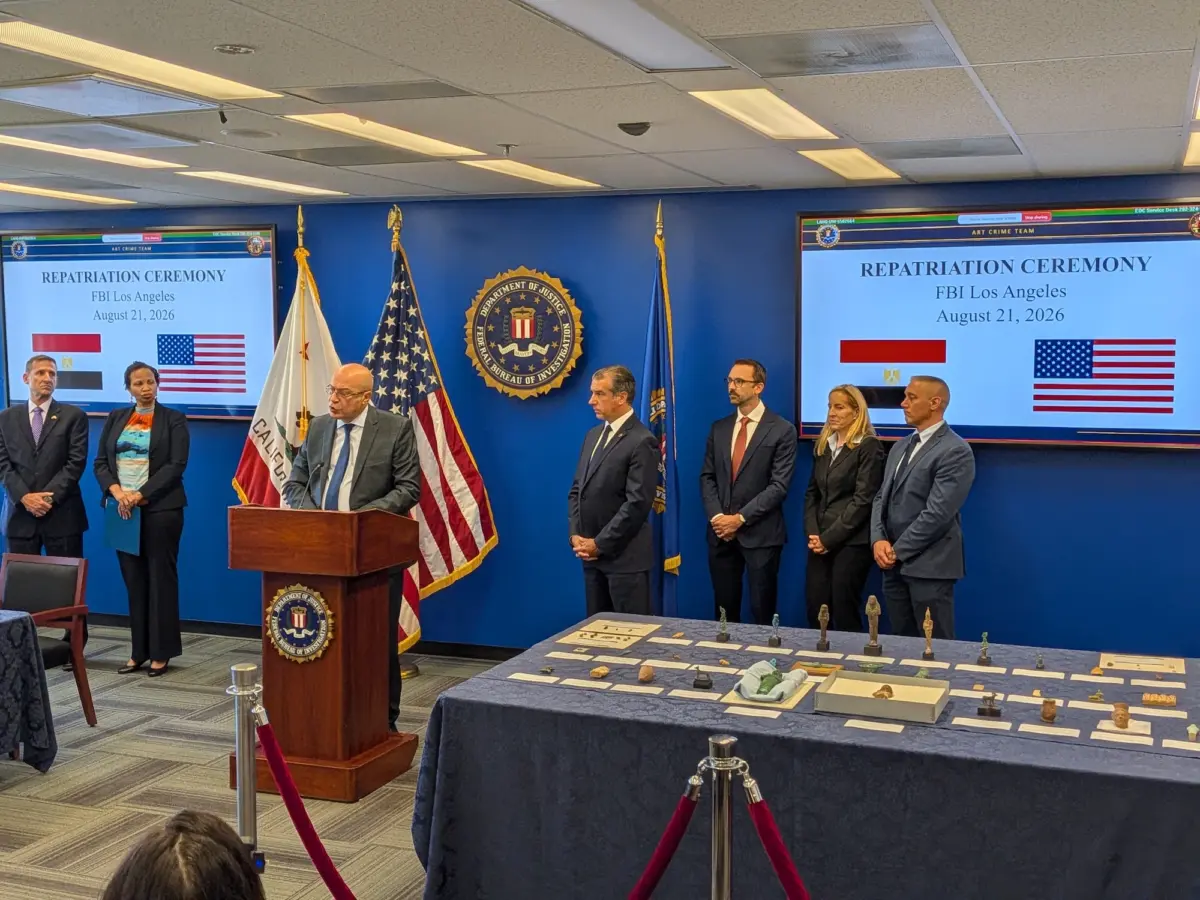
In a formal ceremony held last Friday in Los Angeles, the Federal Bureau of Investigation (FBI) officially repatriated 48 illegally trafficked cultural artifacts to the government of Egypt. This significant international handover underscores the ongoing, collaborative efforts between United States federal law enforcement and the Ministry of Tourism and Antiquities of Egypt to combat the illicit antiquities trade.
Spanning a monumental temporal arc of nearly four millennia, the repatriated collection includes delicately carved figures, protective amulets, and essential funerary and tomb equipment. These items collectively chronicle the multifaceted history of Egypt across the Pharaonic, Roman, and Coptic periods, with origins dating from approximately 3100 BCE to the 9th century CE.
The successful recovery and return of these invaluable pieces highlight not only the tireless work of the FBI’s specialized Art Crime Team, but also the critical efficacy of bilateral cultural property agreements. While the primary individual responsible for the illicit trafficking of these artifacts is deceased, federal investigators have stressed that the broader investigation remains active as authorities seek to identify potential co-conspirators and dismantle the smuggling networks that facilitated the items’ illegal export.
Read Also
This latest restitution adds to a substantial track record of cultural heritage preservation. Over the past decade alone, the United States has successfully returned more than 5,000 cultural artifacts to Egypt. Such actions demonstrate a profound commitment to international cultural stewardship, ensuring that items of profound historical, artistic, and spiritual significance are restored to the people to whom they rightfully belong.
Detailed Chronology of the Investigation and Repatriation
The path that led these 48 antiquities back to their homeland of Egypt is a compelling testament to the vigilance required in the modern antiquities market. Unlike many high-profile cultural property investigations that begin with a foreign government’s distress call or a tip from an international intelligence agency, this particular case originated from an unexpected and morally conscientious source: the private owner of the artifacts themselves.
The Origin of the Tip
According to federal investigators, the investigation commenced when an individual currently possessing the 48 artifacts conducted independent provenance research into the collection. As the owner dug deeper into the history, acquisition pathways, and documentation associated with the carved figures, amulets, and tomb equipment, mounting doubts arose regarding whether the objects had ever entered the United States through legal channels.
Facing the ethical dilemma of holding potentially looted or illicitly smuggled cultural property, the owner proactively contacted federal law enforcement. They handed over the collection to allow authorities to verify its legal status. Subsequent investigations by the FBI yielded no documentation, export permits, or credible evidence to establish that the items had been appropriately or legally removed from Egypt. This lack of a paper trail transformed a private citizen’s ethical inquiry into an active federal antiquities investigation.
The Investigation and the Deceased Trafficker
As the FBI’s Art Crime Team delved into the background of the collection, they sought to trace the transit route and identify the brokers who had introduced the pieces into the United States art and antiquities market. Investigators quickly determined that the primary individual responsible for trafficking these specific artifacts was deceased.
Despite the death of the primary smuggler, the investigation did not stall. Federal authorities recognized that antiquities trafficking rarely occurs in a vacuum; it typically relies on sophisticated networks of middlemen, illicit excavators, corrupt dealers, and international facilitators. Consequently, the FBI’s investigation remains strictly ongoing. Law enforcement personnel are actively pursuing leads to identify and prosecute any surviving co-conspirators, money launderers, or brokers who may have assisted in moving the artifacts from Egyptian soil into private collections abroad.
The Los Angeles Repatriation Ceremony
The culmination of this rigorous investigative process took place on a Friday afternoon in Los Angeles, California. In a formal diplomatic and law enforcement ceremony, federal officials transferred custody of the 48 artifacts back to representatives of the Egyptian government.
Surrounded by diplomats, security attachés, and law enforcement personnel, the ceremony served as both a celebration of recovered heritage and a stark reminder of the vulnerabilities facing global archaeological sites. The return of these pieces marks the end of their decades-long or perhaps centuries-long odyssey away from the Nile Valley, setting the stage for their eventual reintegration into Egypt’s world-renowned museum exhibitions.
Supporting Context, Legal Frameworks, and Operational Metrics
The successful repatriation of these 48 antiquities does not happen by accident; it is the direct result of a carefully constructed legal architecture and the dedicated operations of specialized law enforcement units. Understanding the broader context of this handover requires examining both the bilateral agreements governing US-Egypt relations and the history of the federal unit responsible for executing these recoveries.
The 2016 US-Egypt Cultural Property Agreement
The legal foundation that facilitates these seamless repatriations is rooted in international diplomacy. In 2016, the United States and Egypt entered into a bilateral cultural property agreement under the authority of the Convention on Cultural Property Implementation Act.
This crucial treaty authorizes the United States government to impose strict import restrictions on specific categories of archaeological and ethnological materials originating from Egypt. By regulating what can legally cross US borders, the agreement creates an enforceable framework that allows both nations to cooperate on multiple fronts:
- Identifying: Spotting suspicious shipments and unverified antiquities entering the US market.
- Interdicting: Seizing illicit shipments before they can be absorbed into private collections or commercial galleries.
- Returning: Streamlining the legal and logistical processes required to repatriate trafficked cultural property to its country of origin.
- Encouraging Legal Exchange: Fostering legitimate cultural, educational, and scientific exchanges between American and Egyptian academic and cultural institutions.
This robust framework has yielded extraordinary results. Over the past ten years, the collaborative mechanism established by this agreement has facilitated the return of more than 5,000 cultural artifacts to Egypt, making the nation one of the most frequent beneficiaries of US cultural property restitutions.
The FBI Art Crime Team: Two Decades of Heritage Protection
The operational force behind these recoveries is the FBI’s Art Crime Team (ACT). Established in 2004 in response to a dramatic, global escalation in art thefts, cultural property looting, and illicit trafficking, the ACT is a specialized unit consisting of specially trained agents, analysts, and prosecutors who operate both domestically and internationally.
Since its inception, the Art Crime Team has amassed an impressive record of accomplishment:
- Total Recoveries: The unit has successfully recovered more than 20,000 individual cultural items.
- Monetary Value: The collective value of these recovered artifacts exceeds $1 billion.
- Global Scope: Agents work alongside international police organizations (such as Interpol), foreign ministries of culture, academic institutions, and local law enforcement to track down looted treasures.
The Stolen Art File: A Resource for Collectors and Buyers
In addition to direct investigations and tactical recoveries, the FBI maintains critical public resources designed to curb the market for illicit antiquities. Chief among these is the Stolen Art File, a computerized database of documented cultural property losses.
The database currently includes approximately 5,000 active listings of fine art, rare collectibles, historical manuscripts, and other cultural valuables. The FBI actively encourages art collectors, gallery owners, auction houses, and prospective buyers to review the Stolen Art File before acquiring high-value or ancient pieces. By checking this database, purchasers can ensure they are not inadvertently financing criminal enterprises or purchasing stolen goods that will ultimately be subject to seizure and repatriation.
Official Statements and Diplomatic Perspectives
The repatriation ceremony in Los Angeles drew prominent figures from both Egyptian diplomacy and American federal law enforcement, all of whom emphasized the profound significance of cultural preservation and international cooperation.
Ambassador Hossam Eldeen Aly on the Meaning of Heritage
Addressing the assembled guests and press, Egyptian Ambassador Hossam Eldeen Aly highlighted the emotional and historical weight of the returned objects.
"These handed-over artifacts represent an integral part of the history and cultural heritage of Egypt and its people, and we are very glad and honored to bring those home," Ambassador Aly stated in an official press release. "Egypt looks forward to more constructive and solid bilateral cooperation in the cultural field and beyond."
His remarks underscored the reality that antiquities are not merely aesthetic objects or financial investments; they are tangible links to ancestral identities. For a nation whose history forms a cornerstone of human civilization, the systematic recovery of looted artifacts is a vital act of national reclamation.
Assistant Director Patrick Grandy on FBI Commitment
Speaking on behalf of United States law enforcement, Patrick Grandy, the assistant director in charge of the FBI’s Los Angeles field office, expressed pride in the bureau’s role as a global protector of cultural heritage.
"I’m honored to return these items of historic significance to the people of Egypt, where they belong," Grandy said. "Through the stellar work of the FBI’s Art Crime Team and their diplomatic, academic, and law enforcement partners, the FBI plays a key role in preserving cultural heritage, whether items were stolen, looted, or found through other means, and returning them to the country of origin, where they can be cared for and treasured by their rightful owners."
Grandy also issued a direct appeal to the public and private collectors who may unknowingly possess illicit items, urging them to follow the example set by the citizen who initiated this very case.
"The FBI urges anyone who suspects they may have looted cultural property to contact their local FBI field office and the FBI’s Art Crime Team," Grandy added.
Future Outlook: Challenges and Prospects in Antiquities Protection
While the repatriation of these 48 artifacts represents an undeniable victory for international law enforcement and cultural diplomacy, it also serves as a reminder of the persistent challenges facing global heritage preservation. The illicit antiquities trade remains a multi-billion-dollar enterprise, frequently intertwined with organized crime, money laundering, and the funding of illicit activities in conflict zones.
Emerging Trends in Illicit Trafficking
Law enforcement agencies note that smugglers have increasingly adapted to digital marketplaces, utilizing encrypted messaging apps, online auction platforms, and social media to buy, sell, and launder looted antiquities. While traditional smuggling routes relied on physical concealment and corrupt customs brokers, modern traffickers often exploit digital anonymity to distance themselves from the physical items they trade.
Despite these technological hurdles, international frameworks are also evolving. Enhanced intelligence-sharing between foreign governments, stricter provenance requirements enforced by reputable museums, and increased public awareness are slowly closing the loopholes that bad actors have historically exploited.
The Path Forward for Repatriated Artifacts
As these 48 artifacts—ranging from delicate Pharaonic amulets to robust Coptic tomb equipment—prepare for their reintegration into Egypt’s institutional care, experts anticipate they will undergo thorough conservation assessment and cataloging. Many of these items are expected to find a permanent home within Egypt’s expanding network of national museums, where they will be made accessible to researchers, historians, and the general public.
Ultimately, the successful resolution of this case demonstrates that international cooperation works. By combining the ethical awakening of private collectors, the investigative prowess of specialized units like the FBI Art Crime Team, and the steadfast diplomatic commitments formalized in agreements like the 2016 US-Egypt treaty, the global community takes another decisive step toward ensuring that history’s greatest treasures are preserved for posterity rather than lost to the shadows of the illicit market.




Comments
Facebook App ID not configured. Please add it in the Customizer.