
Executive Overview
In the rapidly evolving landscape of contemporary independent cinema, a distinct micro-genre has begun to claw its way into the cultural zeitgeist: "Zoomer horror." Characterized by digital-native aesthetics, unsettling liminal spaces, and an acute sense of existential dread, films like Curry Barker’s Obsession and Kane Parsons’ viral sensation Backrooms have redefined how a new generation visualizes terror. Enter Alexander Ullom’s feature film It Ends, a micro-budget narrative focusing on a group of young friends trapped on a seemingly infinite, looping highway.
Distributed and heavily platformed by Neon—a studio deliberately stoking connections to the Backrooms universe through shared personnel, such as producer Chris Ferguson—It Ends arrives draped in high-concept expectations. Prominent promotional pushes have sought to position the film as a spine-chilling descent into the unknown, a companion piece to the algorithmic nightmares currently captivating Gen Z audiences online. Yet, approaching It Ends strictly as a conventional horror film is a recipe for creative misdirection.
Beneath its eerie marketing apparatus lies an entirely different beast: a deliberately slow-paced, atmospheric character study that owes as much to Samuel Beckett and Luis Buñuel as it does to traditional cinematic scares. Eschewing gore and jump scares in favor of philosophical inquiry, prolonged bouts of boredom, and absurdist deadpan comedy, It Ends functions less like a visceral roller coaster and more like an interactive theatrical experiment. While audiences seeking high-octane thrills may find themselves adrift, those attuned to its wavelength will discover a surprisingly profound meditation on modern isolation, repetition, and the search for meaning in a seemingly meaningless void.
Read Also
Detailed Chronology & Narrative Breakdown
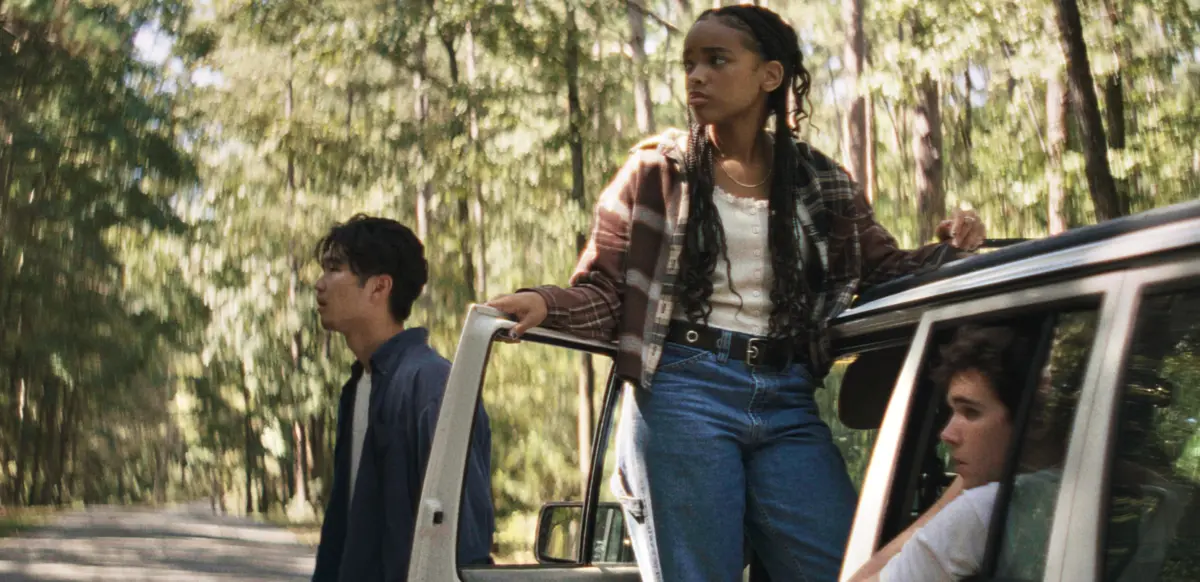
To understand It Ends is to chart a steady descent from conventional narrative tension into total, hypnotic abstraction. The film begins with a deceptive sense of momentum. Four close friends—James (Phinehas Yoon), Day (Akira Jackson), Fisher (Noah Toth), and Tyler (Mitchell Cole)—pile into a car, embarking on a drive that quickly devolves into an existential twilight zone.
Act I: The Illusion of Threat
The film’s opening sequence establishes the highest stakes the narrative will ever offer. Pulling off to the side of a mysterious, unending road, the protagonists step out into the wilderness. Almost immediately, they are swarmed by a hostile, aggressive mob of people emerging from the dense woods. A seizuriffic, flashing title card cuts across the screen, injecting a jolt of pure kinetic adrenaline into the viewing experience.
For a moment, it appears It Ends is positioning itself as a standard survival horror or folk-thriller. However, this eruption of danger is short-lived. The characters quickly adapt, identifying behavioral patterns to bypass subsequent ambushes. Once past this early threshold, external threats completely evaporate. As the vehicle presses deeper into the forest, the population thins out entirely. The occasional figures spotted in the distance are too profoundly dejected and apathetic to mount an attack, let alone generate genuine terror. The danger is replaced by a vast, suffocating emptiness.
The Middle Stretches: Hangout Horror and Absurdism
With physical threats neutralized, It Ends transitions into what director Alexander Ullom has self-referentially termed "hangout horror." The narrative shifts focus entirely to the vehicle’s interior, transforming the road trip into a stationary dialogue engine. Ullom has playfully noted that everything following the tense first act resembles a post-game interview with the traumatized family from Ari Aster’s Hereditary—minus the ritualistic sacrifice and family tragedies.
The characters are left to occupy their minds amidst endless hours of highway monotony. They debate existential hypotheticals, such as choosing whether they would rather be hunted or defended by 10,000 rats, 50 hawks, five gorillas, or a single man with a gun. As the days bleed into one another within this timeless purgatory, the conversation turns inward. The friends begin questioning whether they will eventually exhaust every conceivable thought the human mind is capable of generating.
This middle section relies heavily on the cadence of everyday conversation to maintain momentum. The car accumulates a layered archive of graffiti and in-jokes scribbled onto the upholstery, serving as a physical timeline in a dimension where time refuses to pass normally.
The Resolution: Embracing Inevitability
The title It Ends operates simultaneously as a thematic promise, an ironic punchline, and a narrative spoiler that the filmmakers actively encourage the audience to overlook until its final relevance strikes. Character arcs crystallize slowly. While characters like Day, Fisher, and Tyler occasionally resort to primal, therapeutic screaming matches to vent their mounting frustrations, James remains distinctively reserved. Sporting deadpan humor, James stubbornly insists that the journey must possess some underlying logic or structural purpose.
His refusal to participate in the collective psychological deterioration leads the narrative toward its inevitable, predictable, yet emotionally resonant conclusion. It is a cinematic journey that does not reward the viewer with supernatural revelations or plot twists; instead, it offers the quiet catharsis of acceptance.
Supporting Context & Metrics
Production Scale and Indie Distribution
Produced on a strict micro-budget, It Ends took an unconventional path to traditional theatrical distribution. Before securing its deal with Neon, the film worked its way through the independent festival circuit and served as an early launch title for the digital Letterboxd Video Store streaming platform. This grassroots origin story heavily informs its production design.
Directors of photography Evan Draper and Jazleana Jones faced a monumental challenge: maintaining visual interest while working with a singular, restrictive central visual motif—a car driving down an endless forest road. To combat visual fatigue, the cinematography relies on shifting natural lighting to indicate the passage of time, juxtaposing glaring midday sun against moody twilight hues. In select sequences, extreme close-ups of the asphalt transform the road itself into abstract geometric patterns, turning mundane tarmac into dynamic visual art.
The Gen Z Reception and Pandemic Metaphors
It Ends arrives at a unique cultural crossroads. Its thematic exploration of entrapment, cyclical monotony, and forced proximity invites unavoidable parallels to the COVID-19 pandemic lockdowns. For younger audiences—particularly Gen Z viewers encountering these existentialist concepts for the first time on the silver screen—the impact of the film is expected to be profoundly polarized.
While older, more seasoned cinephiles may recognize the film’s structural DNA as a cinematic cousin to Jean-Paul Sartre’s No Exit or Samuel Beckett’s Waiting for Godot, younger demographics are likely to react more viscerally. The simplicity of its concept bridges the gap between the existential absurdity of Groundhog Day (stripped of its feel-good moral arc) and the bourgeois entrapment of Luis Buñuel’s The Exterminating Angel (stripped of its vicious social satire).
Official Statements and Industry Insights
The marketing campaign for It Ends has leaned heavily into comparisons with viral horror milestones, a strategy actively supported by industry players.
- The Backrooms Connection: Speaking in public forums and fan spaces, Backrooms director Kane Parsons openly compared the eerie, unmoored atmospheric vibe of It Ends to his own viral creations. Neon capitalized on this momentum, spotlighting producer Chris Ferguson—who worked on both projects—to bridge the gap between internet-born digital horror and traditional theatrical releases.
- Redefining the Genre: In interviews surrounding the festival release, director Alexander Ullom explicitly rejected traditional horror categorizations, championing the term "hangout horror." Ullom noted that the film was designed to test the limits of audience patience, subverting standard genre expectations by trading adrenaline rushes for long-form character dynamics.
- MPA Ratings Rationale: The Motion Picture Association (MPA) official rating descriptor for It Ends lists only "pervasive language," entirely omitting notes on violence, gore, or terror. This administrative detail serves as an official indicator of the film’s subversion of traditional horror tropes, cementing its status as a psychological and conversational experiment rather than a slasher flick.
Future Outlook
Despite yielding a mixed critical reception characterized by neutral-to-mildly-positive reviews, It Ends marks a significant stepping stone for its creative team. The film proves that Alexander Ullom possesses a strong grasp of mood, pacing, and visual abstraction on a shoestring budget.
Industry watchers have already turned their attention to Ullom’s next major collaboration with Neon: a death-game horror feature titled 4 x 4: The Event. While It Ends may not achieve the instant, ubiquitous zeitgeist phenomenon status of Curry Barker’s Obsession or serve as a bombastic directorial showcase like Kane Parsons’ Backrooms, it carves out a respectable, highly specific niche.
For viewers willing to embrace its unhurried pace, lack of neat resolutions, and deep-seated commitment to theatrical absurdism, It Ends is an uneven yet undeniably fascinating ride. It establishes Ullom as a filmmaker willing to challenge audience expectations—a promising trait for a director stepping into bigger-budget arenas.





Comments
Facebook App ID not configured. Please add it in the Customizer.