
Executive Overview
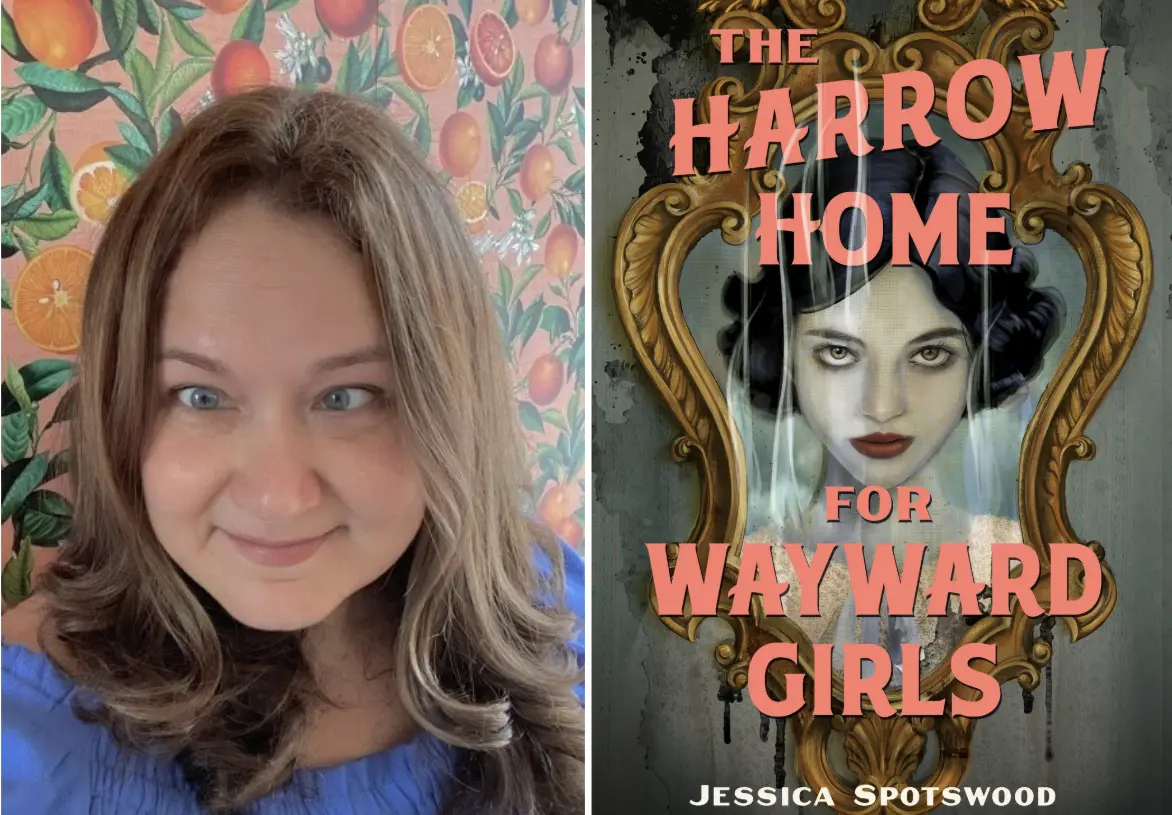
Best known for her captivating Cahill Witch Chronicles, critically acclaimed young adult author Jessica Spotswood returns with an atmospheric new novel that bridges the gap between historical fiction and the supernatural. Out August 25 via Holt, The Harrow Home for Wayward Girls transports readers to the post-World War II era, expertly blending paranormal phenomena with the complex emotional landscapes of institutional history.
The narrative centers on 17-year-old Grace Harrow, whose family dynamic shifts dramatically when her parents sell their family-run maternity home to a wealthy hotelier. The transaction includes continued employment for the Harrows and introduces the hotelier’s enigmatic 17-year-old daughter, Rose Thorpe. As Grace and Rose quickly discover that they are both being haunted by the persistent apparition of an unknown girl, the two teenagers forge an unlikely alliance to investigate the dark, checkered past of the establishment.
In a wide-ranging, exclusive interview with Publishers Weekly, Spotswood peels back the layers of her latest literary offering. She discusses how deeply personal life transitions—including her family’s journey as foster parents in Washington, D.C., and her father’s battle with vascular dementia—informed the book’s emotional core. Furthermore, Spotswood reflects on her day-to-day work as a children’s library associate at the D.C. Public Library, the meticulous historical research required to authentically anchor a fictionalized Maryland town in the post-war mid-20th century, and her preference for collaborative creative processes over isolated writing.
Read Also
Detailed Chronology: From Personal Upheaval to Page
To fully understand the emotional architecture of The Harrow Home for Wayward Girls, one must trace the timeline of its creation, which began amid profound personal and professional milestones for its author in 2021.
The Genesis in 2021: Fostering and Family Caregiving
When Spotswood initially set pen to paper for this manuscript, her domestic life was undergoing significant transformation. She and her husband were actively serving as foster parents in Washington, D.C. Rather than immediately pursuing adoption, the couple chose to support family reunification efforts and provide critical respite care for children in transition.
Concurrently, Spotswood faced a heart-wrenching domestic challenge: her father developed vascular dementia, experiencing a sharp and rapid cognitive decline. This dual reality of caring for vulnerable children while watching a beloved parent fade forced the author to temporarily step away from her manuscript. However, when she returned to the project, her perspective on generational relationships had fundamentally shifted. The nuanced, complex dynamics between Rose Thorpe and her father in The Harrow Home for Wayward Girls directly mirror Spotswood’s emotional processing of her father’s illness.
Observing Community Resilience Post-Pandemic
Simultaneously, Spotswood’s role as a children’s library associate at the D.C. Public Library placed her on the front lines of urban community struggles. As the world navigated the turbulent social aftermath of the COVID-19 pandemic, she bore witness to families grappling with systemic hardships:
- Homelessness and housing instability
- Domestic violence and trauma
- Mental illness and neurodivergence
- Financial insecurity and systemic poverty
- Incarceration and familial separation
- Teen pregnancy and substance reliance
These daily encounters heightened Spotswood’s empathy and sharpened her creative focus. She became intensely invested in exploring the intricate dynamics of adoption, probing the psychological spaces shared by adoptees, biological parents, and adoptive parents.
Historical Deep Dive: Uncovering the Reality of Maternity Homes
Driven by her library experiences and contemporary thematic interests, Spotswood embarked on an extensive historical investigation. She researched the trajectory of mother and baby homes spanning from the late 19th century through the 1960s. Her research yielded a sobering realization: these institutions did not vanish into the annals of history. Spotswood noted a notable resurgence in Florida-based maternity homes following the legal repeal of Roe v. Wade, proving that the socio-economic vulnerabilities driving young women into such facilities remain an urgent, ongoing reality.
Supporting Context & Metrics: Reconstructing Post-WWII Maryland
To bring a tactile, sensory authenticity to The Harrow Home for Wayward Girls, Spotswood’s world-building relies on rigorous primary-source research and meticulous attention to period detail.
Small-Town Geography and Primary Sources
Although the town where Grace Harrow resides is a fictional creation, its cultural and geographical blueprint is drawn from real, small rural communities nestled along the eastern shore of Maryland. To capture the cadence of life in this region during the post-WWII era, Spotswood turned to authentic historical archives, focusing heavily on the Easton Star-Democrat, a historic eastern Maryland newspaper.
Rather than relying solely on major historical milestones, Spotswood dove deep into the micro-history of local journalism:
- Social Column Chronicles: Old newspapers dedicated substantial column inches to routine social calls—such as local residents gathering for a game of bridge. Spotswood found charm and authenticity in these mundane human interactions.
- Wholesome Community Bulletins: She uncovered historical gems, such as a local advisory instructing townspeople to peer into the newspaper office window to inspect a rare three-headed squash brought in by a local farmer.
- Agricultural Cues: By tracking historical mentions of seasonal crops, Spotswood aligned Grace’s mother’s baking and household planning with authentic mid-Atlantic agrarian rhythms (e.g., timing chapters around the local strawberry harvest).
Sensory Immersion: Decor, Fashion, and Material Culture
Spotswood’s dedication to historical fidelity extends far beyond newspaper clippings. She conducts deep-dive research into mid-20th-century home decoration, domestic technology, and period fashion. Her goal is to craft a setting so palpably tactile that readers feel anchored to a specific geographic coordinate and historical moment. By infusing the prose with authentic sensory details—from the texture of post-war fabrics to the specific layout of a rural maternity home—Spotswood ensures the setting functions as an active participant in the narrative rather than mere background scenery.
Official Statements & Reflections: The Author Speaks
In her conversation with Publishers Weekly, Spotswood offered profound insights into her writing methodology, her unexpected path to librarianship, and her philosophy on creative collaboration.
On the Dual Realities of Library Work
Many aspiring writers romanticize the idea of working in a library, assuming it affords endless hours of quiet reading. Spotswood is quick to disabuse people of this notion, explaining that modern libraries function much more like bustling community centers.
Reflecting on her transition to librarianship after publishing her debut novel, Born Wicked, in 2012, Spotswood shared:
"After my first book came out in 2012, I wrote full time for a couple of years. But I found that I really needed a schedule—and, prosaically, health insurance—that forced me to go out into the world more. Some people… are so good at being self-disciplined. I am not. I thought a part-time job would get me what I needed. Working at a library is not what I thought it would be. People are like, ‘It must be so nice to read all day.’ That does sound like it would be nice, but that is not what we do. Libraries now are so much like community centers."
Her lifelong relationship with libraries began early. As a second grader reading Louisa May Alcott’s Little Women, a hesitant librarian questioned whether she could handle such a massive tome, to which a young Spotswood firmly replied, "I absolutely do want that."
On Creative Isolation Versus Collaboration
While many authors carve out strictly isolated writing spaces to protect their creative vision, Spotswood embraces a radically different, highly social approach to craft. Her background in theater history and criticism—alongside her professional work as a theatrical dramaturg—laid the groundwork for a career defined by teamwork.
This collaborative instinct manifests in her co-writing projects (such as Great or Nothing) and her editorial work on anthologies (A Tyranny of Petticoats, The Radical Element, Toil & Trouble). It also hits close to home: her husband is acclaimed mystery author Stephen Spotswood.
"Drafting on my own is difficult. I love getting feedback. I know some people write their manuscripts in isolation because they want a protected space, but that is not me. It’s really useful having a husband who is also a writer because every time I finish a chapter I’m like, ‘Read this.’ I think I’ve always been pretty collaborative… I love working with others to take stories to the next level."
Future Outlook
As the August 25 release date from Holt approaches, The Harrow Home for Wayward Girls is poised to captivate both loyal fans of Spotswood’s paranormal catalog and new readers drawn to historical mysteries with social depth.
By grounding supernatural elements—such as the haunting apparition shared by Grace and Rose—in the very real historical traumas of institutionalized women and marginalized families, Spotswood bridges the gap between genre thrills and resonant social commentary. The novel underscores the enduring resilience of young women navigating oppressive systems, a theme that resonates just as powerfully in the post-WWII era as it does today.
Looking ahead, Spotswood’s dual career as a community-centered librarian and a prolific YA author ensures that her work will continue to draw inspiration from the raw, authentic complexities of human relationships. As she balances her ongoing work at the D.C. Public Library with future literary projects, her unique blend of meticulous historical research, theatrical collaboration, and deep-seated empathy guarantees that her voice will remain a vital fixture in contemporary young adult literature.





Comments
Facebook App ID not configured. Please add it in the Customizer.