
Executive Overview
By the spring and summer of 2025, the smartphone had cemented its status as an omnipresent tether. For millions, the pocket-sized slab of glass functioned simultaneously as a vast library, a slot machine, a navigation system, a leash, and an alarm clock. It extended human capacities while steadily eroding psychological resilience. Yet, amid the warp-speed acceleration of artificial intelligence, algorithmic feeds, and data capture, a countercultural resistance quietly took root.
In late 2024 and throughout 2025, New York City emerged as the epicenter of a burgeoning "neo-Luddite" scene. Comprising independent technologists, artists, writers, gig workers, and disillusioned Gen-Z and millennial organizers, this decentralized coalition began mobilizing against the corporate enclosure of public life. Rather than advocating for primitive isolationism, today’s neo-Luddites are engaged in a prefigurative, cultural project. Their mission is to reclaim collective agency, foster unmediated human connection, and challenge the extractive architecture of Big Tech through unpredictable, participatory public events.
Detailed Chronology: From Digital Fatigue to the Streets of Manhattan
The Tipping Point: Fall 2024 to Winter 2025
The movement’s modern resurgence began in the interstices of trend pieces covering Gen-Z "phoneless parties" and the resurgence of dumbphones. Observers began to notice a deeper ideological current: young people organizing to divest from major technology platforms and reconstruct physical community.
Read Also
In November 2024, a panel discussion titled "Should We Get Off?" was advertised on the local listings website RedCal and hosted in the basement of a Midtown Manhattan mall. Organized by figures like Nick Plante, the event drew roughly ninety attendees who willingly placed stickers over their phone cameras. The conversation bridged tech-thoughtful critique with radical disengagement, but the true impact occurred afterward. Participants were guided through intimate group discussions regarding how technology shaped their daily existence—a rare participatory inquiry into decades of digital transformation.
The Apple Cube Rally: Winter 2025
By the depth of winter, the scene’s theatrical wing escalated its tactics. An event designated S.H.I.T.P.H.O.N.E. #3: GNOME ON THE CUBE brought neo-Luddites to the perimeter of the Fifth Avenue Apple store. While tourists and shoppers transfixed themselves on a dancing humanoid robot deployed by a tech demonstration outside the glass structure, Luddites gathered in a nearby park.
Adorned in handmade paper gnome hats—a deliberate homage to the Polish anti-authoritarian resistance movement The Orange Alternative—participants engaged in spontaneous public rituals. Attendees publicly deleted social media and AI applications, delivered soapbox speeches, and ceremonially smashed an iPad with a sledgehammer. Led by chanters in combat boots, the crowd marched across the street to encircle the Apple Store. Accompanied by the brass stylings of the Rude Mechanical Orchestra, hundreds of participants danced maniacally around the cube, invoking a visceral sense of "collective effervescence."
The Summer of Ludd: June 2025
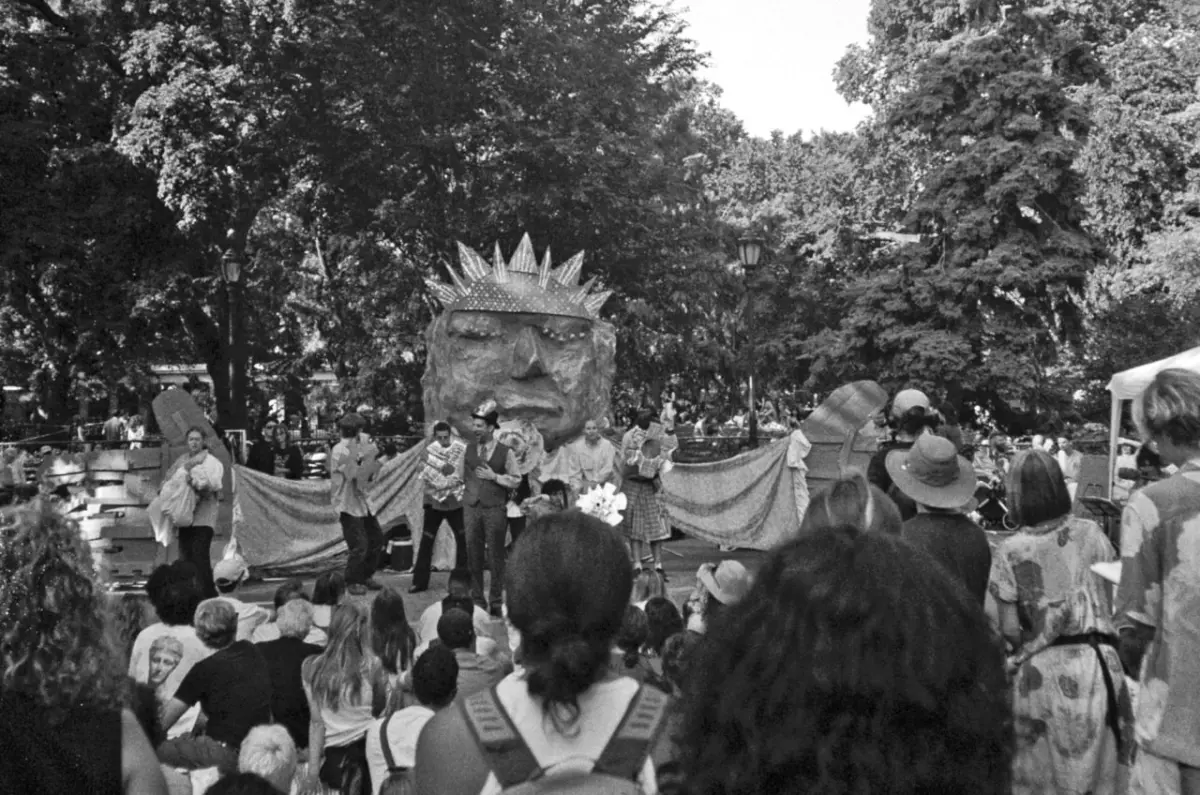
The movement reached a major milestone at the end of June 2025 with the launch of the Summer of Ludd festival in Tompkins Square Park. Forsaking social media advertising in favor of wheatpasting, flyering, and an analog hotline, organizers produced a weeklong festival featuring over 120 free public events. The opening day featured a public play written by filmmaker Amanda Hanna-McLeer, dramatizing the historical struggles of 19th-century English textile workers alongside modern tech oligarchs. The performance encapsulated the movement’s central historical irony: the direct lineage connecting the original machine-breakers to Ada Lovelace, the pioneering technologist whose computational breakthroughs were inspired by the very looms her father defended.
Supporting Context & Metrics: The Scale of the Digital Enclosure
To understand the urgency driving the neo-Luddite movement, one must examine the staggering metrics of modern screen dependency:
- Screen Time Realities: The average American spends approximately 50 hours per week looking at screens, with 16 of those hours dedicated strictly to social media platforms.
- Algorithmic Consumption: Global statistics indicate that the average TikTok user consumes upwards of 100,000 short-form videos annually.
- Lifelong Exposure: Projections for individuals born in 2025 estimate that they will spend an accumulated 21 years of their lifetimes gazing at glowing displays.
- Public Resistance: Reflecting a broader anti-tech sentiment that spans the political spectrum, polling data from Gallup in 2026 revealed that seven out of ten Americans actively oppose the construction of AI data centers within their local communities.
Furthermore, the philosophical underpinnings of the movement draw heavily on critical theory. As scholar Bogna Konior’s "Dark Forest Theory of the Internet" suggests, the digital realm operates less like a neutral tool and more like an alien terraforming project—requiring immense physical infrastructure, including undersea cables, server farms the size of Manhattan, and militarized supply chains—while fundamentally altering human behavior.
Official Statements and Movement Perspectives
Unlike traditional political lobbying groups, the New York neo-Luddite network eschews conventional legislative petitions in favor of cultural re-enchantment. Their philosophy was articulated during interviews with core organizers and artist-activists operating under pseudonyms such as Captain Ludd, General Ludd, Skeleton Ludd, and Lighthouse Ludd, alongside their spokes-puppet, Gowanus.
Reclaiming Commonality
According to Captain Ludd, the movement’s opposition is not directed at technology qua technology, but rather at the social costs and alignment of Big Tech with authoritarian control systems. Referencing historical precedents such as IBM’s early-20th-century data classification systems used by the Nazi regime, organizers argue that data collection and artificial intelligence represent an intensification of legibility—the precise precondition required for state surveillance, ranking, and control.
Shifting from Consumer to Producer Organizing
Damian Thomas, a technologist and co-creator of platforms designed to help users exit social media, emphasized that platform addiction is not merely a consumer failing, but a structural trap.
"People aren’t on Instagram because they love it as a social media platform," Thomas noted. "They’re there because their friends, shows, events, political updates, artists, and creative communities have all been pushed there. That is not a consumer problem; that is a producer problem."
Thomas and fellow organizer Nick Plante—founder of the NYC Off Tech newsletter—argue that political reform flows downstream from culture. By building grassroots infrastructure and hosting unmediated, face-to-face encounters, the movement aims to restore the social muscles required for reciprocal, community-driven life.
Future Outlook: The Horizon of Anti-Tech Resistance
As the neo-Luddite scene matures beyond its initial pockets of Manhattan and Brooklyn, it faces critical structural questions. Navigating issues of accessibility for the time-poor, the socially anxious, and disabled individuals remains an ongoing challenge. Moreover, maintaining a big-tent ideological framework that bridges left-wing anti-capitalism with populist skepticism toward corporate monopolies will determine whether the movement can scale sustainably.
Yet, the prefigurative strategy employed by these organizers offers a profound blueprint for modern resistance. By demonstrating that unmediated life is not only possible but deeply joyful, the neo-Luddites are challenging the presumed inevitability of digital totalitarianism. Whether through the theatrical staging of historical worker rebellions or simply choosing to navigate a city street without consulting a glowing pane of glass, this coalition is carving out a vital space for human autonomy in an increasingly automated world.




Comments
Facebook App ID not configured. Please add it in the Customizer.