
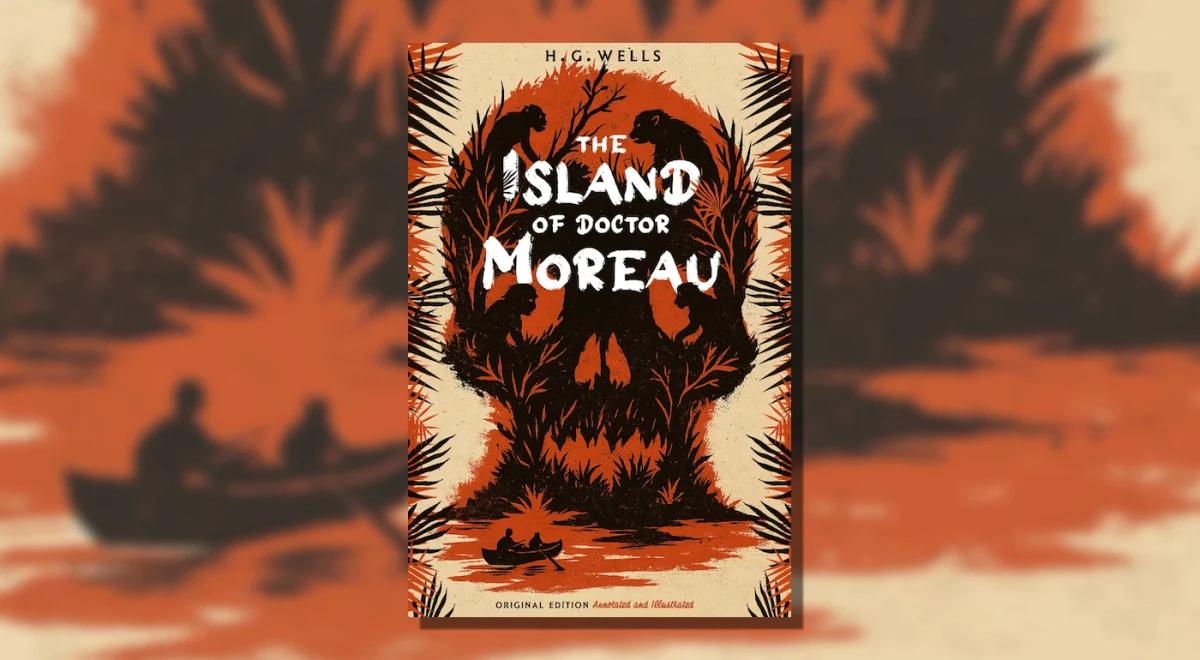
Executive Overview
The descent into the dark heart of H.G. Wells’s 1896 masterwork, The Island of Doctor Moreau, reaches a terrifying and intellectually volatile apex in Chapters 13 through 15. As the protagonist, Prendick, navigates his harrowing encounter with the island’s creator and its tragic, hybridized populace, the narrative shifts from a survival horror ordeal into a deeply unsettling philosophical treatise. Wells’s text challenges the boundaries of scientific hubris, the phenomenology of pain, and the ethical elasticity of early biological experimentation.
This installment of our ongoing critical series, Reading the Weird, examines the convergence of science, theology, and monstrosity within Moreau’s tropical enclave. Through a rigorous breakdown of Prendick’s confrontation at the shoreline (Chapter XIII: A Parley), Moreau’s clinical and chillingly calm rationalization of vivisection (Chapter XIV: Doctor Moreau Explains), and Montgomery’s ethnographic cataloging of the Beast Folk (Chapter XV: Concerning the Beast Folk), this analysis exposes the disturbing underpinnings of an experiment that sought to rewrite the blueprint of sentient life.
Detailed Chronology
Chapter XIII: A Parley
The sequence of events opens with high tension as Prendick, fleeing the inland horrors of the enclosure, races back toward the safety of the shoreline. Driven by a desperate need to break into Moreau’s compound and secure a lethal weapon, Prendick finds his path blocked. Emerging unexpectedly from the jungle foliage are Moreau, his ferocious staghound, Montgomery, and two formidable Beast Men. Recognizing that an inland retreat is impossible, Montgomery and Moreau close in, both wielding heavy, authoritative whips.
Read Also
Faced with the immediate prospect of capture and the horrifying likelihood of being subjected to Moreau’s surgical knife, Prendick chooses a stark alternative: he wades into the ocean, preferring the finality of drowning to the unthinkable indignity of being transformed into a beast. As additional Beast Men—including M’Ling and the Ape-Man—converge on the beach, Moreau commands Prendick to be silent. Instead, Prendick turns his desperation outward, addressing the Beast Men directly. He shouts warnings, asking if they are blind to the fact that Moreau and Montgomery have infected them with a "bestial taint." He points out the fundamental irony of their subjugation: though the Beast Men live in terror of their tormentors, Moreau and Montgomery are themselves vastly outnumbered and deeply afraid of their creations.
For a chilling moment, the Beast Men hesitate, listening intently as if struggling to dredge up fragments of a forgotten human past. When Prendick’s voice finally fails him, Moreau steps forward, offering a chillingly detached assessment in "school-boy Latin," reminding the audience that these entities are not human souls, but mere animals subjected to a mechanical, humanizing process.
Prendick dismisses the rationalization as a "pretty story," prompting Moreau to defend his position: he did not lure humans to the island, and had the Beast Men truly wished to kill him while he was drugged, they had ample opportunity. To prove his lack of immediate malice, Moreau and Montgomery lay down their revolvers and retreat toward the treeline. Prendick seizes the abandoned firearms as a form of "insurance" and agrees to hear Moreau out. As he follows his hosts back to the compound, he casts a lingering glance at the Beast Men, noting that while they were undeniably animals once, he has witnessed something entirely unprecedented: animals attempting the arduous, agonizing labor of thought.
Chapter XIV: Doctor Moreau Explains
Seated safely in Prendick’s designated "guestroom," Moreau initiates what can only be described as a masterclass in psychological and physiological conditioning. Prendick remains on high alert, sitting as far away as possible while keeping the captured revolvers firmly gripped in his hands. Yet, as Moreau’s lecture unfolds, the doctor’s presentation is so intellectually compelling, systematic, and devoid of raw malice that Prendick is suddenly overcome with "hot with shame at [their] mutual positions."
Moreau outlines the vast, terrifying potential of a skilled vivisector operating on living tissue. He touches upon historical and practical procedures—amputations, tongue-cutting, tissue excisions, and skin grafting to correct traumatic injuries. He asserts that modern surgical intervention can transcend single-body limits through the grafting of disparate animal parts, biochemical modifications, blood transfusions, and joint rearticulations. Furthermore, Moreau explains that minds are malleable constructs that can be fundamentally altered via hypnotism, the systematic suppression of inherent instincts, and surgical modifications to the vocal apparatus designed to permit human speech and rudimentary indoctrination.
Prendick’s moral revulsion centers primarily on the subject’s suffering. Moreau, however, reveals himself to be "differently constituted." He argues that pain is neither universal across all living tissue nor uniformly felt across all biological organisms. The more intelligent an organism becomes, and the more capable it is of perceiving environmental danger independently of pain signals, the more it evolves away from relying on pain as a primary warning mechanism.
Expanding on his worldview, Moreau positions himself as a deeply religious man—arguing that "any sane man must be." In Moreau’s twisted theology, the immense importance that ordinary men and women place on pleasure and pain is nothing more than "the mark of the beast upon them." To Moreau, earthly emotions and suffering are trivial markers of low-tier existence, belonging only to creatures that "wriggle in the dust." On this isolated island, free from societal interference, Moreau has finally unlocked "true research" and the "strange, colorless delight of these intellectual desires."
He admits to failures: subjects he thought fully humanized have backslid into savagery. He recounts how a limbless "Thing" slaughtered fellow subjects, drove away or murdered his original Kanaka servants, and was eventually destroyed itself. Yet, Moreau vows to persevere until he maps the absolute limits of living flesh and successfully manufactures an entirely rational creature of his own design—casting a speculative gaze toward the captive puma currently languishing in his laboratory.
When asked if he still fears his host, Prendick finds himself disarmed by Moreau’s physical presence, noting "a touch almost of beauty that resulted from his set tranquility and his magnificent build." Shuddering, Prendick offers to return the revolvers, an offer Moreau calmly waves away, telling him to keep them.
Chapter XV: Concerning the Beast Folk
In the wake of Moreau’s chilling lecture, Prendick deepens his understanding of the island’s populace through extended conversations with Montgomery. Montgomery, having lived alongside the creations for years, regards them as "almost normal human beings," often expressing a preference for their company over the crude sailors he encounters during rare trips off the island.
When questioned about how Moreau and Montgomery manage to prevent the Beast Folk from tearing each other—and their masters—apart, Montgomery points to two primary factors: their "limited mental scope" and the "fixed ideas" surgically and hypnotically implanted by Moreau to suppress their baser animal instincts. The community is bound by a strict social code known as "the Law," a concept seemingly adapted from a missionary-minded Kanaka servant. The Beast Folk adhere to the Law far more rigorously during the daylight hours than under the cover of darkness, though the pervasive, existential dread of the "House of Pain" remains the ultimate deterrent.
Montgomery reveals the sheer scale of the enterprise: Moreau’s total creations number approximately 120, with roughly 60 survivors currently roaming the island, excluding the smaller, unhumanized monstrosities. While some pairs produce offspring, these children do not inherit their parents’ acquired human traits; instead, they are born as wild animals, forcing Moreau to capture and re-humanize the survivors. A persistent demographic imbalance—specifically a disproportionate number of males—introduces constant friction and social instability within the community.
Physically, the Beast Folk bear the unmistakable hallmarks of their unnatural genesis. They typically feature disproportionately long torsos, stunted legs, forward-jutting heads, and awkward spinal curvatures. Their facial structures and hands exhibit a grotesque variety of deformities. Among the most dangerous and prominent are the Leopard-Man who previously stalked Prendick and a vicious Hyena-Swine hybrid. Other notable inhabitants include the Sayer of the Law, the Ape-Man, M’Ling (a hybrid blend of bear, ox, and dog), an ape-goat "satyr," multiple bull-creatures, four Swine-people, a mare-rhinoceros, various wolf-hybrids, a bear-bull, a Saint-Bernard-Man, a collection of dappled youths, and a sluggish sloth-creature. Prendick develops a particular aversion to an odiferous "old woman" synthesized from fox and bear DNA.
As weeks pass, Prendick’s initial visceral horror mellows into a numb, utilitarian acceptance akin to Montgomery’s worldview. A Bull-Man begins to resemble an honest laborer returning home from the fields; a Fox-Bear looks remarkably like a shifty-faced pedestrian caught in a crowded city alleyway. Yet, the illusion is fragile. Periodically, the "beast would flash out upon [him]," as demonstrated when he encounters a female figure swathed in modest white garments, seemingly possessing an exaggerated regard for human decency—only for him to catch a sudden glimpse of slitted, predatory eyes and the sharp claw securing her modest attire.
Supporting Context & Metrics
To fully appreciate the scope of Wells’s narrative architecture, it is necessary to examine the socio-historical and literary frameworks that inform Moreau’s work:
- Publication Context: Serialized and published in book format in 1896, The Island of Doctor Moreau arrived at the height of late-Victorian anxieties surrounding evolutionary regression, imperial overreach, and the fierce public debate over animal experimentation.
- Demographic Metrics of the Island:
- Total Creations (Historical): ~120 subjects.
- Current Population: ~60 intelligent Beast Folk (excluding minor, unhumanized animal mutations).
- Gender Distribution: Heavily male-skewed, contributing to societal volatility and violations of the Law.
- Literary Precedent (Libronomicon): Moreau explicitly cites Victor Hugo’s L’Homme Qui Rit (The Man Who Laughs) as a historical precursor to his physiological modifications, referencing the fictional Comprachicos—a group of child-buyers who surgically altered human bodies for amusement and profit.
- Ideological Biases: The text reflects late-19th-century racial and social biases. Beast-men are frequently compared to marginalized human populations with casual abandon—such as Moreau describing his first successful creation as a "fair specimen of the negroid type." Furthermore, Prendick’s evolving lexicon shifts from recognizing individual traits to routinely dehumanizing the creations by referring to them as "it."
Official Statements & Critical Commentary
The philosophical weight of these chapters has generated extensive scholarly debate, notably captured in the dual commentaries of literary critics Ruthanna and Anne.
Ruthanna’s Commentary: The Aesthetics of Ruthlessness
Ruthanna critiques the romanticized notion of the "mad scientist," noting that Moreau transcends simple cartoon villainy. Moreau is not motivated by pedestrian malice or crude material gain; rather, he is driven by an unyielding, almost religious devotion to scientific inquiry. Comparing Moreau’s unwavering focus to comic-book antipodes like Magneto, Ruthanna highlights the chilling nature of pure intellectual clarity.
Drawing on Katherine Applegate’s definition of ruthlessness from Animorphs: The Reunion, Ruthanna observes that true ruthlessness is "not about being mean. It’s about seeing the bright, clear line that leads from A to B… and not caring about anything but the beautiful fact that you can see the solution." Moreau’s fatal flaw is not his attempt to "play God"—a misreading often applied to Shelley’s Frankenstein, whose true sin was maternal abandonment—but rather his profound sociopathy. By completely detaching himself from natural human empathy and social bonds, Moreau blinds himself to the variables of his own art, reducing divine creation to a sterile, frustrating exercise in mechanical engineering.
Anne’s Commentary: The Ethics of Vivisection and the Burden of Pain
Anne approaches the text through the lens of modern animal ethics, contrasting Moreau’s academic rationalizations with visceral modern horrors, such as online videos of captive amphibians subjected to physical torment for digital engagement. Anne notes that Moreau’s calm assertion that "the study of Nature makes a man at last as remorseless as Nature" forces both Prendick and the reader to confront uncomfortable questions regarding the utility of suffering.
Anne contextualizes Wells’s personal evolution regarding vivisection. While early reviewers like zoologist P. Chalmers Mitchell condemned Moreau as a cheap anti-vivisectionist cliché, Wells’s later writings—such as his 1927 New York Times article—clarify that his critique was never aimed merely at the infliction of physical pain, but rather at the cold, methodical detachment of the scientific mind. Wells observed that anti-vivisectionists often hypocritically accept the wider subjugation and slaughter of animals for food, reserving their moral outrage specifically for the clean-handed researcher wielding a scalpel. Ultimately, Moreau’s downfall is not merely his cruelty, but his inability to recognize that empathy and pain are intrinsic components of the human condition he desperately seeks to manufacture.
Future Outlook
As Reading the Weird continues its exploration of H.G. Wells’s seminal nightmare, the fragile social order constructed by Moreau—held together only by the hypnotic terror of the Law and the threat of the House of Pain—stands on the precipice of total collapse. The friction between the island’s male-dominated demographic, the persistent backsliding of humanized subjects into primal savagery, and Prendick’s precarious neutrality guarantees that the delicate veneer of civilization on the island cannot hold.
In our next installment, the series pivots toward contemporary weird fiction, examining C.T. Muchemwa’s award-winning short story "The Inheritance." As featured in Fiyah Issue 33 and The Best Weird Fiction of the Year, Volume 2, Muchemwa’s work promises to test our understanding of legacy, choice, and cosmic consequence. Readers are encouraged to catch up on the text ahead of next week’s deep dive.


Comments
Facebook App ID not configured. Please add it in the Customizer.