Yayoi Kusama, the visionary architect of infinity who transformed personal trauma and profound psychological trials into a universally celebrated aesthetic lexicon, passed away on August 14 at a hospital in Tokyo. She was 97 years old. Her death, resulting from multiple organ failure, was first reported by Kyodo News and subsequently confirmed by her longtime representative, gallerist David Zwirner.
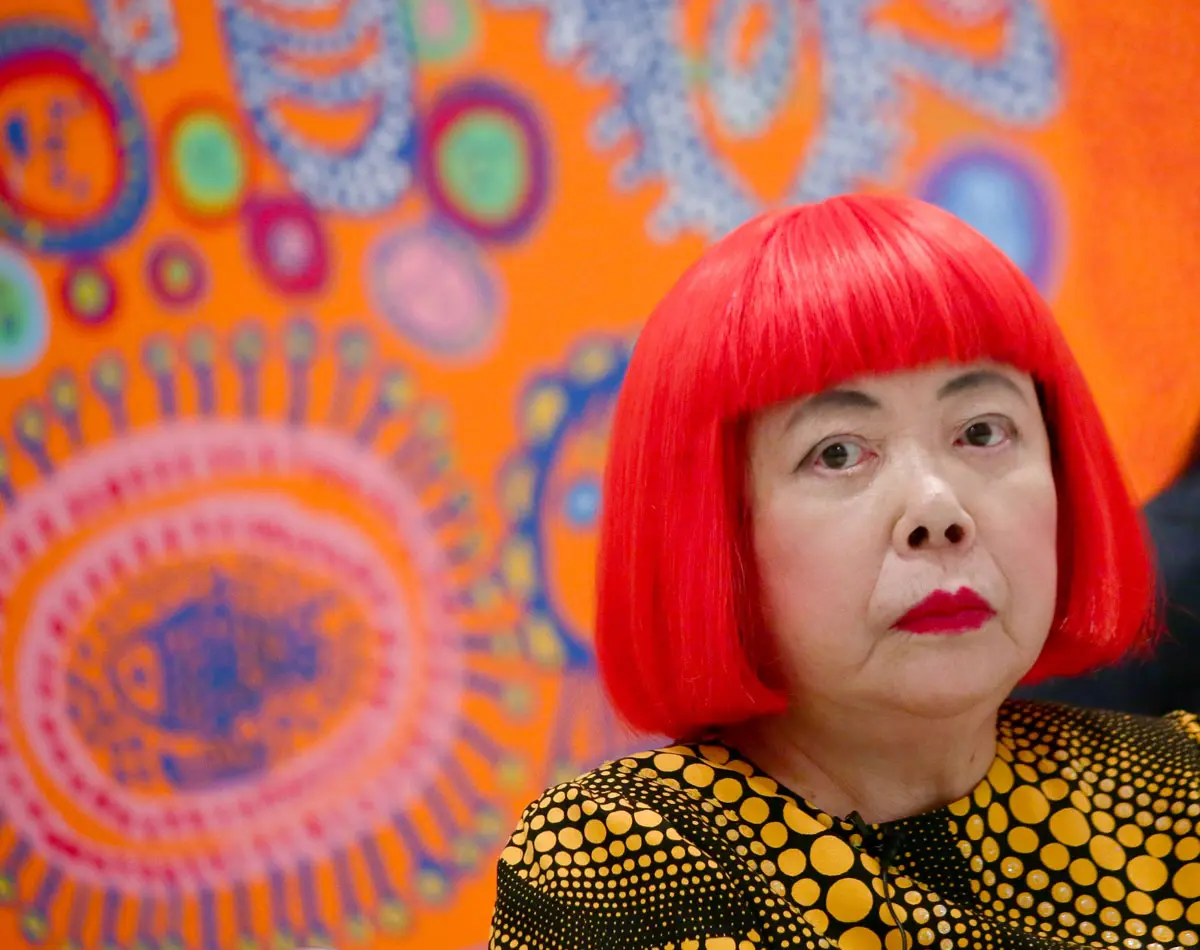
For more than seven decades, Kusama defied artistic boundaries, moving fluidly between painting, sculpture, immersive installation, performance art, literature, and high fashion. With her signature bob haircut, polka-dotted garments, and mesmerizing mirrored environments, she transcended the traditional boundaries of the contemporary art world to become a cultural phenomenon. At the time of her passing, she held the undisputed title of the world’s most famous living artist—a global brand onto herself, and arguably the most influential figure to emerge from postwar Japan.
Her obsessive repetitions of dots, nets, and phallic forms were not merely stylistic choices; they were survival mechanisms. Born from the vivid, terrifying hallucinations she experienced as a young child in rural Japan, Kusama’s art provided a way to process her internal world and project it onto a grand, cosmic scale. In doing so, she carved out an indelible space in modern art history, shifting the paradigms of avant-garde practice from mid-century New York to the global stage of the twenty-first century.
Detailed Chronology: From Matsumoto to the Global Stage
Formative Years in Nagano and the Genesis of the Dot
Born on March 22, 1928, in Matsumoto, Nagano Prefecture, Kusama was the youngest of four children in an affluent family that operated a commercial seed nursery. Her early life, however, was far from idyllic. Raised in a turbulent household marked by her father’s infidelities and an emotionally abusive mother who frequently forced young Yayoi to spy on her husband, Kusama began experiencing severe visual and auditory hallucinations.
As she later recounted, the world would suddenly dissolve into flashes of light, auras, or dense fields of dots that consumed her vision. Animals and flowers seemed to speak to her, and the patterns on tablecloths would detach and multiply across the walls. To cope with the sheer terror and intensity of these episodes, Kusama turned to drawing. At age 10, she created a striking portrait of her mother set against a turbulent sea of polka dots—a foundational motif that would eventually engulf frames, rooms, and entire architectural structures.
Seeking an escape from domestic strife and the conservative expectations of provincial Japanese society, Kusama enrolled at the Kyoto Municipal School of Arts and Crafts in 1948 to study nihonga, a traditional style of Japanese painting. Though she held her first solo exhibition in Matsumoto in 1952 and continued to exhibit locally, she quickly grew suffocated by the rigid constraints of Japan’s postwar art establishment.
A pivotal turning point arrived when Kusama chanced upon a book of paintings by American artist Georgia O’Keeffe. Boldly, the young Japanese artist tracked down O’Keeffe’s address in New York and mailed her a letter accompanied by several watercolors, asking for professional guidance. To Kusama’s astonishment, O’Keeffe replied with words of encouragement. Buoyed by this transatlantic validation, Kusama made the momentous decision in 1957, at the age of 28, to leave Japan for the United States, carrying little more than sixty silk kimonos—which she later cut up to sell—and a cache of her own drawings.
The New York Avant-Garde and the "Infinity Nets"
After a brief stopover in Seattle, Kusama settled in Manhattan during the late 1950s—a period of intense artistic ferment dominated by Abstract Expressionism. Living in freezing, unheated lofts and struggling to secure basic sustenance, Kusama maintained a prodigious output, channeling her anxieties into her work.
It was during this crucible of poverty and ambition that she birthed her legendary "Infinity Nets" series. These vast, monochromatic canvases—covered edge to edge with minute, obsessive, hand-painted loops of pigment—defied the masculine bravado of the New York school with their hypnotic, meditative scale. When shown at New York’s Brata Gallery in 1959, the paintings stunned critics and peers alike.
Donald Judd, then an emerging artist and astute critic, praised Kusama’s work in the pages of ARTnews, eventually purchasing one of her paintings. Other luminaries, such as Frank Stella, took notice. Through these monumental works, Kusama articulated her philosophy of "self-obliteration"—the psychological dissolution of the ego where the artist, and ultimately the viewer, becomes one with the infinite universe.
Happenings, Narcissus Garden, and Political Protest
By the mid-1960s, Kusama’s practice expanded beyond the two-dimensional canvas into immersive environments and provocative performances, or "happenings." In 1965, she debuted Infinity Mirror Room—Phalli’s Field, a mirrored chamber populated by soft, bulbous, phallic sculptures covered in red polka dots. The mirrors multiplied the objects and the viewer ad infinitum, laying the groundwork for the immersive installations that would later define her legacy.
Operating against the backdrop of the Vietnam War and escalating countercultural movements, Kusama staged guerrilla-style performances across New York landmarks, including the Museum of Modern Art and Wall Street. Often featuring nude participants whose bodies she painted with polka dots, these "Love Happenings" were designed to protest war, social conformity, and sexual repression.
Her penchant for institutional critique reached a fever pitch in 1966 at the 33rd Venice Biennale. Uninvited by the official organizers, Kusama staged an unauthorized intervention titled Narcissus Garden. She arranged 1,500 reflective silver plastic spheres on a lawn outside the Italian Pavilion, placing a sign that read: "YOUR NARCISSISM FOR SALE." She proceeded to sell the spheres to passersby for $2 each until Biennale authorities, scandalized by her commercialization and unsanctioned occupation of space, forced her to stop. The gesture remains a masterclass in conceptual art, brilliantly mocking the art world’s commodification of beauty.
Repatriation, Literary Pursuits, and International Rediscovery
Exhausted and physically depleted by the relentless pace of her New York life, Kusama returned to Japan in 1973. The transition was agonizing. Japan in the 1970s was ill-prepared for her radical, boundary-pushing oeuvre; the media focused more on the sensationalized nudity of her American happenings than the conceptual rigor of her art.
Finding herself marginalized in her homeland, Kusama turned inward, channeling her creative energy into literature. Beginning with her semi-autobiographical debut novel, Manhattan Suicide Addict (1978), she published a prolific body of fiction, poetry, and short-story collections that explored themes of mental health, isolation, and mortality.
Her fortunes began to turn in the late 1980s. A significant retrospective organized by the Center for International Contemporary Arts in New York in 1989 reevaluated her pioneering role in the transition from Abstract Expressionism to Minimalism and Pop Art.
The crowning moment of her international rehabilitation arrived in 1993, when curator Akira Tatehata selected Kusama to represent Japan at the 45th Venice Biennale. Twenty-seven years after being chased off the lawn with her silver spheres, Kusama returned as the official occupant of the Japanese Pavilion, dazzling international audiences with a mirrored room filled with cascading yellow pumpkins and black polka dots. A massive 1998 museum retrospective—Love Forever: Yayoi Kusama, 1958–1968—traveled from Los Angeles to New York, Minneapolis, and Tokyo, finally cementing her status as an art-historical titan.
Supporting Context & Metrics: The Market Titan and Global Brand
As she entered her 70s, 80s, and 90s, Kusama exhibited a superhuman work ethic, producing some of her most celebrated series while managing an exploding global demand for her work.
"My Eternal Soul" (2009–2021): Over a 12-year period, Kusama produced roughly 900 large-scale acrylic paintings characterized by blazing, psychedelic colors and biomorphic motifs resembling eyes, faces, and cellular structures.
Auction Dominance: In 2023, Kusama achieved a historic milestone by becoming the world’s top-selling contemporary artist at auction, generating an astonishing $80.9 million and surpassing artists like David Hockney. Her 2014 painting A Flower fetched nearly $10 million at Christie’s Hong Kong. This followed a pandemic-era surge in 2021 where her total auction sales climbed to $183.5 million.
Blockbuster Exhibitions: Her touring exhibitions, particularly Yayoi Kusama: Infinity Mirrors, shattered attendance records at institutions like the Hirshhorn Museum and Sculpture Garden, Tate Modern, and M+ in Hong Kong, routinely inspiring multi-hour queues.
Commercial and Public Art Collaborations: Beyond the white cube, Kusama’s polka dots conquered the mainstream. Her high-profile collaborations with Louis Vuitton in 2012 and 2023—featuring life-sized animatronic figures of the artist painting storefronts across New York, Paris, and Tokyo—became viral social media sensations. Meanwhile, her monumental outdoor sculptures, such as the yellow Pumpkin on the art island of Naoshima, became permanent shrines for cultural tourists worldwide.
Official Statements
The global art community mourned the loss of a pioneer whose influence touched every corner of contemporary culture.
David Zwirner, longtime gallery representative:
"It’s been one of the great privileges of my professional life to have been able to represent Yayoi Kusama’s extraordinary art for the last fifteen years. The last time Kusama visited New York, a city where she lived for many years, was in 2013. During that visit, she opened the first of many exhibitions in our galleries that had hour-long lines for the chance to experience her work… At the time of her passing, Kusama was, without a doubt, the most famous living artist in the world. I will miss her terribly."
Akira Tatehata, curator and critic:
"Yayoi Kusama did not merely observe the avant-garde; she lived it, weaponized it, and ultimately transcended it. Her ability to channel personal suffering into an expansive, generous vision of infinity changed how humanity understands visual space. She was a titan of postwar art who broke open doors for women and international artists alike."
Future Outlook
Though Yayoi Kusama has drawn her final breath, the machinery of her boundless universe will continue to turn. Her legacy is permanently anchored by institutions dedicated to her preservation, most notably the Yayoi Kusama Museum in Tokyo’s Shinjuku district, which opened in 2017, and the Matsumoto City Museum of Art in her hometown.
Furthermore, her profound influence on generations of contemporary artists—spanning installation, digital media, and performance—ensures that her visual vocabulary will reverberate long into the future.
Kusama herself anticipated this transition with characteristic poetry in her 2013 memoir, Polka Dot Autobiography:
"I hope that the polka dots will continue to proliferate and carry my message to people everywhere. And even after my death, I would be happier than anything if the traces I have left could extend far and deep, continuing without end to reach generations to come. From today to tomorrow, and from tomorrow to the day after, I want to keep working, step by step, to move people through my art."
The dots have not stopped multiplying. Through her mirrors, her nets, and her infinite fields of color, Yayoi Kusama has achieved the very immortality she spent a lifetime painting into existence.




Comments
Facebook App ID not configured. Please add it in the Customizer.