
Executive Overview
Marking a solemn milestone, twenty-five years have elapsed since the catastrophic terror attacks of September 11, 2001, which reduced the twin towers of the World Trade Center to rubble, claimed more than 2,700 lives, and fundamentally fractured the physical and psychological landscape of Lower Manhattan. The quarter-century that followed has witnessed one of the most complex, politically fraught, and economically punishing urban reconstruction projects in modern human history.
What began as an unprecedented outpouring of global architectural ambition—featuring proposals ranging from the deeply mournful and pragmatic to the wildly speculative and avant-garde—soon collided with the immovable machinery of municipal politics, real estate leverage, bureaucratic paralysis, and competing visions of public memory. Over time, through incremental compromises and intense public scrutiny, the site righted itself. Today, a constellation of elements defines the sixteen-acre footprint: a solemn sunken memorial and museum, towering corporate skyscrapers, a polarizing transit hub, and a newly minted performing arts center.
Yet, as the dust of construction finally settles and the rebuilding process reaches its functional conclusion, profound questions linger. What lessons can New York City draw from this twenty-five-year saga? What does the contemporary layout of the World Trade Center site reveal about the trajectory of Lower Manhattan, the mechanics of governance spanning New York City and Albany, and the shifting tides of architectural culture? Most pressingly, a quarter of a century after the tragedy, does Ground Zero function as a living, breathing neighborhood, a static zone of perpetual mourning, or some uneasy, fragmented combination of the two?
Read Also
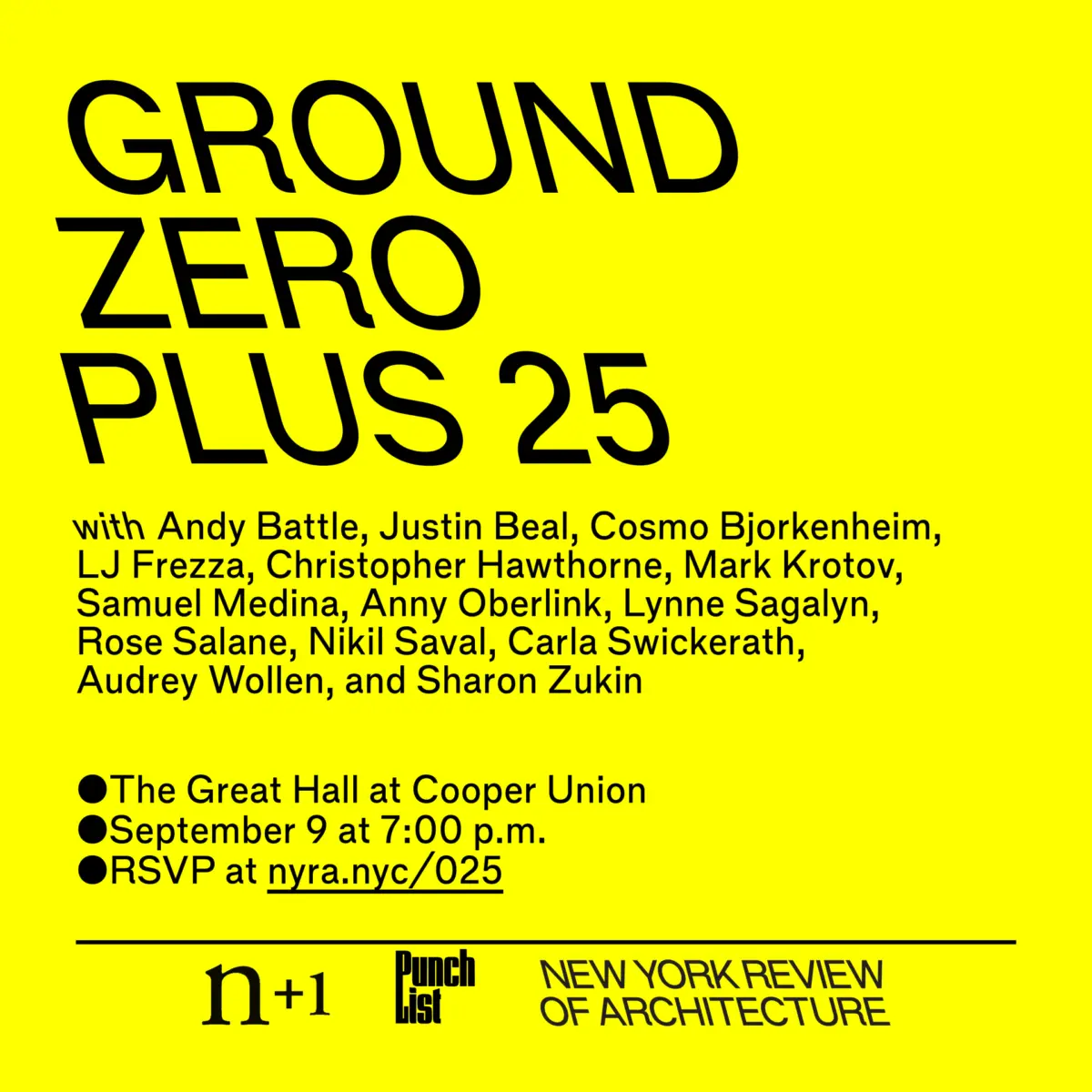
To unpack these pressing themes, leading cultural and architectural publications—including n+1, the New York Review of Architecture, and Punch List—are convening a public discussion. The event will interrogate the twenty-five-year rebuilding process, the paths not taken, and the enduring identity of the World Trade Center site. The conversation is scheduled for Wednesday, September 9, at 7:00 PM in the historic Great Hall at Cooper Union, located at 7 East 7th Street in New York City. Tickets are available via Luma, priced at $14 for subscribers of n+1 and their guests, and $24 for non-subscribers.
Detailed Chronology: From Ruin to Reconstruction
Phase I: The Immediate Aftermath and Ideological Fracturing (2001–2003)
In the immediate aftermath of 9/11, the primary imperative was rescue and recovery, followed by the monumental task of clearing millions of tons of twisted steel and pulverized concrete from the site. By 2002, the Lower Manhattan Development Corporation (LMDC) was established by Governor George Pataki and Mayor Rudolph Giuliani to oversee the revitalization of downtown.
The early design phase was characterized by competing impulses. Should the entire sixteen acres be preserved as a sacred burial ground, or should commercial vitality be restored to reassure global markets? In 2002, the LMDC launched an international design competition that captured the world’s imagination. Visionary architects submitted proposals featuring sky-high vertical parks, cantilevered memorial structures, and twisting corporate towers. Daniel Libeskind’s "Memory Foundations" master plan ultimately won favor in 2003, promising a towering spire (originally dubbed the Freedom Tower) anchoring a sweeping descent toward the footprints of the fallen towers, framed by a sunken memorial.
Phase II: Bureaucratic Gridlock and Commercial Realities (2004–2011)
Libeskind’s poetic vision, however, soon crashed against the harsh realities of real estate developer Larry Silverstein—who held the 99-year lease on the World Trade Center complex—and the Port Authority of New York and New Jersey, the public agency owning the land.
Years were squandered in acrimonious disputes over security requirements, floor-to-ceiling heights, financing, and insurance payouts. The initial design of the One World Trade Center was famously scrapped after the NYPD raised severe concerns regarding its vulnerability to truck bomb attacks, forcing a hurried redesign by architect David Childs of Skidmore, Owings & Merrill (SOM). Simultaneously, the site became a political football for state executives in Albany and City Hall, delaying infrastructure development and straining public trust.
Phase III: Incremental Realization and Civic Integration (2012–2026)
Despite the friction, the physical components of the master plan slowly materialized. The National September 11 Memorial, designed by Michael Arad and Peter Walker, opened to the public in 2011, followed by the underground museum in 2014. The monumental One World Trade Center opened in November 2014, signaling the return of commercial life to the skyline.
Subsequent years saw the completion of Santiago Calatrava’s controversial, budget-busting World Trade Center Transportation Hub (the Oculus)—a structure praised for its soaring skeletal wings and criticized for its exorbitant cost and delayed timeline. Office towers designed by world-class firms, including Rogers Stirk Harbour + Partners and Fumihiko Maki, filled out the eastern edge of the site along Greenwich Street. Most recently, the Perelman Performing Arts Center (PAC NYC) opened its doors, attempting to infuse cultural vibrancy into a commercial district historically criticized for emptying out after business hours.

Supporting Context & Metrics: The Scale of the Enterprise
The reconstruction of the World Trade Center stands as one of the most expensive and legally intricate construction projects in modern history. Understanding the sheer magnitude of the endeavor requires examining key metrics spanning finance, urban demographics, and infrastructural capacity:
- Financial Scale: The total cost of rebuilding the World Trade Center complex has eclipsed $25 billion, making it the most expensive real estate project ever undertaken in the United States. This figure encompasses public subsidies, insurance payouts, Port Authority capital investments, and private financing.
- Acreage and Footprint: The site spans approximately 16 acres in the heart of the Financial District, bordered by Church Street to the east, Vesey Street to the north, West Street to the west, and Liberty Street to the south.
- Commercial Density: The master plan reintegrated millions of square feet of prime Class-A office space back into Lower Manhattan, proving crucial as the financial district sought to reinvent itself following the decentralization accelerated by the COVID-19 pandemic.
- Transit Convergence: The site reconnects 11 subway lines alongside the PATH commuter rail network through the Oculus, handling hundreds of thousands of daily commuters and bridging Brooklyn, Manhattan, and New Jersey.
- Visitor Metrics: The 9/11 Memorial & Museum has welcomed tens of millions of visitors from across the globe since its inception, establishing Lower Manhattan as one of the premier international tourism destinations.
Official Statements and Critical Perspectives
The silver anniversary of the attacks has prompted deep introspection among urban planners, architectural critics, and civic leaders regarding the legacy of the rebuilding effort.
"The rebuilding of the World Trade Center was never just about replacing lost square footage; it was an existential exercise in how a democratic society memorializes tragedy while refusing to surrender to it," notes a forthcoming essay by the New York Review of Architecture. "Yet, in attempting to satisfy every stakeholder—from grieving families and security agencies to real estate tycoons and municipal bureaucrats—the site often reflects the compromises of committee design rather than a singular, transcendent architectural vision."
Urban sociologists have similarly pointed to the tension between the commercial imperative and the sacred nature of the ground. The introduction of luxury retail within the Oculus and the surrounding towers has frequently clashed with the quiet reverence expected at a national memorial.
"We built a fortress of capital wrapped in a monument of sorrow," remarked a leading urban studies scholar ahead of the Cooper Union panel. "The central paradox of Ground Zero today is that it strives to be an ordinary neighborhood of residential high-rises, gourmet dining, and corporate law firms, yet it is anchored by a mass grave and a global tourist magnet. Managing that friction will define the next twenty-five years of Lower Manhattan."
Future Outlook: The Next Quarter-Century for Lower Manhattan
As the World Trade Center site enters its second quarter-century, the conversation has shifted from physical construction to long-term sustainability, cultural relevance, and urban integration.
Lower Manhattan has undergone a profound demographic transformation since 2001. Once a ghost town after the closing bell of the stock exchange, the neighborhood has evolved into a vibrant residential community, with tens of thousands of residents populating converted office buildings and new residential towers. The opening of the Perelman Performing Arts Center has provided the missing cultural anchor, ensuring that the district is not solely defined by finance and remembrance.
However, new challenges loom on the horizon. Climate change and sea-level rise pose an existential threat to the low-lying geography of Lower Manhattan, as vividly demonstrated by Hurricane Sandy in 2012. Future urban planning efforts must focus on resilient infrastructure, coastal protection, and sustainable stormwater management surrounding the perimeter of the World Trade Center site.
Furthermore, as generational memory of September 11 shifts from lived experience to historical curriculum, the institutional responsibility of the 9/11 Memorial & Museum will evolve. Ensuring that the site remains an educational beacon rather than a commercialized tourist trap will require vigilant oversight from both civic organizations and the public.
Ultimately, the upcoming panel at Cooper Union on September 9 serves as a vital public forum to assess these trajectories. By examining the paths not taken—the visionary, unbuilt proposals that once captured the public’s imagination—architects, critics, and citizens can better evaluate the city we inherited, the city we built, and the city that is yet to come.
Event Details At a Glance
- What: Panel discussion on the 25-year rebuilding of the World Trade Center, hosted by n+1, New York Review of Architecture, and Punch List.
- When: Wednesday, September 9, at 7:00 PM.
- Where: The Great Hall at Cooper Union, 7 East 7th Street, New York, NY.
- Admission: $14 for n+1 subscribers and plus-ones; $24 for non-subscribers. Tickets available via Luma.




Comments
Facebook App ID not configured. Please add it in the Customizer.