
Executive Overview
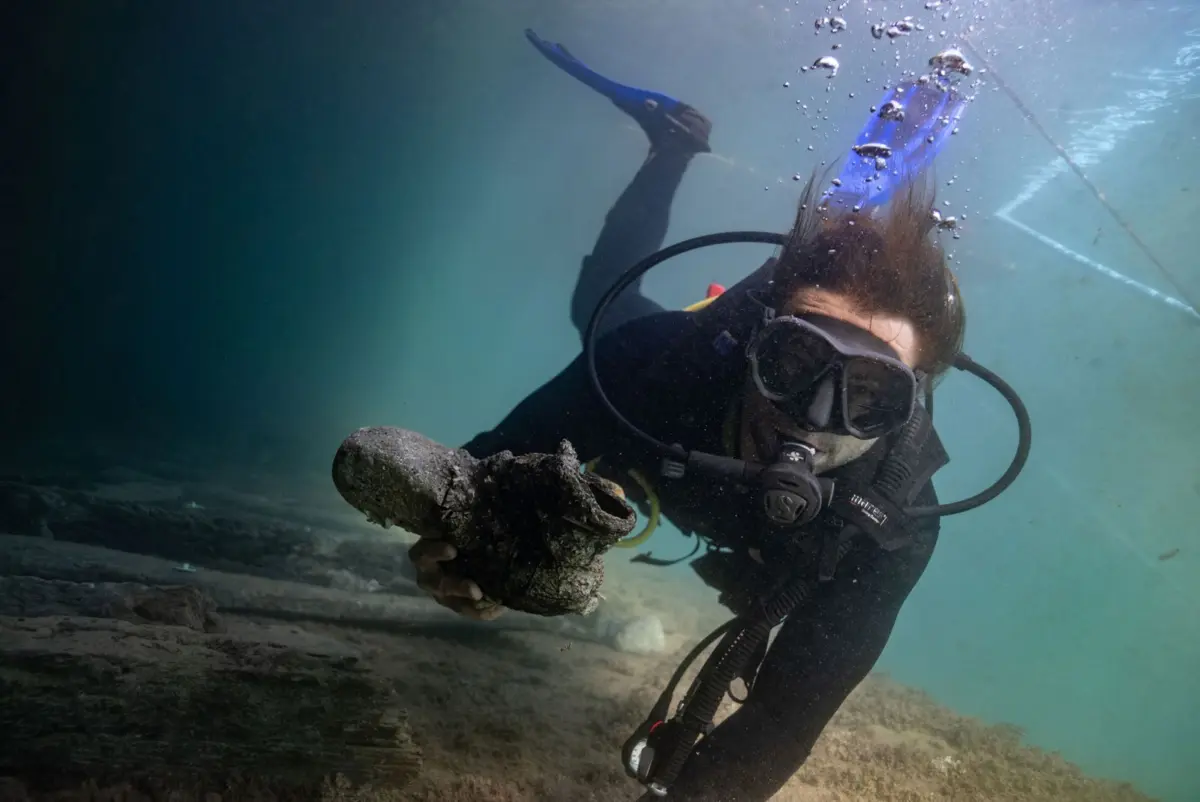
Beneath the deceptively placid, turquoise waters of Menorca’s Cala en Busquets lies an archaeological treasure trove that is rewriting the maritime history of the Western Mediterranean. Dubbed the "Cove of Mysteries," this ancient harbor off the coast of Ciutadella has yielded a rare and extraordinary discovery: three overlapping 13th-century trading vessels that sank simultaneously, likely victims of a violent meteorological tsunami more than 750 years ago.
Led by the Menorca Shipwreck Project—a collaborative initiative uniting local cultural heritage experts and the New York City-based Explorers Club—marine archaeologists have spent recent years carefully peeling back layers of sediment to reveal these exceptionally preserved medieval ruins. Initially mistaken for 18th-century wrecks, rigorous wood-dating analysis confirmed their true medieval vintage.
What makes the "Busquets" fleet profoundly significant to the global archaeological community is not merely their age, but the cultural mosaic of their cargo. Containing artifacts originating from both Christian kingdoms and Moorish communities of the Iberian Peninsula, these underwater time capsules challenge long-held assumptions about the rigid separation of powers during a period of intense geopolitical friction and impending war. As researchers continue to excavate the site—utilizing innovative techniques to brave zero-visibility waters—the Cove of Mysteries stands poised to reveal even deeper secrets about medieval commerce, navigation, and human resilience.
Read Also
/https://tf-cmsv2-smithsonianmag-media.s3.amazonaws.com/filer_public/96/18/96189b3d-e04b-4d00-8996-245f89801b5f/dsc04914.jpg)
Detailed Chronology: From Submersion to Discovery
The Fateful Surge: The 13th-Century Disaster
The story of the Busquets wrecks begins in the turbulent geopolitical landscape of the mid-13th century. At the time, the Balearic Islands—comprising Ibiza, Formentera, Majorca, and Menorca—were under Moorish rule, positioned precariously between the expanding Christian kingdoms of modern-day Spain and the dynamic Islamic dynasties of the Iberian Peninsula.
On a fateful day in the late 1240s, disaster struck not from the sword of an invading army, but from the fury of the sea itself. The three vessels, now designated Busquets I, II, and III by expedition founder and leader Trevor J. Wallace, were berthed or operating within the confines of the ancient harbor when they were struck by a rissaga—the local Catalan term for a meteorological tsunami, or meteotsunami.
Unlike seismic tsunamis caused by tectonic plate shifts, meteotsunamis are atmospheric phenomena driven by rapid changes in air pressure. They can manifest unpredictably within minutes, generating violent, fluctuating surges in sea level that possess the terrifying power to submerge entire fleets in a matter of hours. Caught in this localized oceanic tempest, the three trading vessels were overwhelmed, sinking together into the murky depths and coming to rest in an overlapping formation that pointed directly to a singular, catastrophic event.
/https://tf-cmsv2-smithsonianmag-media.s3.amazonaws.com/accounts/headshot/katie-hitchcock-smith.png)
Centuries of Silence and the Reconquista
Following their submersion, the ships settled into a watery grave where they would remain entirely undisturbed for more than seven and a half centuries. Much of the documentary history surrounding this era of Menorca’s maritime trade was obscured or lost following the 1287 conquest of the island by Alfonso III of Aragon, which permanently shifted the island’s political and cultural trajectory.
While many other Mediterranean harbors were heavily dredged, modified, or cleared of underwater obstacles during widespread 19th-century infrastructure projects, Cala en Busquets was miraculously spared. Because modern Menorca’s primary harbor was constructed on the opposite side of the island, the Cove of Mysteries remained an isolated, undisturbed underwater museum.
Decades of Exploration: The Long Road to Excavation
The modern chapter of this discovery began in 2009, when Catalan archaeologist Xavier Aguelo Mas first surveyed the site during preliminary dives. Confronted with murky, near-zero visibility conditions that he aptly describes as being "like chocolate," Aguelo Mas immediately recognized the archaeological potential of the seafloor anomalies. However, securing institutional backing, funding, and widespread academic consensus proved to be an uphill battle.
:focal(2120x1413:2121x1414)/https://tf-cmsv2-smithsonianmag-media.s3.amazonaws.com/filer_public/96/18/96189b3d-e04b-4d00-8996-245f89801b5f/dsc04914.jpg)
Echoing a common Spanish idiom, Aguelo Mas notes, "After the bulls pass [by], everybody knows." For years, his conviction that the site held medieval significance was met with skepticism from the wider archaeological community, who initially categorized the wreckage as dating to the much later 18th century.
It was not until the formal establishment of the Menorca Shipwreck Project—a partnership blending the resources of The Explorers Club with dedicated field experts—that systematic, funded excavations commenced in 2023. Advanced wood-dating and carbon analysis conducted in 2025 finally vindicated Aguelo Mas’s long-held hypothesis, definitively dating the timber frames to the 13th century and elevating the site to international archaeological prominence.
Supporting Context & Metrics: The Rarity of Medieval Marine History
To understand the magnitude of the Menorca Shipwreck Project’s findings, one must examine the broader landscape of Mediterranean marine archaeology.
/https://tf-cmsv2-smithsonianmag-media.s3.amazonaws.com/filer_public/51/0b/510bde82-912f-49ee-baf3-b38070d885f7/dsc02626.jpg)
- The Amphora vs. Barrel Paradigm: For decades, underwater archaeologists exploring the Mediterranean have grown accustomed to finding ancient Roman shipwrecks. Roman merchant vessels typically carried goods in amphorae—large ceramic jars used for wine, olive oil, and fish sauce. Because these ceramic shards survive indefinitely on the seafloor and are easily spotted by divers, Roman wrecks have historically been prime targets for both legitimate researchers and illicit treasure hunters. However, by the second century C.E., merchants increasingly transitioned to degradable wooden barrels, which were vastly easier to transport and stack. As underwater archaeologists frequently summarize: "The barrel killed the amphora." This transition rendered younger medieval wrecks exponentially harder to detect visually, leaving them largely hidden from modern looters.
- Geographical Scarcity: According to marine geoarchaeologist Beverly Goodman-Tchernov of the University of Haifa—who was not involved in the excavation—shipwrecks from the medieval period are exceptionally rare in the Mediterranean archaeological record. This scarcity is particularly acute outside the eastern basin, largely due to the aggressive 19th-century harbor clearance projects that destroyed countless shallow-water medieval sites across southern Europe.
- The Busquets Milestone: The discovery of Busquets I, II, and III represents the first verified group of 13th-century shipwrecks ever uncovered in Menorca. Their untouched status provides an unpillaged baseline for studying medieval naval architecture, cargo distribution, and regional seafaring logistics during the High Middle Ages.
Official Statements and Methodological Innovations
Working in the challenging, low-visibility waters of Cala en Busquets required the development of specialized excavation protocols. Expedition divers, operating under grueling physical conditions, perfected a unique sediment-clearing maneuver. Diver Kevin Carrigan affectionately dubbed the team’s preferred technique the "Queen Elizabeth"—a deliberate nod to the late British monarch’s signature, smooth hand wave.
When executed underwater, this rhythmic, side-to-side sweeping motion of the palm gently stirs the dense silt blanketing the wreckage without damaging fragile organic remains. The suspended sediment is then safely vacuumed away via a specialized discharge tube, slowly exposing the historical strata beneath.
This meticulous methodology yielded what Xavier Aguelo Mas describes as Menorca’s "artifact of the decade": a rare 13th-century encolpium, or religious reliquary. Expedition leader Trevor J. Wallace recalls the moment of discovery:

"I was working next to a millstone, and I saw a black corner of something that I thought was contemporary trash. As I uncovered it, I saw a king with a scepter."
The encolpium—a portable devotional case traditionally worn by high-ranking clergy—is an intricate and seemingly one-of-a-kind artifact. Its discovery, alongside unbroken 13th-century Islamic pottery recovered from the same hulls, has prompted profound reflections from experts on the socioeconomic realities of the era.
Marcel Pujol Hamelink, an authority on medieval shipbuilding methods who contributed to the project, notes that these artifacts provide undeniable material proof that Christian merchants and Muslim Moors "were not two worlds apart" at a time traditionally defined solely by military conflict and religious polarization.
/https://tf-cmsv2-smithsonianmag-media.s3.amazonaws.com/filer_public/72/19/7219c825-464f-4663-8bc6-e3e138249f0c/three_shipwrecks_bruno_2.jpg)
Reflecting on the overarching significance of the site, Beverly Goodman-Tchernov emphasizes:
"Shipwrecks serve as archaeological time capsules, preserving a narrow window of time and space. While nearly all discovered shipwrecks warrant some research and capture our attention, not all are equally important."
Future Outlook and Ongoing Research
The work at the Cove of Mysteries is far from finished. While archaeologists have successfully completed excavations on Busquets I and II, meticulous recovery and documentation efforts on Busquets III remain ongoing.
/https://tf-cmsv2-smithsonianmag-media.s3.amazonaws.com/filer_public/ab/e0/abe0f3e5-84d6-4e1d-8f6a-7f5c154eb5df/shipwreck-12-dh.jpg)
The recovered encolpium has been transported to the Museum of Menorca, where it is undergoing a delicate professional desalination process. Once stabilized, curators and historians plan to open the reliquary to analyze its internal contents. Speculation among the team runs high; as Aguelo Mas muses, the sealed compartment could contain fragmental parchment, sacred relics, or bone fragments that could illuminate the personal faith and travel habits of a 13th-century traveler.
The collaborative research team aims to synthesize their multi-year findings into a comprehensive peer-reviewed research paper slated for publication in the spring of 2027. Yet, both local and international researchers maintain a shared sense that the Cove of Mysteries has only just begun to yield its secrets.
Looking forward with cautious optimism, Aguelo Mas envisions the potential for future discoveries just beyond the immediate excavation zone: "We [could] have Busquets IV, V."
/https://tf-cmsv2-smithsonianmag-media.s3.amazonaws.com/filer_public/6e/21/6e21315d-1412-4a29-960b-cb991acb4f27/encolpium.jpg)
Trevor J. Wallace echoes this sentiment, framing the project not as a finite expedition, but as an ongoing narrative:
"It’s an unraveling story still. This tiny little cove, this underwater museum… still has a lot to tell."
As technological advancements in marine archaeology continue to bridge the gap between murky depths and historical clarity, the 13th-century tragedy preserved in Menorca’s waters will undoubtedly continue to reshape our understanding of medieval maritime networks for years to come.


Comments
Facebook App ID not configured. Please add it in the Customizer.