
Executive Overview
Dual-timeline storytelling remains one of the most ambitious and formidable challenges in contemporary fiction. By design, these narratives demand that authors construct two—or sometimes more—distinct worlds that must not only function independently as gripping pieces of fiction, but also coalesce into a unified, resonant emotional experience. Readers approach dual-timeline novels looking for depth, psychological complexity, and the intricate puzzle of "breadcrumb" plots that invite them to piece together historical and modern mysteries side by side. They crave settings that feel raw, immediate, and visceral, whether the action unfolds in a high-rise contemporary metropolis or a rural English village four centuries in the past.
However, achieving this delicate balance is notoriously difficult. Many first-time attempts stumble because authors treat one timeline as the primary vehicle while reducing the secondary setting to a superficial backdrop. When feedback on an initial draft is scathing—such as being told a manuscript fails "to use the potential in two powerful story lines in more than a mildly interesting way"—it can feel devastating to a writer. Yet, these harsh critiques often serve as the crucible in which genuine narrative mastery is forged.
This report explores the mechanics of dual-timeline construction, analyzing structural methodologies, plotting architectures, and thematic integration techniques. By examining how authors can transform lopsided drafts into cohesive, tightly bound literary works, this masterclass provides a blueprint for turning the daunting challenge of multi-era storytelling into an enduring artistic triumph.
Read Also
Detailed Chronology: From Scathing Critique to Structural Breakthrough
The evolution of a successful dual-timeline novel rarely follows a straight path. For many authors, the journey begins with an ambitious vision that ultimately shatters against the harsh realities of pacing, structural imbalance, and weak character distribution. Tracing the trajectory of this creative process reveals critical milestones every writer must navigate.
Phase One: The Ambition and the Initial Failure
In the early stages of conceiving a dual-timeline project, writers are frequently intoxicated by the sheer scope of their ideas. The contrast between a historical epoch—fraught with high stakes, physical danger, and dramatic consequence—and a modern setting creates an immediate sense of scale. Authors dive headfirst into drafting, often prioritizing the historical narrative because its outward action feels inherently more cinematic.
During this initial drafting phase, the contemporary timeline is frequently marginalized. It is reduced to a few expository scenes or emotional interludes designed merely to bridge the historical chapters. The resulting manuscript suffers from severe structural asymmetry. The historical strand is thick, vibrant, and overstuffed, while the modern strand is wispy, fragile, and emotionally unconvincing.
Phase Two: The Crushing Reality Check
The turning point arrives with the first round of beta reader feedback, editorial reviews, or critique group evaluations. The critique is often blunt: the dual-timeline structure fails to capitalize on the inherent power of its dual components.
For the author, this feedback is a bitter pill to swallow. It forces a complete reassessment of the work. Rather than abandoning the project, the writer must deconstruct the manuscript down to its foundational elements. This phase requires abandoning the original layout and adopting a forensic approach to narrative architecture. Every scene must be interrogated: Does this timeline pull its weight? Are the stakes balanced? Is the reader being given enough narrative protein in both eras?
Phase Three: The Re-Engineering Process
Once the flaws are acknowledged, the writer enters the re-engineering phase. This involves moving away from linear drafting and toward mechanical planning. Authors begin treating timelines not as hierarchical master-and-slave narratives, but as equal partners in a symbiotic relationship.
By mapping out every event, emotional beat, and turning point side-by-side, the writer starts to see where pacing flags and where thematic echoes can be amplified. This chronological and spatial reorganization transforms a chaotic manuscript into a disciplined, deliberate work of art.
Phase Four: Mastery and Refinement
In the final phase of development, the mechanical scaffolding recedes, leaving behind a seamless reading experience. The author learns to trust their hard-won structural instincts—what many refer to as "writer’s intuition." With balanced timelines, tightly wound plotting, and resonant thematic objects acting as bridges between eras, the novel achieves the harmonious closure that defines enduring dual-timeline fiction.
Supporting Context & Metrics: The Anatomy of a Dual-Timeline Manuscript
To fully understand why dual-timeline stories either soar or plummet, one must examine the underlying mechanics of pacing, structural metaphors, and narrative weight distribution. Successful multi-era fiction relies on specific design principles that govern how information is parsed to the reader.
The Braid Metaphor: Visualizing Narrative Strands
One of the most effective pedagogical tools for conceptualizing dual-timeline fiction is the metaphor of the braid. In a poorly constructed manuscript, the historical setting often forms a thick, dominant main strand, while the contemporary setting is wrapped loosely around it like a few stray hairs. This produces an uneven, wobbly structure where scenes in the weaker timeline feel thin, unconvincing, and structurally unstable.
[Poor Braid Structure]
Historical Timeline (Thick & Dominant) = = = = = = = = = = = = = = = = = = = = =
Contemporary Timeline (Thin & Wobbly)    -   -   -   -   -   -   -   -   -   -

[Optimized Braid Structure]
Strand A (Past POV 1)        ~~~~~~~~~~~~~~~~~~~~~~~~~~~~~~~~~~~~~~~~~~~~~~~
Strand B (Past POV 2 / Alt)  ===============================================
Strand C (Present Timeline)  -----------------------------------------------
Both timelines are inherently valuable; otherwise, they would not occupy space in the same book. Consequently, each strand of the braid must be cultivated to look strong, full, and healthy during the drafting phase. Pruning and thinning can happen later during revisions, but it is infinitely easier to trim excess material from a robust narrative than it is to artificially inflate a weak one.
Furthermore, writers must determine what kind of braid they are creating. Some stories function best with two intersecting perspectives, while others require three or more points of view to fully capture the scope of the narrative arc. Finding the precise geometric configuration of viewpoints allows an author to pour maximum substance into each section, ensuring that when the strands are ultimately woven together, the resulting bond is unbreakable.
The Side-by-Side Event Matrix
A critical pitfall in dual-timeline writing is the imbalance of narrative modes—for instance, housing all physical action and external plot advancement in the past timeline while relegating the present timeline entirely to internal, psychological processing.
To rectify this, authors must construct a comprehensive event matrix. By laying out every plot point of the past and present timelines side-by-side (often utilizing a visual grid or table), writers can systematically engineer thematic and causal connections between eras:
- Tension Mirroring: If the historical narrative features a high-stakes confrontation or escape, the contemporary narrative should introduce a corresponding form of high-stakes pressure or crisis.
- Flashback Alignment: Structural echoes can be created by mirroring reflective moments, flashbacks, or realizations across both timelines, reinforcing the thematic resonance for the reader.
- Pacing Audits: A visual plot grid allows authors to instantly spot dead zones, ensuring that narrative momentum does not stall entirely in one era while the other races forward.
Deconstructing "Writer’s Intuition"
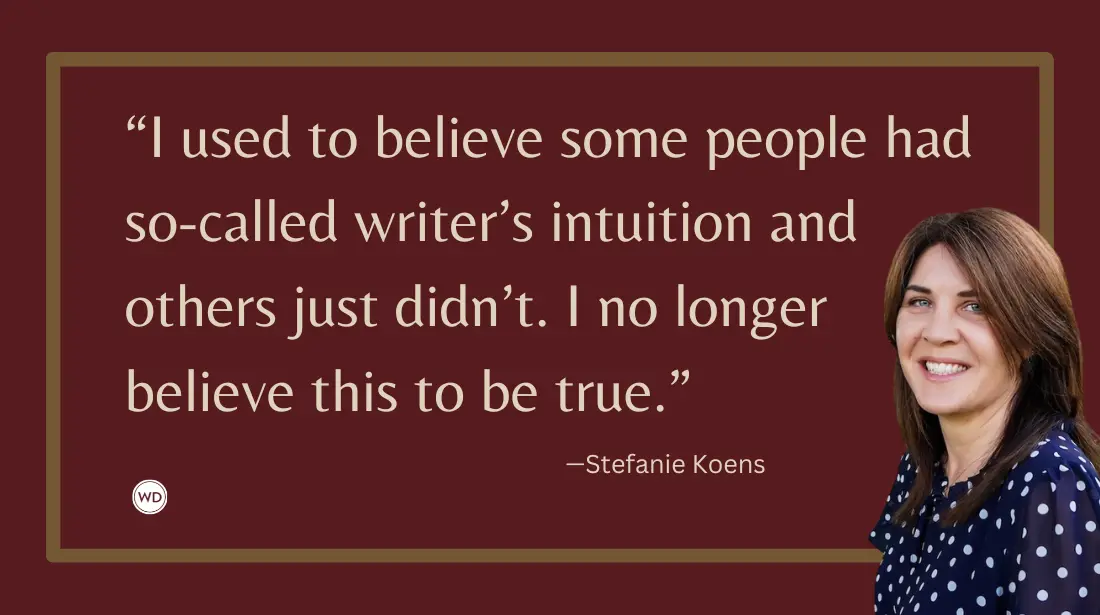
A common myth among aspiring novelists is that "writer’s intuition" is an innate, mystical gift bestowed upon a select few. In reality, writer’s intuition operates as a sophisticated spectrum built over years—often decades—of active reading, analytical consumption of literature, and iterative trial and error.
By analyzing what narrative devices they enjoy as readers, what tropes frustrate them, and how their favorite authors solve complex structural problems, writers unconsciously calibrate their internal compass. Recognizing intuition as a developed skill rather than a genetic trait democratizes the craft, empowering authors to systematically cultivate their editorial judgment.
Official Insights & Craft Perspectives: Bridging Past and Present
Industry professionals and seasoned novelists agree that the success of a dual-timeline novel hinges on how effectively the author bridges the physical and emotional gap between eras. While the "found diary" or discovered manuscript remains a classic trope, it is frequently maligned by critics as a simplistic, lazy mechanism for exposition and mystery-solving.
However, narrative experts point out that the underlying principle of the found-diary technique—the transmission of physical evidence across time—can be elevated through the strategic use of inanimate objects.
The Power of Tactical Objects
Instead of relying solely on written documents or expository dialogue to reveal historical truths, authors can employ tangible objects to anchor a narrative in a deeply emotional and visceral way.
"What you leave behind is not what is engraved in stone monuments, but what is woven into the lives of others." — Pericles
An object as unassuming as a piece of heirloom jewelry, a damaged timepiece, or a specific garment from the historical timeline can migrate across centuries, eventually finding its way into the hands of a contemporary protagonist. These items carry their own silent history. They provide exposition without the need for written words, acting as narrative catalysts that can trigger unexpected twists, profound revelations, and deeply satisfying emotional closures.
By letting objects speak across time, authors bypass the clunkiness of info-dumps and create an organic, tactile bridge between the characters of the past and those of the present.
Future Outlook & Industry Implications
As the literary marketplace continues to evolve, reader demand for immersive, complex, and emotionally layered historical-contemporary fiction shows no sign of abating. Publishers actively seek out manuscripts that offer multi-dimensional reading experiences, rewarding books that successfully marry high-concept plots with rich character development.
For emerging authors, the path forward requires embracing the rigorous demands of multi-era plotting. While dual-timeline novels are undeniably difficult to execute, their payoff is immense. Readers return to them again and again because a well-crafted dual-timeline story delivers a unique psychological resonance—the comforting yet thrilling realization that human emotions, struggles, and triumphs echo across generations.
Writers stepping into this subgenre should not be daunted by its complexity. Instead, they should lean into the structural challenges, deploy meticulous planning tools like event matrices and braid frameworks, and write the story anyway. In doing so, they contribute to a timeless literary tradition: weaving individual human lives into an enduring, collective tapestry.



Comments
Facebook App ID not configured. Please add it in the Customizer.