

In the realm of aesthetics, literature, and philosophy, the concept of nonduality—derived from the Sanskrit Advaita—offers a radical departure from the binary structures that typically govern human thought. Far from being a niche metaphysical pursuit or an exercise in Eastern mysticism, nonduality challenges the fundamental tools of human expression: language, linear narrative, and literalism.
By examining the foundational legends of Zen Buddhism, the mechanics of modern poetry, and the avant-garde framing of mid-century European cinema, cultural critics and artists alike have long sought to bypass the limitations of the rational mind. This inquiry traces how transformative art acts as a psychological and linguistic rupture—shattering the glass of literal interpretation to plunge the audience directly into an unnamable, unified field of experience.
Through the historical lens of the Sixth Zen Patriarch Huineng, the self-interrogating verses of poets like Chase Twichell and Giuseppe Ungaretti, and the spatial disorientation of Michelangelo Antonioni’s landmark 1960 film L’avventura, this article investigates how nondualistic frameworks dismantle our reliance on dualistic certainty. Ultimately, these artistic expressions do not offer answers or resolutions; instead, they embrace a state of profound "not-knowing," functioning as modern koans that wake the observer from a dualistic slumber.
Read Also
Detailed Chronology: From the Marketplaces of Lingnan to the Celluloid of Sicily
To understand the mechanics of nondualistic disruption, one must trace its historical and artistic lineage across centuries, moving from ancient epiphanies to modern cinematic masterpieces.
1. The Awakening in Lingnan (Circa 7th Century)
The enduring legend of Huineng (638–713), who would become the Sixth Great Patriarch of Zen, begins in the frost-bitten spring of Lingnan. Sent by his impoverished mother to sell firewood in the local market, the young Huineng encountered a group of traveling northern monks reciting verses from the Diamond Sutra:
All conditioned phenomena
Are like a dream! An illusion! A bubble! A shadow!
Like dew or a flash of lightning! Thus we shall perceive them!
Upon hearing these words, Huineng experienced a psychological and physical dissolution. The boundary between his body—his hemp robe, belt, and sandals—and the surrounding dirt, wood, and stalls vanished. He was no longer a separate observer in time and space, but part of the material fabric of the world.
Driven by this lightning strike of nondualistic understanding, Huineng walked northward to the Gunin Daiman monastery. When challenged by the head monk regarding his southern "barbarian" origins, Huineng responded only by shouting the verses he had memorized. Put to work in the rice shed, and too light to operate the heavy hulling machine, he tied a river stone to his waist to anchor himself. Day after day, through sun and rain, he repeated the sutra lines—embodying an unyielding commitment to a reality beyond literal translation.
2. The Poetic Interruption of Literalism (20th Century)
Centuries later, poets and writers confronted the same linguistic barrier that Huineng pierced. Language, by its very design, is built on dualistic classifications: subject and object, past and future, self and other. Yet, modernist and contemporary poetry sought to bypass these boundaries.
In Giuseppe Ungaretti’s ultra-short Italian poem Mattina, the text reads simply:
M’illumino d’immenso ("I illuminate myself with immensity.")
Here, the narrator does not exist as an isolated ego within time and space; rather, the "self" expands into an unlimited, boundaryless field of experience.
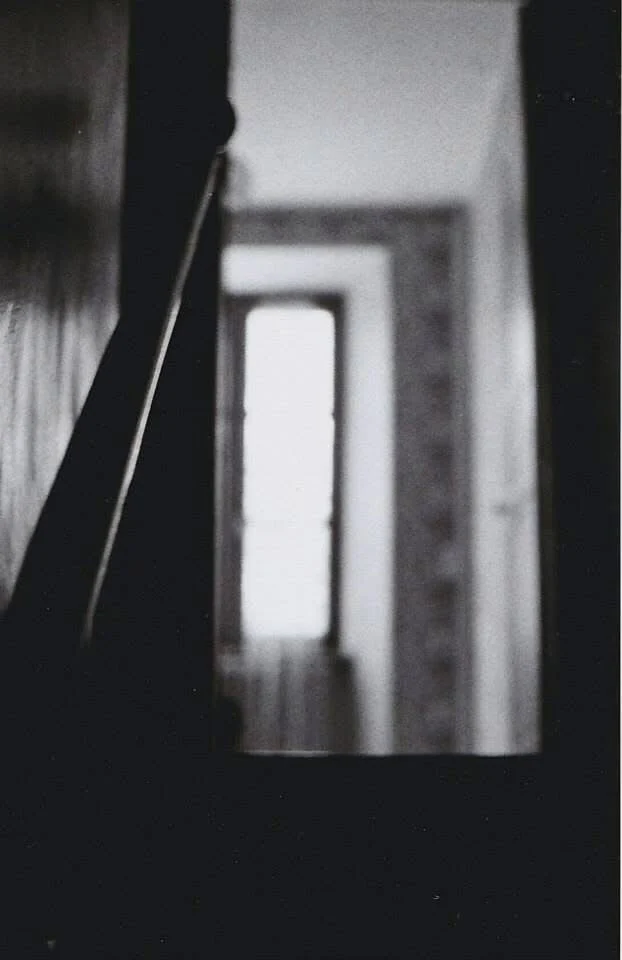
Similarly, American poet Chase Twichell, in works like Makeshifts, deliberately sabotages the traditional nature poem. Beginning with a seemingly concrete description of a late-November landscape—solid ice waterfalls, white pines, and snow shifting from blue to pink—Twichell abruptly pulls back the curtain in the second stanza:
Here’s a little bouquet—ice
and evergreen and sun, three moments
arranged for human looking,
though it’s only the husks of their names
that I’ve gathered and paralyzed.
By reminding the reader that these natural elements are merely "husks of their names" fabricated by the poet, Twichell disrupts our comforting immersion in a pastoral scene. As Twichell famously observed of poetry’s true function, it is "not window cleaning. / It breaks the glass."
3. The Cinematic Architecture of L’avventura (1960)
Michelangelo Antonioni translated this precise philosophical disruption into the medium of film with his masterpiece L’avventura. Traditional cinema relies heavily on plot, narrative closure, and psychological motivation—dualistic tethers that guide the spectator safely through a story. Antonioni systematically severs these tethers.
Following the mysterious disappearance of Anna on a desolate Mediterranean island, her lover Sandro and her friend Claudia embark on a half-hearted search that quickly transforms into an ambivalent romance. The characters drift through wealth and boredom, acting as psychological amnesiacs who change their minds, fall into despair, and forget their grief with unsettling speed.
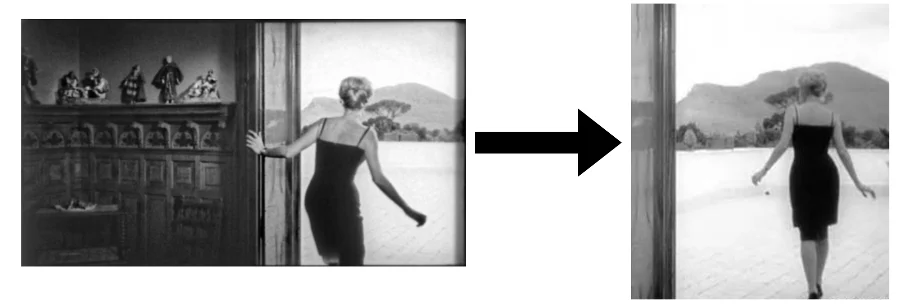
Antonioni visually reinforces this psychological erasure through a recurring spatial motif: the doorway effect. By continuously framing Claudia as she passes through archways, doorways, and thresholds, the director induces a cinematic equivalent of short-term memory loss in the viewer. We, too, are stripped of our narrative footing.
The film culminates in the town of Taormina, Sicily. After discovering Sandro’s infidelity, Claudia flees into the early morning streets, confronting an apocalyptic landscape framed by an bombed-out tower and the distant peak of Mount Etna. Staring into the rustling leaves of a tree for twelve agonizing seconds, her internal turbulence mirrors the nondualistic void. When Sandro weeps on a park bench, Claudia approaches and places her hand on his head—an act Antonioni described not as forgiveness, but as pure "pity." The camera pulls back to a static establishing shot of the tiny human figures against the immense, active volcano, leaving the audience suspended in permanent uncertainty.
When critics later begged Antonioni for narrative exposition regarding the unresolved fates of his characters, his response was absolute: Mu!
Supporting Context & Metrics: The Mechanics of Nonduality
To fully appreciate the intersection of Zen philosophy, poetry, and cinema, it is necessary to examine the psychological and structural mechanics that underpin nondualistic art.
+-------------------------------------------------------------------+
                  THE DUALISTIC VS. NONDUALISTIC SPECTRUM
+-------------------------------------------------------------------+

   DUALISTIC MIND                     NONDUALISTIC REALITY
   ----------------                   --------------------
   • Literal-focused                  • Beyond linguistic capture
   • Subject / Object split           • Indivisible field of experience
   • Searching for "facts"            • Negative Capability / "Mu"
   • Cave shadows (Plato)             • Stepping out into direct form
   • Narrative tethering              • Ephemeral "husks" of language
Defining Advaita and the Limits of Language
Derived from the Sanskrit Advaita (literally "not two"), nonduality points toward a reality that transcends divisions. Defining it presents a fundamental paradox because human language is inherently dualistic, relying on binary oppositions (hot/cold, good/bad, self/other) to function.
As poet and essayist Jane Hirshfield notes, "Non-duality is not the negation of multiplicity in favour of some idea of the absolute; it is also not the nihilism so many Westerners think Buddhism to be." Instead, it is perceived not by what it is, but by what it is not: it is impersonal, timeless, and indivisible.
The Zen Koan and Negative Capability
In Zen practice, the koan serves as a psychological wedge designed to jam the gears of the rational, dualistic mind. When Master Joshu was asked whether a dog possessed Buddha nature, his response was simply: "Mu!"
Translated loosely as "no" or "not," Mu is ultimately a non-answer that rejects the premise of the question itself, forcing the mind out of its conditioned patterns.
This mechanism mirrors John Keats’s literary concept of Negative Capability. Keats praised individuals who were "capable of being in uncertainties, mysteries, doubts, without any irritable reaching after fact and reason." Both the koan and Negative Capability require an active embrace of "not-knowing," dismantling the illusion that the literal mind can capture ultimate truth.
Official Statements & Critical Perspectives
Prominent artists, filmmakers, and philosophers have consistently addressed the friction between literal language and nondualistic expression.
-
Roland Barthes on Translation and Fiction:
"In him, another dialectic appears, trying to find expression; the contradiction of the terms yields in his eyes by the discovery of a third term, which is not a synthesis but a translation; everything comes back, but it comes back as Fiction, i.e., at another turn of the spiral."
Barthes highlights how contradiction is never truly resolved through standard logic, but is instead elevated into fiction—a recursive spiral of perception. -
Chase Twichell on Mind-to-Mind Transmission:
"Zen is said to be a ‘mind-to-mind transmission.’ The best poems are exactly that: they leap from one mind to another without stopping to explain exactly how they did it. Poetry cannot be paraphrased because it can’t be apprehended by a purely literal mind."
Twichell underscores why uninitiated readers often feel alienated by poetry: our modern culture trains us to operate within a strictly literal framework, whereas poetry demands an entirely different mode of consciousness. -
Michelangelo Antonioni on Cinematic Ambiguity:
When repeatedly questioned by critics about the unresolved narrative threads and ambiguous motivations in L’avventura, Antonioni consistently resisted offering definitive narrative resolutions. By treating his characters less as psychological case studies and more as ephemeral "husks" caught between active volcanoes and indifferent landscapes, Antonioni’s artistic stance echoed the ultimate Zen refusal: Mu.
Future Outlook
As contemporary culture becomes increasingly saturated by fast-paced, hyper-literal, and algorithmically mediated information, the spaces for true ambiguity and nondualistic contemplation are rapidly contracting. Yet, the enduring resonance of works like Huineng’s koans, Twichell’s poetry, and Antonioni’s cinema suggests an innate human hunger for experiences that shatter the glass of literalism.
Looking forward, the intersection of aesthetic theory and nondualistic philosophy points toward an essential shift in how we consume and create art. Creators are increasingly tasked with resisting the pressure to provide neat narrative closures, didactic messaging, or easily digestible thematic summaries. Instead, the future of avant-garde literature and film lies in embracing the discomfort of "not-knowing"—building digital and physical cultural spaces that function as modern koans.
By prioritizing direct, unmediated perception over intellectual categorization, future artistic movements will continue to challenge audiences to step out of the cave of dualistic shadows, look directly at the forms of reality, and echo the timeless, unanswerable silence of Mu.


Comments
Facebook App ID not configured. Please add it in the Customizer.