
Executive Overview
In his recent memoir, Communion, Vice President JD Vance reflects on the modern landscape of young adult romance with a stark diagnosis: he feels “profoundly sad for today’s kids” navigating the dating scene. Vance writes candidly about the legacy of the sexual revolution, noting that while traditional hookup culture was far from an ideal embodiment of Christian sexual ethics, its mistakes were at least inherently human. They were manageable missteps—errors of judgment that spurred genuine introspection, late-night conversations with confidants, and the formative heartbreak that builds character.
That familiar, messy era of collegiate hookups and localized romance has since been systematically replaced by a far bleaker cultural architecture. Today’s young adults navigate an ecosystem dominated by gamified dating apps functioning as digital meat markets, an endless and easily accessible buffet of online pornography, and algorithmically amplified gender-war content designed to stoke resentment between the sexes. Vance is far from a lone voice in the wilderness; a growing chorus of cultural critics, observers, and political figures shares a begrudging nostalgia for the relatively harmless fumbles of yesteryear. If there is any consolation to be drawn from the current landscape, it is that a broad consensus has emerged: modern romance has hit a definitive cultural dead end. The current system is structurally broken, and the public appetite for an alternative is reaching a boiling point.
Enter One Night Only, a provocative new romantic comedy currently playing in theaters nationwide that dares to ask a subversive question: What if a world entirely stripped of rules and restrictions around sex is ultimately less sexy—and vastly less fulfilling—than a society that treats sex as something powerful, potent, and intensely consequential?
Read Also
Operating as an affectionate love letter to New York City, a sharp critique of algorithmic dating apps, and a sideways satire of public health overreach, the film occupies a unique space in contemporary cinema. It functions either as the most red-blooded cinematic defense of traditional morality in decades or as the most subtly reactionary deconstruction of hookup culture since HBO’s Girls went off the air. In short, it is a distinctly First Things sex comedy for a post-digital age.
Detailed Chronology of a Post-Digital Romantic Crisis
To understand the cultural resonance of One Night Only, one must trace the timeline of how modern intimacy deteriorated from physical community norms into digital isolation.
The Shift from Analog Fumbles to Algorithmic Isolation
For generations, the mechanics of courtship relied on spatial proximity—high school hallways, college campuses, local bars, and community networks. While this analog system produced no shortage of social anxiety, it forced young people to develop interpersonal negotiation skills. Rejection was face-to-face; flirtation required body language; and the consequences of behavior reverberated within a tangible social fabric.
The advent of the smartphone-era dating app fundamentally re-engineered these dynamics. By turning human selection into a binary swipe left or right, platforms transformed potential partners into interchangeable commodities. Concurrently, the mass proliferation of high-speed, on-demand pornography conditioned millions of young men and women to view intimacy as a solitary, purely visual consumption habit rather than a reciprocal relational act.
The Legislative Fantasy of One Night Only
Against this backdrop of digital anomie, One Night Only establishes a high-concept speculative premise. Set in a near-future New York City, the film imagines a world three years after the federal passage of a sweeping government “mandate.” Under this fictional legislative regime, sex outside of legally sanctioned marriage is rendered strictly illegal for 364 days of the year.
The narrative itself unfolds entirely over the course of a single, chaotic, Bacchanalian evening—the one night annually when the federal restriction is lifted, and citizens are legally permitted to pursue non-marital encounters.
Rather than presenting this world as a dystopian hellscape in a purely straightforward manner, the film uses the artificial framework to highlight the psychological deficit of total sexual liberation. By placing a hard, legally enforced boundary around the pursuit of intimacy, the movie restores a sense of high-stakes urgency to the mating dance. The chase becomes analog again. As one character remarks to a confidant just hours before the evening’s restrictions lift:
“I really thought this whole thing was going to ruin sex for me. [But] it gave it new meaning. Who do you choose to be with for this one night? Choice itself is romantic. Maybe the fascists were right about this one.”
Supporting Context, Cultural Metrics, and Critical Reception
The film’s refusal to toe the standard Hollywood ideological line has made it a lightning rod for cultural debate, exposing deep divisions between mainstream critical establishments and an audience hungry for narratives addressing the modern loneliness epidemic.
The Critical Backlash and Real-World Parallels
Mainstream film critics have been markedly cool toward One Night Only, struggling to process a comedy that implicitly validates conservative critiques of modern sexual atomization. Reviewers have balked at the film’s playful deployment of terms like “fascists” and their “mandate”—sly, unmistakable winks at the heavy-handed public health mandates and biometric surveillance regimes experienced during recent real-world health crises.
Within the film’s universe, corporate America has seamlessly adapted to the government’s moralizing edicts. Cutesy marketing campaigns from ubiquitous brands like Dunkin’ Donuts, Equinox, and Duolingo enthusiastically endorse the state’s chastity policies. Citizens appear to have acquiesced to ubiquitous biometric tracking and mandate enforcement with barely a whimper of organized resistance. Pictographic warnings and public service announcements produced by a fictionalized CDC-style bureaucracy proliferate across the city’s digital billboards, preaching the gospel of state-sanctioned abstinence.
The Philosophy of Meaningful Restraint
Despite its biting satire of religious-right administrative overreach, One Night Only demonstrates profound sympathy for the traditional conservative argument that human desires as potent as sex require cultural and social guardrails to retain their value.
The film’s heroine, portrayed with grounded skepticism by Monica Barbaro, articulates a worldview that mirrors contemporary critiques of unbridled post-feminist hookup culture. Reflecting on the bleak mathematics of modern dating, she notes to a friend that the statistical probability of experiencing genuinely fulfilling intimacy from a random one-night stand hovers around a depressing 2.8 percent.
“Of course I want sex . . . but not sex that just leaves me feeling empty,” she confesses.
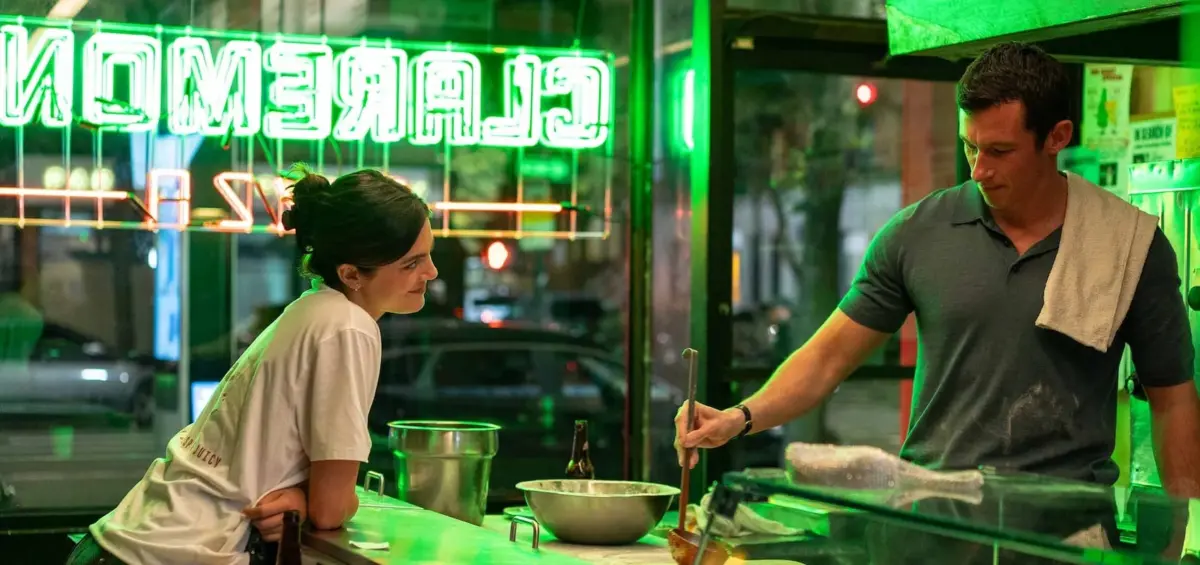
Her counterpart in the narrative is an earnest, unassuming pizzeria owner played by Callum Turner. Their evolving relationship develops organically away from glowing screens, culminating in a late-night culinary interaction. Turner’s character approaches his craft with a level of sensual care and professional mastery that captivates Barbaro—a depth of character and competence utterly alien to the superficial grading systems of dating apps. Their connection is forged through physical endurance, shared footsteps navigating the nocturnal streets of New York, and real-time dialogue.
In the dying moments of the legally sanctioned night, when the window for casual hookups is rapidly slamming shut, the pair make a conscious choice. Rather than rushing into a fleeting physical encounter just to beat the clock—a move that would cheapen their mutual narrative arc—they decide to wait a full year. They choose to bypass the immediate gratification model, opting instead to build a genuine relationship free from the frantic pressure of immediate sexual surrender.
Official Statements, Cultural Commentary, and Political Alignment
The thematic architecture of One Night Only arrives at a moment of intense political and cultural reassessment regarding the outcomes of the 1960s sexual revolution and its subsequent technological acceleration.
The Convergence of Politics and Art
Prominent conservative thinkers and politicians have increasingly seized upon the psychological fallout of hookup culture as a cornerstone of their broader critique of modern liberalism. JD Vance’s reflections in Communion are part of a broader discursive shift that spans political factions. While traditional libertarians and progressive champions of the sexual revolution historically argued that dismantling social taboos would maximize human happiness, a counter-narrative is gaining traction among young people themselves.
This perspective posits that the utopian dream championed by cultural icons from Hugh Hefner to Gloria Steinem—a landscape of frictionless, consequence-free, emotionally weightless eroticism—has curdled into something markedly different. Instead of liberation, the modern sexual marketplace has birthed an epidemic of isolation, where the baseline experience is frequently solitary, solipsistic, and ultimately sexless.
The Paradigm Shift in Hollywood
What makes One Night Only noteworthy is not merely its ideological stance, but its origin within the broader ecosystem of cultural production. For Hollywood to release a picture that suggests voluntary or involuntary restrictions on sexual license might actually foster deeper human connection represents a notable departure from decades of unchallenged cinematic orthodoxy.
Cultural critics observing this shift note a growing weariness among younger demographics. As the physical and mental health tolls of constant digital exposure, cyber-pornography addiction, and the exhaustion of app-based dating become impossible to ignore, audiences are increasingly receptive to stories that question the dogma of absolute personal autonomy.
Future Outlook: Where Do We Go From Here?
As One Night Only continues its theatrical run, its cultural legacy will likely be measured less by its box office receipts and more by the conversations it forces into the open regarding the future of human relationships.
The Re-Emergence of Neo-Traditionalism
The film serves as a cultural bellwether for what many sociologists are terming "neo-traditionalism" among Gen Z and younger millennial cohorts. Exhausted by the hyper-individualistic, frictionless paradigms of the 2010s tech boom, younger demographics are quietly experimenting with counter-cultural norms that prioritize commitment, community oversight, and structural boundaries.
Whether these impulses will translate into enduring legislative or social movements remains to be seen. However, the commercial and critical discourse surrounding films like One Night Only demonstrates that the cultural monopoly of the uninhibited sexual marketplace is fracturing.
Conclusion: The Paradox of Freedom
Ultimately, One Night Only offers a paradoxical moral: when a society systematically demolishes the social guardrails, taboos, and communal signposts that historically hemmed in young people’s romantic lives, it does not achieve true freedom. Instead, it engenders a profound, paralyzing anxiety.
By imagining an absurd totalitarian state that forces people to slow down, the film paradoxically champions a deeply human truth. In an era drowning in infinite choice, genuine connection requires limits. As cultural anxiety surrounding digital isolation reaches a fever pitch, One Night Only suggests that accepting certain voluntary restrictions on our modern impulses might just be the secret recipe for finding a genuinely happy ending.





Comments
Facebook App ID not configured. Please add it in the Customizer.