
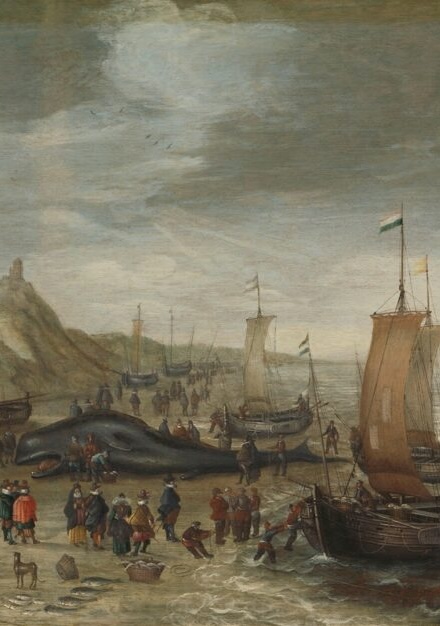
In the grey, bracing chill of a November morning on the northern shores of Nantucket, an ancient and haunting visitor made landfall. A massive male sperm whale—measuring fifty feet in length and scaling a staggering 104,000 pounds (roughly fifty-two tons)—washed ashore, its leaden, lifeless form yielding helplessly to the cadence of the raw, frigid surf. It marked the first time a sperm whale had stranded on the iconic Massachusetts island in more than two decades, instantly transforming a remote stretch of sand into a focal point for ecological grief, scientific inquiry, and municipal paralysis.
The logistical nightmare that ensued forms the beating heart of "How to Move the Dead," a stirring new poem by Gretchen Williams, which has been selected as the Missouri Review Poem of the Week for September 7, 2026. Williams, a poet and writer specializing in global health equity with a Master of Science from the Harvard T.H. Chan School of Public Health, uses the colossal stranding as an extended metaphor for the intractable griefs of human existence.
Beyond its striking literary merit, the real-world event underscored a growing crisis in modern marine conservation: the tragic intersection of endangered marine megafauna and human industry. While local authorities initially struggled simply to clear the hazard from public view, subsequent scientific investigations revealed a sobering narrative. The magnificent creature—an animal that spent the majority of its life plying the dark, abyssal trenches of the ocean—did not succumb to natural causes or disease. Rather, it fell victim to the long-term, compounding injuries of a vessel strike, serving as a visceral reminder of the anthropogenic pressures reshaping our global oceans.
Read Also
Through meticulous prose and poetic reflection, this article examines the multifaceted story of the Nantucket sperm whale: the logistical puzzle of its removal, the ecological context of ship strikes, the creative genesis of Williams’s award-winning verse, and what this leviathan’s final journey teaches us about the universal human burden of letting go.
Detailed Chronology: From Shoreline Spectacle to Abyssal Return
Day One: The Discovery and the Impasse
When the fifty-foot leviathan was first spotted resting awkwardly in the shallows of Nantucket’s north shore, it immediately drew a crowd of locals, mourners, and the merely curious. The whale’s lower jaw had already been meticulously sawed off—a grim measure taken by authorities to deter illicit prize hunters from harvesting the valuable teeth as relics. With its mouth agape in a permanent, silent yawn against the relentless wash of the waves, the animal looked as though it had been cut off mid-call.
Yet, as onlookers scattered flower petals and sang coastal hymns for the "anointed mariner," municipal and state officials faced an immediate, unprecedented crisis. The animal weighed as much as eight adult African elephants or twenty-four midsize sedans. There was no heavy machinery on the island—nor indeed anywhere easily accessible along that stretch of creation—powerful enough to haul a carcass of that magnitude across solid land. Small exploratory excisions on the beach uncovered gnarled scar tissue, but no immediate signs of a lethal pathogen or traumatic injury.
Days Two through Four: The Logistics of the Impossible
For nearly a week, the massive corpse presented a compounding problem. Leaving it to rot openly on a public beach was deemed unsafe, unsanitary, and unseemly. Yet moving it inland for a comprehensive necropsy seemed entirely out of reach. The story dominated local news updates as engineers, marine biologists, and public works departments debated solutions to an object deemed quite literally "too big to move."
The impasse forced planners to pivot from terrestrial transport to maritime execution. If the whale could not be brought inland to science, science would have to make peace with the sea.
Day Five: The Operation and the Return
On the fifth day, a viable, if brutal, solution was deployed. Officials brought in a heavy-duty excavator to shift the mountain of flesh, looping a thick tether securely around the whale’s massive tail.
The carcass was dragged back into the surf, where it was hitched to a powerful tugboat. The vessel churned churning waters, towing the dead leviathan fifty miles offshore into the deep Atlantic. There, far enough to ensure it could not drift back with the changing tide, the whale was jettisoned. It sank back down into the dark—the abyssal zone where it had spent most of its life—returning to the ocean reliquary as a nutrient-rich feast for benthic scavengers, closing a tragic circle of life and death.
Supporting Context & Metrics: The Crisis of Ocean Megafauna
The stranding of the Nantucket sperm whale is not an isolated incident, but rather a high-profile window into an escalating global crisis. Sperm whales (Physeter macrocephalus) are listed as vulnerable globally and endangered under the United States Endangered Species Act. As deep-dive feeders capable of plumbing depths of over 3,000 feet in search of squid, these magnificent mammals must regularly surface to breathe, leaving them dangerously vulnerable to maritime traffic.
| Metric / Fact | Detail |
|---|---|
| Animal Dimensions | 50 feet in length, weighing approximately 52 tons (104,000 lbs). |
| Historical Context | The first sperm whale stranding on Nantucket in over 20 years. |
| Primary Cause of Death | Long-term complications resulting from a commercial ship strike. |
| Removal Method | Excavator shift, tail tethering, and tugboat transport 50 miles offshore. |
| Ecosystem Impact | Whale fall provides decades of sustenance for deep-sea benthic organisms. |
The Anthropogenic Threat: Vessel Strikes
While initial beachside investigations revealed no obvious trauma, scientists later determined that the whale was likely killed by the delayed effects of a ship strike. As global commercial shipping lanes expand and vessel speeds increase, collisions between high-speed container ships and marine mammals have surged.
For animals as massive as the sperm whale, a collision with a bow can cause catastrophic internal trauma that the animal may survive for weeks or months before succumbing to infection, tissue necrosis, or the inability to dive and feed effectively. This invisible toll represents a tragic anthropogenic epilogue to the lives of creatures that have navigated the world’s oceans for millions of years.
Official Statements and Literary Perspectives
The Voice of the Author
Gretchen Williams, whose poem "How to Move the Dead" captures the emotional resonance of the Nantucket event, brings a unique interdisciplinary lens to her work. Holding a Master of Science from the Harvard T.H. Chan School of Public Health and serving as a certified guide with the Association of Nature and Forest Therapy, Williams bridges the gap between ecological observation and human interiority.
Refining her creative process through prestigious fellowships at the Bread Loaf Writers’ Conference, Kenyon Review Writers Workshop, Virginia Center for the Creative Arts, and the Massachusetts Audubon Society, Williams reflected on the conceptual origins of her poem:
"This poem explores the ways we often try to address seemingly intractable problems or situations," Williams noted in her author’s note. "And how what seems like solely an issue of logistics at first glance may instead be a matter of will—a practice in the motions required to release just about anything."
Bridging the Whale and the Human Heart
In the poem’s concluding stanzas, Williams masterfully pivots from the macrocosm of the fifty-ton mammal to the intimate, quiet tragedies of human life. She equates the removal of the stranded whale to domestic griefs:
“Like how you carry any dead thing: a broken housecat from the / middle of the road, the getaway plan long abandoned but tough / to shake off, a paper-thin marriage stock-still in its sickbed. / Hands slick with blood and marked by scars of mottled memory.”
This transition elevates the news story into an exploration of universal mourning. The logistical impossibility of moving the dead whale mirrors the emotional impossibility of processing profound loss. Whether dealing with a pet, a failed relationship, or the memory of a loved one, the burden of release requires an act of raw, physical and emotional labor. As the narrator notes, it involves “cradling whatever remains to the curb, to the shoreline, to an uncertain threshold—released into the next world,” while searching for words and casting eyes about to avoid looking down as one finally lets go.
Future Outlook: Conservation and Cultural Reflection
The story of the 2025 Nantucket sperm whale stranding, as immortalized in Williams’s 2026 poetry recognition, leaves a lasting imprint on both marine science and contemporary literature.
On an ecological front, marine conservationists continue to push for mandatory vessel-speed restrictions in known whale migration corridors and feeding grounds. Incidents like the Nantucket stranding serve as stark reminders that the health of our oceans is inextricably linked to human accountability. Every ship strike is an avoidable tragedy that demands technological innovations—such as acoustic monitoring and thermal imaging systems on commercial vessels—to detect and avoid marine mammals before impact occurs.
Culturally, the event and its poetic transformation invite society to confront our discomfort with mortality. In an era that often sanitizes death and attempts to engineer solutions for every natural obstacle, the stranded whale reminded island residents and global readers alike of the raw, untamed reality of nature. It required physical labor, community witness, and ultimately, a surrender to the sea.
As "How to Move the Dead" continues to resonate with readers of the Missouri Review and beyond, it stands as a testament to the power of art to metabolize tragedy. Gretchen Williams has transformed a grim logistical crisis on a cold Massachusetts beach into a timeless meditation on stewardship, grief, and the heavy grace required to let go of what we can no longer hold.





Comments
Facebook App ID not configured. Please add it in the Customizer.