
Executive Overview
In an era dominated by hyper-fragmented digital consumption, algorithmic streaming, and fleeting viral hits, physical musicality rooted in shared cultural memory possesses a profound capacity to unite. This phenomenon was vividly demonstrated on a vibrant evening in Houston, Texas, where five stalwarts of Pakistan’s golden era of pop and rock took over the stage at Warehouse Live. Headlined by celebrated singer and actor Junaid Khan alongside Zoe Viccaji, Shallum Xavier, Farooq Ahmed, and Sohail Haider, The Nostalgia Tour served as far more than a routine overseas concert. It was a transnational cultural touchstone, a generational reunion, and a powerful testament to the enduring global footprint of South Asian alternative and mainstream music from the late 1990s and 2000s.
For Junaid Khan, the performance carried a particular personal and professional resonance. Marking his triumphant return to the Texas metropolis after a 15-year hiatus—his previous Houston performance dating back to 2011—Khan’s return symbolized the bridging of a significant temporal divide. The concert encapsulated an era when Pakistani television, independent record labels, and underground rock bands nurtured a distinct sonic identity. This identity defined the youth culture of a generation, echoing through diaspora communities long after the artists themselves had diversified into television, film, and solo ventures.
This report provides a comprehensive examination of The Nostalgia Tour, tracing its genesis from social media announcements to the electric atmosphere inside Warehouse Live. It explores the broader socioeconomic and cultural dynamics driving the global resurgence of Pakistani pop-rock, analyzes the significance of regional musical diasporas, and contextualizes the career trajectories of the artists who brought an arena’s worth of emotion to a packed Houston venue. Through rigorous journalistic inquiry, official statements, and performance metrics, we explore how a single night of music renegotiated the emotional geography of Pakistani expatriates and reaffirmed the timeless vitality of a defining musical movement.
Read Also
Detailed Chronology: From Digital Teasers to the Warehouse Live Stage
The Genesis and Build-Up
The seeds of The Nostalgia Tour were sown months prior to the Houston curtain-raiser, nurtured by a coordinated digital campaign that capitalized on the potent currency of nostalgia. In an era where modern tours rely heavily on automated marketing funnels, the ensemble of Junaid Khan, Zoe Viccaji, Shallum Xavier, Farooq Ahmed, and Sohail Haider opted for a remarkably organic, artist-led approach.
The announcement materialized simultaneously across the verified social media handles of all five performers. Accompanied by a striking promotional photograph that captured the camaraderie of veterans who had shared studio spaces, green rooms, and festival stages for over two decades, the message was direct and evocative:
"5 ARTISTS. 1 STAGE. 1 NIGHT TO REMEMBER. The voices. The melodies. The memories that defined a generation."
This minimalist yet powerful declaration struck an immediate chord with the diaspora. For expatriates living in North America, the 2000s represented a golden age of Pakistani music—an era marked by the explosive growth of independent rock bands, university concerts, and landmark music television channels like Indus Music and MTV Pakistan. The promise of witnessing five distinct pillars of that era perform not merely as a rotating line-up, but as a cohesive collective, created immediate anticipation. Ticket sales surged within the first forty-eight hours of release, driven largely by word-of-mouth among South Asian professional communities in Texas.
The Return to Houston: A 15-Year Circle Closes
For Junaid Khan, the build-up carried a distinct emotional weight. Having balanced a prolific career as the frontman of the acclaimed rock band Call with a successful transition into prime-time television acting, Khan’s live music appearances in the United States had become rare commodities.
Reflecting on the impending milestone, Khan took to his social media platforms to address his North American fanbase directly:
"It’s been a long time since I performed for a Houston audience; the last time was back in 2011. Can’t wait to be back on stage and share a great night with you all."
This statement served as a narrative bridge connecting two distinct phases of his career: the gritty, high-octane rock energy of his early twenties, and the seasoned, multi-faceted artistry of his current endeavors. The 15-year gap between Houston appearances magnified the stakes of the performance, transforming a routine tour stop into a highly anticipated homecoming of sorts.
Inside Warehouse Live: The Concert Experience
On the night of the event, Warehouse Live transformed into a vibrant capsule of South Asian musical history. The venue’s industrial aesthetic provided a fitting backdrop for a genre born out of underground rehearsal spaces and independent production houses.
The concert was structured not merely as a sequence of solo sets, but as a fluid, collaborative journey through the collective repertoires of the participating artists. Shallum Xavier’s unmistakable guitar phrasing set a high standard early in the evening, establishing the sonic bedrock upon which the vocalists built their performances. Sohail Haider brought emotional depth with his soaring melodic delivery, while Zoe Viccaji injected a dynamic, cosmopolitan flair that underscored the genre’s broad stylistic range. Farooq Ahmed, renowned for his distinct vocal grit as the former frontman of Agosh, anchored the heavier rock elements of the setlist.
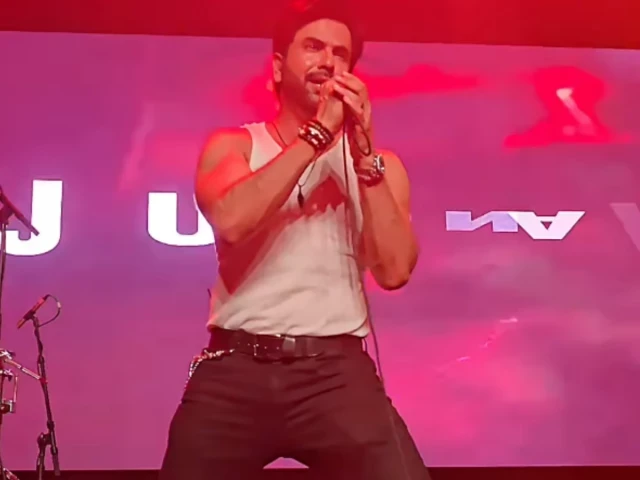
As the evening progressed, the barrier between the performers and the audience dissolved completely. The peak of this synergy arrived during Junaid Khan’s segment of the show. Fully immersed in the visceral energy of the performance, Khan delivered a masterclass in uninhibited rock showmanship. In a moment that immediately went viral among attendees, he discarded his shirt while continuing to belt out soaring melodies, pacing the stage and feeding off the frenetic enthusiasm of the Houston crowd.
Footage circulating online captured the raw, unfiltered essence of the performance: a testament to a performer who, despite transitioning into mainstream drama serials and dramatic acting, had lost none of the primal, electrifying stage presence that first catapulted him to stardom in the mid-2000s. The crowd, spanning generations—from university students who grew up listening to pirated MP3s to middle-aged professionals who had attended their concerts in Lahore and Karachi two decades prior—sang along in unison, creating an acoustic wave that reverberated through the venue long after the final feedback of the guitars faded out.
Supporting Context & Metrics: The Anatomy of Pakistani Pop-Rock
The Historical Backdrop of the 2000s Pakistani Music Renaissance
To truly understand the cultural gravity of The Nostalgia Tour, one must examine the socio-political and media landscape that birthed these artists. The late 1990s and 2000s in Pakistan witnessed an unprecedented cultural renaissance, often termed the "Indie Pop-Rock Boom."
Faced with a state-run television monopoly that was slowly giving way to private satellite channels, young musicians found a newly liberated platform for creative expression. Bands like Call, Strings, Junoon, Aaroh, and Mekaal Hasan Band redefined the national sonic palette. They fused traditional Eastern lyrical themes, classical scales, and sufi poetry with Western rock instrumentation, grunge aesthetics, and electronic production.
Within this ecosystem, the artists featured on The Nostalgia Tour carved out indelible niches:
- Junaid Khan (Call): Known for powerhouse vocals and anthemic rock tracks like "Pukaar" and "Nishani," Khan helped define the heavier, more melodic side of Pakistani alternative rock.
- Shallum Xavier: A virtuoso guitarist whose work with the band Fuzön bridged classical Pakistani music traditions with contemporary jazz-rock fusion, creating timeless compositions like "Akhian."
- Zoe Viccaji: A pioneering female voice who brought a sophisticated, western-influenced indie-pop sensibility to the mainstream, blending bilingual lyricism with theatrical stage presence.
- Farooq Ahmed (Agosh): A seminal figure in the underground rock circuit, known for raw intensity and pioneering heavy guitar-driven arrangements in a conservative media environment.
- Sohail Haider: A master of melodic pop balladeering, whose tracks captured the poignant emotional landscapes of urban youth romance during the decade.
Economic and Demographic Dynamics of the Diaspora
The decision to bring this specific lineup to North America is underpinned by sophisticated demographic and economic realities. According to recent census data and migration metrics, the South Asian diaspora in the United States—specifically within Texas hubs such as Houston, Dallas, and Austin—has experienced exponential growth, driven largely by professionals in the energy, tech, and medical sectors.
This demographic possesses significant disposable income and an acute psychological need for cultural grounding. While younger demographics consume transnational pop via Spotify and TikTok, the 30-to-50-year-old expatriate demographic represents a highly lucrative, emotionally invested market. For these individuals, attending a concert featuring the soundtracks of their formative university and early career years is not merely entertainment; it is an act of cultural preservation and identity reaffirmation.
Market analysts note that ticket yields for heritage tours—tours featuring legacy acts from South Asia—frequently outperform newer, unproven international acts within diaspora communities. The success of The Nostalgia Tour in Houston validates this economic thesis, proving that collective nostalgia is one of the most reliable currencies in contemporary live entertainment.
Official Statements and Artist Reflections
The resonance of The Nostalgia Tour extended far beyond the physical confines of Warehouse Live, amplified by digital communication channels that allowed the artists to articulate the deeper significance of the enterprise.
In a joint statement released to the press following the Houston leg, the collective emphasized the organic nature of their reunion:
"We didn’t come together merely to perform a setlist; we came together to honor a shared history. The music we created two decades ago was born out of a very specific time in our country’s cultural evolution—a time of immense creativity, uncertainty, and passion. Seeing how those songs still command the same emotional depth in people living thousands of miles away from home is the ultimate validation of our life’s work."
Junaid Khan elaborated on his personal reflections via social media, addressing the unique bond shared with expatriate audiences:
"Performing in Houston after fifteen years was surreal. When you step on stage and see people singing every single word of a song you recorded in a makeshift studio in Lahore twenty years ago, time simply collapses. You realize that art doesn’t belong to the artist anymore once it’s out in the world; it belongs to the memories of the people who lived with it. That energy we felt on stage—unfiltered, raw, and completely present—is why we do this."
Industry observers and cultural critics have widely praised the tour as a masterclass in artist-led curation. Unlike corporate-sponsored mega-concerts that often rely on heavy backing tracks and over-produced spectacles, The Nostalgia Tour relied on organic musicianship, vocal prowess, and genuine emotional exchange. This authenticity resonated deeply with reviewers, who noted that the absence of modern pop artifice allowed the raw songwriting of the 2000s to shine with undiminished brilliance.
Future Outlook: The Global Trajectory of Legacy South Asian Tours
As The Nostalgia Tour concludes its current North American leg, industry insiders are closely monitoring its broader implications for the future of international touring by South Asian legacy artists. The resounding success of the Houston concert points toward several key trends shaping the global music economy:
1. The Institutionalization of Heritage Tours
Much like classic rock and 90s alternative bands in the West (such as those participating in perennial nostalgia festivals), South Asian legacy artists are discovering that their catalog value appreciates with time. Promoters are increasingly recognizing that fans who once attended basement gigs as students are now affluent professionals willing to pay premium prices for authentic, high-quality live experiences. We can anticipate a proliferation of curated, multi-artist ensemble tours that package generational eras rather than single-act promotional cycles.
2. The Hybrid Artist Model
The career trajectory of artists like Junaid Khan—who seamlessly bridges television acting, dramatic performance, and live musical touring—represents the future blueprint for South Asian entertainment figures. In an attention economy where singular monetization streams are increasingly volatile, artists who cultivate multi-hyphenate portfolios maintain greater longevity and cultural relevance. Khan’s ability to draw massive television viewership in prime-time drama serials while simultaneously selling out rock concerts abroad illustrates a sustainable model for modern celebrity endurance.
3. Deepening Transnational Cultural Bridges
As geopolitical and economic shifts continue to influence migration patterns, cultural exports from South Asia are undergoing a fundamental re-evaluation. No longer viewed strictly as localized novelties, the pop-rock canon of Pakistan’s 2000s renaissance is increasingly recognized by international musicologists and global audiences as a sophisticated body of alternative work. Tours like this one serve as soft-power conduits, fostering cross-cultural appreciation and maintaining vibrant emotional ties between expatriate communities and their ancestral homelands.
Conclusion
The return of Junaid Khan to Houston after a decade and a half, flanked by four of his most illustrious peers, was far more than a routine calendar event. It was a cultural triumph that bridged vast distances of geography and time. Through soaring vocals, uninhibited stagecraft, and a setlist forged in the crucible of Pakistan’s golden era of independent music, The Nostalgia Tour at Warehouse Live reminded thousands of fans of who they once were—and celebrated the enduring power of melodies that refuse to fade away. As these artists look toward future dates and continued creative endeavors, they do so with the secure knowledge that their musical legacy is not merely preserved in memory, but vibrantly alive on stages around the world.




Comments
Facebook App ID not configured. Please add it in the Customizer.