In the freezing pre-dawn darkness of August 5, 1944, a catastrophic explosion of violence ripped through the quiet countryside of New South Wales, Australia. More than 900 Japanese prisoners of war (POWs) launched a coordinated, desperate mass uprising against their Allied captors at the Cowra POW camp. Armed with improvised weapons—ranging from baseball bats and gardening tools to sharpened cutlery and heavy blankets designed to drape over razor wire—the desperate men charged the perimeter fences in what remains the largest and bloodiest prison break in the history of World War II.
By the time the smoke cleared and the guns fell silent later that morning, 234 Japanese men and 5 Australians were dead. Every single prisoner who managed to break free from the confines of the facility was recaptured over the ensuing days, making the high-stakes escape tactically futile. Yet, the tactical failure misses the point entirely. For the Japanese soldiers, the breakout was never about freedom; it was about redemption. Imbued with an unyielding wartime philosophy that dictated surrender was an unforgivable, ultimate disgrace, these men viewed their very survival as a living death. They took up arms not to escape captivity, but to reclaim their honor through a glorious death.
Despite its staggering scale—eclipsing the famous 76-man Allied breakout from Stalag Luft III immortalized in The Great Escape—the Cowra incident has largely slipped out of Western historical consciousness. Today, more than eight decades later, the event serves as a haunting testament to the ideological gulf that separated Imperial Japan from the Western Allies, transforming a remote Australian valley into a poignant symbol of reconciliation.
The roots of the Cowra breakout stretched back to February 1942, when naval pilot Hajime Toyoshima became the first Japanese prisoner of war captured on Australian soil after his Zero fighter crashed on Melville Island. Initially detained elsewhere, Toyoshima and hundreds of other captured Japanese servicemen were transferred to the Cowra camp in New South Wales by January 1943.
Originally built to house Italian POWs, the Cowra facility was expansive, well-maintained, and divided into distinct compounds. Enlisted Japanese men lived in Compound B, while Japanese officers and conscripted Korean and Taiwanese laborers resided in Compound D. Under the requirements of the 1929 Geneva Convention—which Japan had signed but never officially ratified—the camp provided substantial creature comforts: dining halls, recreation huts, tailoring and barber shops, theater spaces, and even provisions for organized soccer and baseball.
However, these relatively comfortable conditions did little to soothe the psychological torment felt by the prisoners. Many struggled immensely with the reality of their survival, viewing the humane treatment extended by their Australian guards not as a humanitarian gesture, but as an insulting manifestation of weakness.
The Spark: The Transfer Order
The immediate catalyst for the uprising occurred on August 4, 1944. Camp authorities announced a plan to disperse lower-ranking prisoners—specifically those below the rank of lance corporal—to a different facility to alleviate severe overcrowding.
Japanese camp leaders vehemently objected, arguing that younger, enlisted soldiers relied heavily on older officers for emotional stability and cultural guidance. When Australian officials dismissed these objections, the mood within Compound B turned volatile. Later that evening, the compound’s hard-line faction convened a mass meeting. Propagandized by militaristic extremists who accused opponents of failing to live up to imperial standards, roughly 80 percent of the assembled prisoners voted in favor of a suicidal, coordinated mass breakout. Preparations were swift: prisoners gathered makeshift weapons, fashioned protective guards from baseball gloves and blankets to scale the barbed wire, and whispered final farewells, pledging to reunite spiritually at the Yasukuni Shrine in Tokyo.
The Attack at 2:00 AM
At approximately 2:00 a.m. on August 5, a distressed Japanese prisoner scaled a fence, weeping and crying out in fear, alerting the camp guards. Seconds later, a piercing bugle call—sounded by Toyoshima—echoed through the compound.
Instantly, more than 900 men burst from their huts, setting fire to their living quarters and surging toward the perimeter. Armed Australians rushed to their positions. Privates Benjamin Gower Hardy and Ralph Jones manned a Vickers machine gun, valiantly trying to beat back the human wave. They were swamped by prisoners; Jones was stabbed to death, and Hardy was clubbed. Before dying, however, Hardy managed to dismantle and remove a vital piece of the gun mechanism, successfully preventing the escapees from turning the heavy weapon against the camp guards.
Simultaneously, waves of prisoners hurled themselves over the razor-wire fences, using heavy blankets to absorb the tearing barbed wire as they poured out into the surrounding countryside.
The Aftermath and Recapture
The chaos lasted for hours until the gunfire finally subsided around 6:20 a.m. Hundreds of prisoners had successfully cleared the perimeter, initiating a massive nine-day manhunt across the New South Wales countryside. Local farmers, military units, and volunteers scoured the region. By mid-August, every single escapee had been accounted for.
Of the hundreds who fled, a devastating number never made it back alive. By the time the final casualty counts were tallied, 231 Japanese prisoners were dead immediately, with three more succumbing shortly thereafter, bringing the final Japanese death toll to 234. Roughly 183 died from gunshot wounds inflicted by guards, while dozens more committed suicide or were killed in violent infighting among the prisoners themselves. Four Australian soldiers—Hardy, Jones, Private Charles Henry Shepherd, and Lieutenant Harry Doncaster—were killed during the initial melee and subsequent manhunt, while a fifth, Thomas Roy Hancock, died in a tragic friendly fire accident.
Supporting Context & Metrics: Ideology, Culture, and Statistics
To fully comprehend why men would willingly charge machine-gun nests with baseball bats, one must examine the fierce ideological conditioning of Imperial Japan’s military culture.
The Senjinkun and the Stigma of Surrender
At the heart of the Japanese soldier’s mindset was the Senjinkun (Field Service Code), a pocket-sized directive issued in 1941. The text explicitly commanded soldiers to "be determined always to sacrifice himself" for his unit and explicitly warned: "If alive, do not suffer the disgrace of becoming a prisoner; in death, do not leave behind a name soiled by misdeeds."
Surrender was viewed as the ultimate cultural taboo—an act of supreme dishonor that severed a soldier’s ties to his family and country. The numbers vividly illustrate this stark psychological divide:
Total Allied POWs captured by Japan: Tens of thousands subjected to horrific conditions, forced labor, and brutal atrocities across the Pacific theater.
Total Japanese service members captured by Western Allies: Estimated at approximately 35,000 throughout the entire war.
Comparison with European Theater: In stark contrast, nearly 8 million German soldiers surrendered to Allied forces during World War II, including some 340,400 held in secure camps across the United States alone.
For Japanese soldiers, ending up in enemy hands meant their lives were functionally over. Fearing that their survival would bring eternal shame upon their households, many prisoners provided false names to their captors, while the Japanese government often officially classified missing troops as "killed in action" to spare families the social stigma of having a prisoner in the family tree.
Official Statements and Institutional Reflection
In the decades following World War II, both the Australian and Japanese governments worked deliberately to transform the site of tragedy into a monument to peace and mutual understanding.
Reflecting on the psychological barriers that blinded the camp administration to the impending disaster, military historian and author Mat McLachlan observed:
"The Australians simply couldn’t get their heads around the fundamental concept that Japanese prisoners preferred death to imprisonment. They could only view the Japanese through their own lens, and that distorted perspective bred a dangerous complacency."
Meanwhile, modern curators and cultural preservationists emphasize the profound transformation of Cowra’s legacy. Speaking on the integration of the local Japanese War Cemetery and the expansive Cowra Japanese Garden established in the 1970s, Australian War Memorial curator Kerry Neale noted:
"In many ways, the cemetery is a place which links the violence of the past with the restoration of the present. The Japanese gardens and the peace bell are symbols of hope and harmony set against the reality of the violence of the past."
Future Outlook: Preserving Memory Across Generations
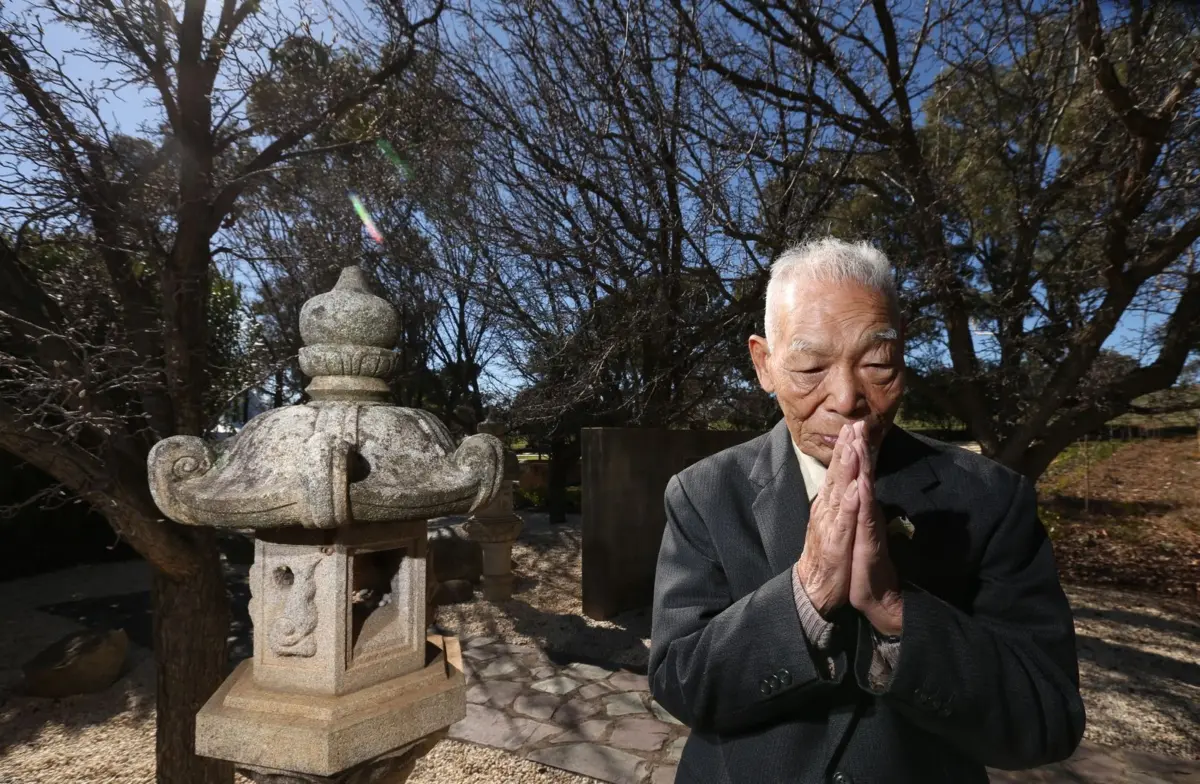
As time marches on, the living links to the events of August 1944 have slowly faded into history. Teruo Murakami, the last known survivor of the Cowra breakout, passed away in 2023 at the remarkable age of 103. With his passing, an era of firsthand testimony has drawn to a close, placing the heavy burden of historical stewardship onto museums, historians, and international educational programs.
Looking forward, the preservation of the Cowra POW camp site and its associated institutions remains vital for global historical literacy. Far from being viewed merely as a localized military skirmish, Cowra stands today as a profound global case study in cross-cultural empathy. Annual memorial ceremonies held at the Cowra Japanese War Cemetery continue to draw dignitaries, students, and citizens from both Australia and Japan, ensuring that the lessons of cross-cultural miscomprehension, wartime trauma, and eventual reconciliation are passed down intact to future generations.

/https://tf-cmsv2-smithsonianmag-media.s3.amazonaws.com/filer_public/93/b2/93b2606a-1623-4018-8a40-5857fe0dd865/gettyimages-453574876.jpg)
/https://tf-cmsv2-smithsonianmag-media.s3.amazonaws.com/accounts/headshot/meilan_headshot2.png)
:focal(2492x1638:2493x1639)/https://tf-cmsv2-smithsonianmag-media.s3.amazonaws.com/filer_public/93/b2/93b2606a-1623-4018-8a40-5857fe0dd865/gettyimages-453574876.jpg)
/https://tf-cmsv2-smithsonianmag-media.s3.amazonaws.com/filer_public/14/29/1429fe5b-958d-477f-ac5c-ca00faa46df6/baseball.png)
/https://tf-cmsv2-smithsonianmag-media.s3.amazonaws.com/filer_public/b3/5e/b35e1338-7998-4cdd-abd9-6ffb122a1be8/bats.png)
/https://tf-cmsv2-smithsonianmag-media.s3.amazonaws.com/filer_public/9d/9d/9d9d2c0e-3274-4a17-9268-52ea4284eef8/statelibqld_1_80019_japanese_prisoners_arriving_at_brisbane_from_new_guinea_ca_1945.jpg)
/https://tf-cmsv2-smithsonianmag-media.s3.amazonaws.com/filer_public/66/24/6624772d-17c7-44a5-9afe-c87dc664c2a2/japanese_pows_guam_aug_1945.jpeg)
/https://tf-cmsv2-smithsonianmag-media.s3.amazonaws.com/filer_public/0d/2e/0d2ebc7e-5e5a-4451-9732-65d655352ef0/hajime.png)
/https://tf-cmsv2-smithsonianmag-media.s3.amazonaws.com/filer_public/53/c2/53c2bf20-3a22-4f67-8730-68cb9d67a094/japanese-pows.png)
/https://tf-cmsv2-smithsonianmag-media.s3.amazonaws.com/filer_public/82/c2/82c2344c-9b4f-4f81-bc1c-db9141287768/blankets.jpg)
/https://tf-cmsv2-smithsonianmag-media.s3.amazonaws.com/filer_public/b2/db/b2dbfc48-0864-4e72-8faa-59661bcd6f70/survivor.png)


Comments
Facebook App ID not configured. Please add it in the Customizer.