
In the sprawling, often insular ecosystem of literary translation, few dispatches possess the razor-sharp wit, intellectual density, and irreverent candor of Miss Translation’s periodic columns. Following a whirlwind tour that spanned a rocket-propelled departure from Iowa to packed literary mixers in New York and Chicago, our anonymous correspondent has returned. Having recently crossed the threshold into her forty-first year, she remains delightfully unmoored from contemporary nomenclature—professing a total lack of understanding regarding the Gen Z concept of being "official," yet diving headfirst into the labyrinthine complexities of global linguistic exchange.
This month’s installment unfurls a thematic tapestry best summarized by the recurring axiom: Everything is Bulgarian (Unless it is Taiwanese). From viral pop music videos featuring cybernetic canids to the exhaustive structural mechanics of 19th-century Balkan prose, the column serves as both a celebration of cross-cultural adaptation and a searing meta-critique of the academic and commercial apparatuses that govern modern literature.
Beyond personal updates and party reports, this edition delivers a robust investigation into the politics of Women in Translation Month, an appraisal of queer translation theory, and an exploration of stylistic mechanics. Most notably, it presents the astounding submissions for the latest translation puzzles, showcasing the eccentric genius of contemporary translators grappling with everything from Roman visual poetry to dense, serpentine Bulgarian clauses.
Read Also
Detailed Chronology: From Iowa Rockets to the Academic Seminars
The narrative arc of Miss Translation’s recent months reads like a picaresque novel of the transatlantic literary circuit. The timeline unfolds across distinct geographies and institutional spaces:
1. The Midwestern Launch and Urban Mixers
The journey began with a high-profile departure from Iowa, setting the stage for two high-energy literary mixers hosted in New York and Chicago. Designed to foster community among translators working across disparate linguistic traditions—including Tamil, Romanian, Portuguese, Mandarin, Ukrainian, and German—these events laid the groundwork for the winter and spring AWP programming. Notably, the New York mixer accidentally catalyzed a spontaneous cross-cultural exchange: two Bulgarian attendees, previously convinced they were the sole practitioners of their specific literary niche in the city, were triumphantly united by the host.
2. The Chicago Translation Crossroads
In Chicago, the intellectual stakes were raised significantly through interactions with local translator Alta L. Price. Price’s current undertaking involves translating Tongue Mother (Lingua madre), a novel by Italian author Maddalena Fingerle set in the linguistic borderland of South Tyrol. The novel hinges on a brilliant structural conceit: toward its conclusion, the protagonists’ names are revealed to be anagrams that double as profound statements on their character and the book’s central themes (for instance, Biagio Prescher rearranging to crepai, borghesi—"I croaked, you bougies," and Luisa Prescher becoming capire Husserl—"to comprehend Husserl"). Price’s ongoing quest to replicate these intricate anagrams in English underscores the invisible, herculean labor undertaken by literary translators daily.
3. The Classroom and Theoretical Confrontations
Shifting from the social sphere to the ivory tower, Miss Translation details her descent into academia as an instructor of a niche course centered on queerness in translation. Grappling with abstract theoretical frameworks—such as the notion of "queering translation" to interrogate cultural mediation, the constructed self, and the political implications of canon-creation—she questions whether high-level theorizing actually aids the physical act of translation. Ultimately, the course pivots toward experimentation and transgressive literature, offering a vital space for queer students to connect, while drawing a direct line back to her own political coming-of-age translating Pussy Riot and feminist literature from Russia a decade prior.

Supporting Context & Metrics: Deconstructing WITM and Stylistic Mechanics
The Paradox of "Women in Translation Month"
In a characteristically contrarian segment, the column interrogates Women in Translation Month (WITM). Highlighting a perennial semantic confusion, the author notes that the initiative celebrates women writers rather than women translators.
- The Demographic Reality: Women already constitute the overwhelming majority of literary translators working into English and across global languages.
- The Marginalization Matrix: While translators occupy a historically marginalized position within the publishing industry—frequently erased by marketing departments and academic compartmentalization—the post-MeToo feminist literary turn has successfully elevated the visibility of women-authored books in translation to roughly fifty percent of the Anglophone market.
- The Sociological Undercurrent: Reflecting on her internal resistance, the author attributes her anxiety not to the initiative itself, but to an inherent fear of power and a solidarity-driven aversion to the corporate machinery of major publishing houses like Penguin Random House.
The Anatomy of Style
Following an experiment in attending a virtual masterclass on style hosted by Garth Greenwell—where 200 participants dove into the nitty-gritty of parts of speech—the column explores the ideological underpinnings of prose style. Contrasting the spare, muscular, "Strunk and White" aesthetic traditionally championed by American MFA programs (characterized as cishet-masculine) with the florid, expansive stylings associated with queer writers like Greenwell and James Baldwin, the discussion touches on the rigid boundaries forced upon literature by commercial and academic packaging.
Official Statements & Highlights: The Puzzle Results and Submissions
True to its format, the column serves as a venue for rigorous intellectual play, showcasing breathtaking responses to previous translation challenges alongside a brand-new linguistic puzzle.
The Optatian Triumph
The previous challenge—rendering Roman poet Optatian’s visual poem Carmen 23—drew extraordinary, highly conceptual responses that confounded skeptics:
- John R. Sesgo offered a conceptual piece utilizing a grid of highlighted characters to spell out a meta-commentary on the nature of the prompt.
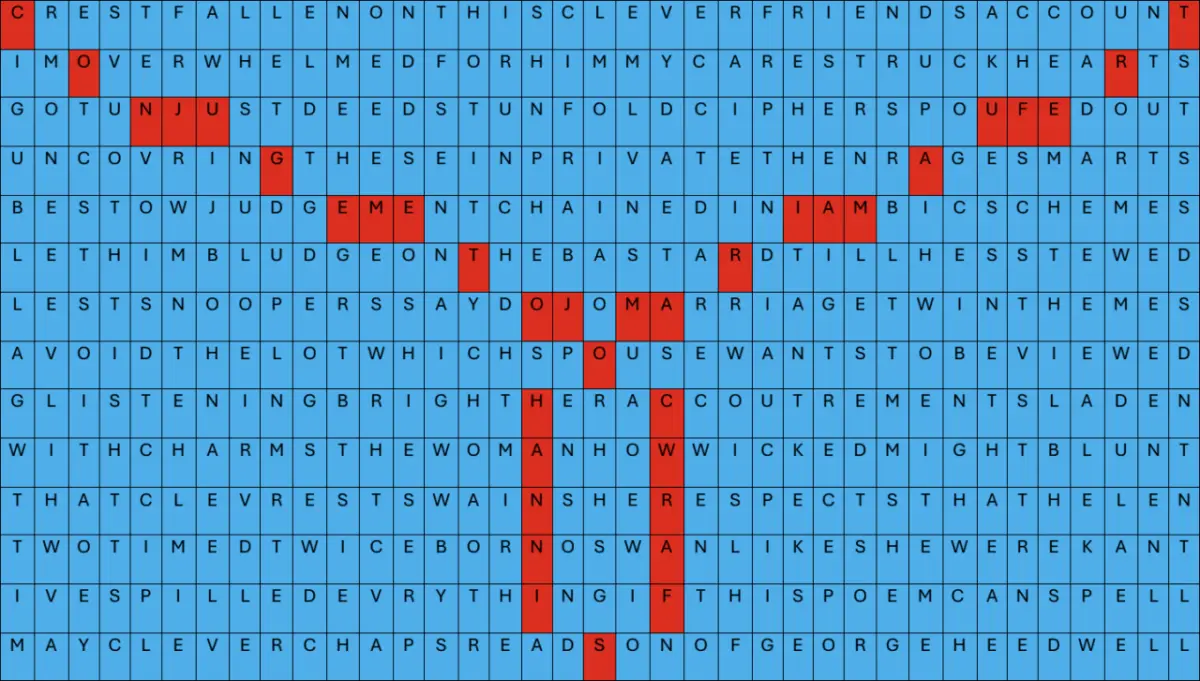
- Nikola Denkov bridged Bulgarian and English, crafting a grid that integrated a transliterated secret message ("I caught Ana passionately tangled with Mark") with biting commentary on the impossibilities of classical names.
- KR Emmanuel delivered a masterclass in translation by turning the Latin original into a Shakespearean sonnet in iambic pentameter, complete with detailed scholarly footnotes. His secret message, rendered in dactylic hexameter and shaped pictographically into a stag’s head (the universal symbol of a cuckold), translated to: "Oh John, Faruq’s even carrying off your spouse, Mary."
The New Challenge: Traveling in the Direction of the Shadow
Looking ahead, the September puzzle features an 18-clause, serpentine sentence from Iana Boukova’s 19th-century Balkan novel Traveling in the Direction of the Shadow, translated from the Bulgarian by Ekaterina Petrova. The sentence, which simultaneously captures the deep past, the middle present, and the immediate present while a groom and bride breach a long-abandoned, rodent-infested house, challenges readers to manipulate tenses, verbs, and adjectives for optimal musicality and rhythm. Solutions are slated for submission to [email protected].
Future Outlook: Taiwanese Queer Literature and the Aesthetics of Despair
As the column draws to a close, Miss Translation trains her lens on two monumental works of Taiwanese queer literature translated by Ari Larissa Heinrich, highlighting a vibrant literary boom that followed the dissolution of the KMT military dictatorship in 1987:
- The Membranes by Chi Ta-Wei (Translated by Ari Larissa Heinrich): A 22nd-century eco-dystopian novel following Momo, a lonely transfemme dermal care technician navigating a complex, violent relationship with a female android named Andy. The text exemplifies the unmitigated dread, danger, and despair characteristic of an era where political liberation did not equate to emotional ease.
- Last Words from Montmartre by Qiu Miaojin (Translated by Ari Larissa Heinrich): A fragmented, non-linear masterpiece functioning essentially as an extended suicide note by an author who tragically took her own life in Paris in 1995 at the age of 26. The book’s profound influence cemented its protagonist’s name as a foundational, non-derogatory term for lesbians in 1990s Taiwan.
These works—steeped in cynicism, emotional urgency, and formal experimentation—point the way forward for contemporary translators and writers alike. Whether navigating the bureaucratic constraints of academia, wrestling with the theoretical bounds of queer translation, or meticulously rearranging the clauses of a 19th-century Bulgarian sentence, Miss Translation continues to map the shifting frontiers of global letters with unmatched acuity.




Comments
Facebook App ID not configured. Please add it in the Customizer.