
Executive Overview
Few cultural moments in recent history have cleaved the American public consciousness quite as sharply as the events of December 4, 2024. On that brisk winter morning outside a New York hotel hosting UnitedHealth Group’s annual investor conference, the simmering rage of a populace battered by corporate medical bureaucracy erupted into sudden, shocking violence. Masked assailant Luigi Mangione allegedly gunned down UnitedHealthCare CEO Brian Thompson, igniting a whirlwind multi-state manhunt, an unprecedented wave of dark digital humor, and a complex cultural reassessment of corporate power, healthcare equity, and the limits of civil disobedience.
Now, Los Angeles-based filmmaker and interdisciplinary artist Stanya Kahn has captured the raw, chaotic nerve of that cultural earthquake in her newly debuted 30-minute video installation, Deny, Defend, Depose (2026). Named chillingly after the corporate-style defensive litigation tactics and the phrases allegedly etched onto the shooter’s bullet casings—a dark mirror to the insurance industry’s mechanisms for denying patient care—Kahn’s work synthesizes the raw surveillance footage of the killing with a relentless, dizzying flash-flood of social media commentary.
Moving beyond mere historical archiving, Kahn’s project interrogates the collective psyche of a nation brought to its knees by medical debt and administrative cruelty. By juxtaposing the grim reality of assassination footage with the chaotic, subversive humor of viral internet memes, Deny, Defend, Depose positions itself as both a stark artifact of a fractured information ecosystem and a profound meditation on contemporary alienation. As the legal proceedings against Mangione advance toward a federal trial in early 2027, Kahn’s work forces viewers to confront an uncomfortable truth: when institutional systems fail to protect the vulnerable, the boundary between tragic violence and populist catharsis begins to dangerously blur.
Read Also
Detailed Chronology: From Midtown Manhattan to the Digital Underground
The saga that inspired Kahn’s artistic intervention unfolded with the breathless pacing of a high-stakes geopolitical thriller, uniquely augmented by the omnipresence of twenty-first-century digital media.
December 4, 2024: The Shooting
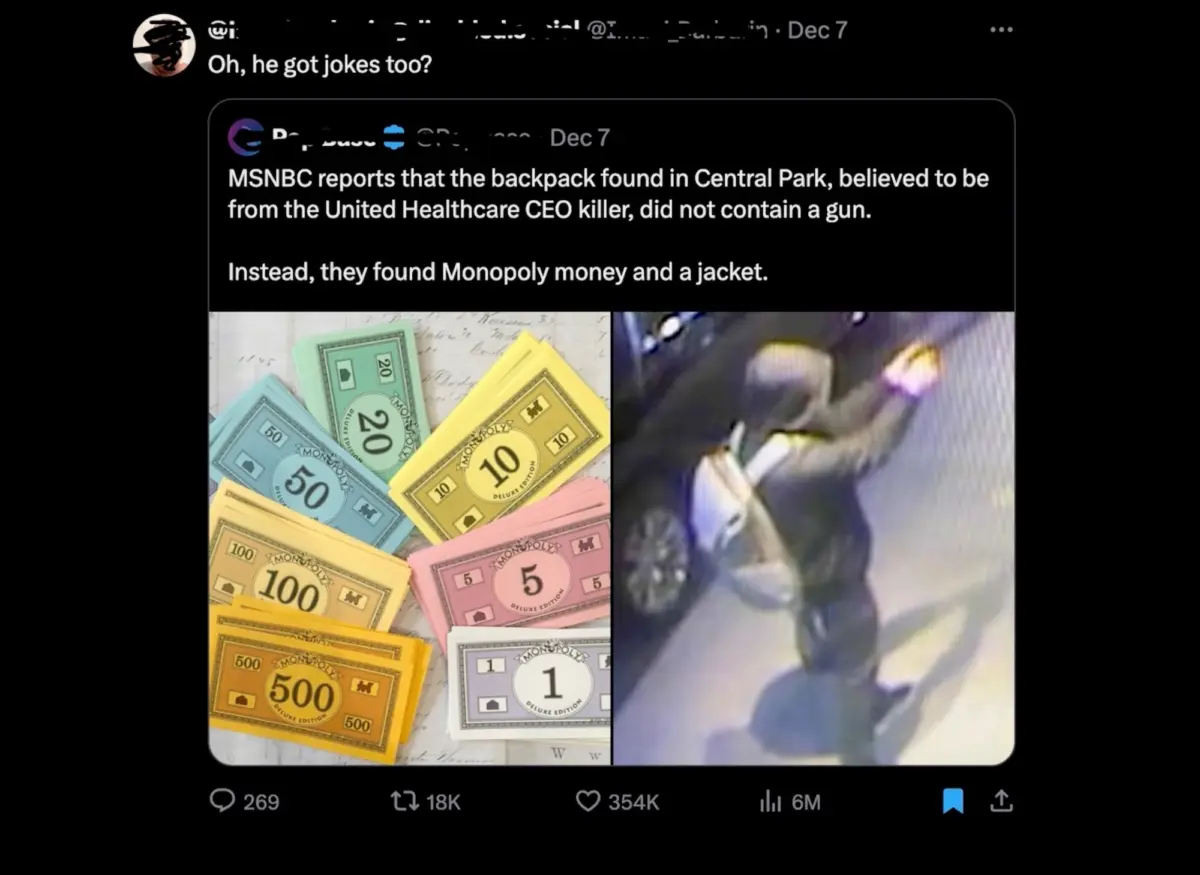
In the early morning hours outside the New York Hilton Midtown, where executives of UnitedHealth Group had gathered for their annual investor conference, Brian Thompson was ambushed. Security cameras captured a masked assailant stepping out from the shadows, opening fire, and instantly neutralizing the head of one of the nation’s largest health insurers. The gunman fled the scene on a Citi Bike, vanishing into the sprawling avenues of Manhattan before looping through Central Park, where authorities later recovered a backpack containing a theatrical, almost mocking artifact: a stack of Monopoly money.
The Manhunt and the McDonald’s Arrest
A massive multi-state manhunt ensued, transfixing a global audience. The suspect managed to slip away to Pennsylvania, evading dragnets until a sharp-eyed employee at a local McDonald’s recognized him days later. The informant’s actions, while praised by law enforcement, triggered an immediate and ferocious backlash across the internet. The fast-food franchise was inundated with a wave of digital retribution—specifically, a coordinated deluge of one-star reviews on public review platforms by internet users sympathetic to the fugitive.

The Birth of an Unlikely Folk Hero
Almost overnight, the narrative shifted from a standard crime reportage to a dark, satirical folk tale. Details of the suspect, Luigi Mangione—a Princeton graduate possessing striking facial bone structure and reportedly suffering from excruciating, intractable pain following a severe back injury—leaked into the public sphere. Rather than inspiring universal condemnation, Mangione became an unlikely vessel for populist rage. Internet forums exploded with black humor, romanticized iconography, and biting critiques of the American healthcare status quo. The public did not merely excuse the alleged violence; they projected their deepest frustrations with corporate greed onto the suspect, transforming a murder suspect into an anti-corporate folk hero.
Legal Milestones and Ongoing Proceedings
As the cultural reverberations continued to echo, the legal apparatus ground forward. On August 14, Mangione formally pleaded guilty to two federal charges related to the stalking of Thompson, issuing a stark, unadorned confession in open court: "I shot Mr. Thompson in Manhattan, and he died." With federal trials scheduled to ramp up toward a broader legal reckoning in January 2027, the societal debate surrounding the root causes of the tragedy remains entirely unresolved.
Supporting Context & Metrics: The Anatomy of a Cultural Shift
Stanya Kahn’s Deny, Defend, Depose does not exist in a vacuum; it is rooted in a long lineage of interdisciplinary art that investigates the waste-land of contemporary media, digital saturation, and systemic complicity. Kahn, whose previous acclaimed works include No Go Backs and institutional exhibitions at MoMA PS1, the New Museum, and the Whitney Biennial, recognized instantly on December 4 that she was witnessing a seismic historical pivot.
The Methodology of the Archive
In the immediate aftermath of the shooting, Kahn began screen-grabbing social media posts across platforms (notably X, formerly Twitter, and various Reddit threads), operating on an instinct honed by her earlier documentary practices. Recognizing that corporate moderation and platform algorithms would inevitably attempt to suppress, scrub, or bury the graphic surveillance footage and subversive public commentary, she preserved a volatile digital record.
The resulting video installation is structured as an unrelenting sensory experience:
- Visual Presentation: The piece opens with the authentic, haunting surveillance footage of the shooting before transitioning into a relentless stream of social media reactions. To protect the privacy and safety of the original posters, their names and digital avatars are aggressively obscured with a digital pen tool.
- Pacing and Rhythm: The posts race across the screen at breakneck speed, often vanishing before the viewer can fully absorb their textual weight. This stylistic choice mirrors the exhausting, hyper-accelerated cadence of the modern news cycle.
- Auditory Landscape: The visual deluge is anchored by a thumping, industrial acid-house and jungle soundtrack curated by forward-thinking electronic artists, including Acid Arab, Baseck, Caterina Barbieri, Cameron Outlaw, Unknown Origin, and Kahn herself.
Philanthropic Engagement and Public Screenings
Rather than treating the tragedy as mere artistic exploitation, Kahn has embedded community support directly into the exhibition model. Following its premiere on September 6 at the Los Angeles artist-run nonprofit Human Resources, the project scheduled subsequent screenings at the Now Instant cinema/bookstore and Leroy’s art gallery, with efforts underway to bring the installation to New York City. At these events, attendees can purchase T-shirts emblazoned with the work’s title, Deny, Defend, Depose. Crucially, 100 percent of the proceeds from ticket sales and merchandise are funneled directly into GoFundMe campaigns established to help ordinary citizens alleviate crushing, system-induced healthcare costs.

Official Statements and Artistic Insights
In an exclusive interview with ARTnews, Stanya Kahn unpacked the complex motivations behind the creation of her piece, shedding light on the public’s shocking embrace of violent direct action and the therapeutic role of humor in national trauma.
Reflecting on her initial impulse to document the digital storm, Kahn noted:
"I didn’t know exactly what I was screengrabbing for, except that I do have an earlier practice of live-documenting current events through screen grabs. That impulse was still in me, to capture a moment that I might be fleeting… I saw these tweets unfolding and was astonished and started screengrabbing right away. At first it was just ‘That’s so funny, I have to send that to someone.’ Then it was just reveal after reveal."
Kahn highlighted how the public’s fascination quickly transcended mere gossip, morphing into a profound political statement:
"After a week of gathering these, the reveal came that he had pulled down his mask and people are like ‘Oh, he’s hot,’ and of course that was political. If he had killed children, no one would have said ‘He’s got good bone structure.’ He became an outlet for political frustration. People openly sexualized an alleged assassin, and what was sexy was not his cheekbones but that he took down a CEO."
When asked about the broader societal lessons embedded within the Mangione saga, Kahn pointed directly to the boiling point of American economic anxiety:

"Perhaps what amazed me the most was the breadth and the depth to which a general American public seemed to be at a tipping point around the exorbitant cost of health care and how cavernous the gap is between the one percent and the 99 percent. I was moved to see such a plain representation of the breadth of a disaffected public that so easily celebrated violent direct action. So one of the things we learned was that the American public has no love for a CEO, and seemed closer to accepting violent direct action than I knew."
Finally, addressing the jarring mix of laughter and outrage observed among audiences at her screenings, Kahn connected the humor directly to collective mourning:
"Humor goes hand in hand with trauma and is often a great way in to dropping down into what really hurts. And this country is hurting and this world is hurting and I think humor invites us to have a collective experience."
Future Outlook
As Deny, Defend, Depose continues its exhibition run across independent art spaces, its implications stretch far beyond the contemporary art circuit. The artwork arrives at a volatile juncture in American socio-political history, serving as a permanent monument to a moment when the social contract between corporate monoliths and everyday citizens frayed to the breaking point.
Looking ahead, several key developments will shape the ongoing discourse:
- The Federal Trial (January 2027): With Luigi Mangione having already confessed to stalking and killing Brian Thompson in federal court hearings, the upcoming 2027 trial will undoubtedly reignite national media focus, transforming the courtroom into a theatrical stage for broader debates on medical ethics, insurance negligence, and criminal justice.
- The Evolution of Political Art: Kahn’s methodology—harvesting unmoderated digital ephemera to construct an atmospheric critique of late capitalism—pioneers a new paradigm for documentary video art. As platforms increasingly sanitize and suppress controversial populist movements, independent artists acting as digital archivists will play an increasingly vital role in preserving historical dissent.
- The Healthcare Reform Stalemate: Despite the cultural shockwaves of December 2024, structural reforms to America’s for-profit healthcare system remain intensely gridlocked. Installations like Deny, Defend, Depose ensure that the underlying systemic rage—the life-or-death frustration of denied claims, exorbitant premiums, and bureaucratic cruelty—cannot simply be swept under the rug by corporate PR machines.
Ultimately, Stanya Kahn’s work reminds us that art’s highest calling is not to provide comfortable answers, but to hold up an unsparing, brilliant mirror to our collective fractures. Whether viewed as an indictment of corporate greed, a psychological study of internet-era mythmaking, or an act of mourning for a broken society, Deny, Defend, Depose stands as a defining cultural document of our turbulent times.




Comments
Facebook App ID not configured. Please add it in the Customizer.