
Executive Overview
In a strategic move poised to reshape the landscape of printed electronics, display manufacturing giant E Ink has announced a major financial investment in NewCopper, a privately held U.S. technology startup specializing in conductive copper ink. The investment—structured through a post-money Simple Agreement for Future Equity (SAFE)—aims to accelerate NewCopper’s production scale-up, transition its breakthrough chemistry from laboratory research to commercial manufacturing, and integrate advanced copper-based solutions into next-generation ePaper displays and flexible electronic architectures.
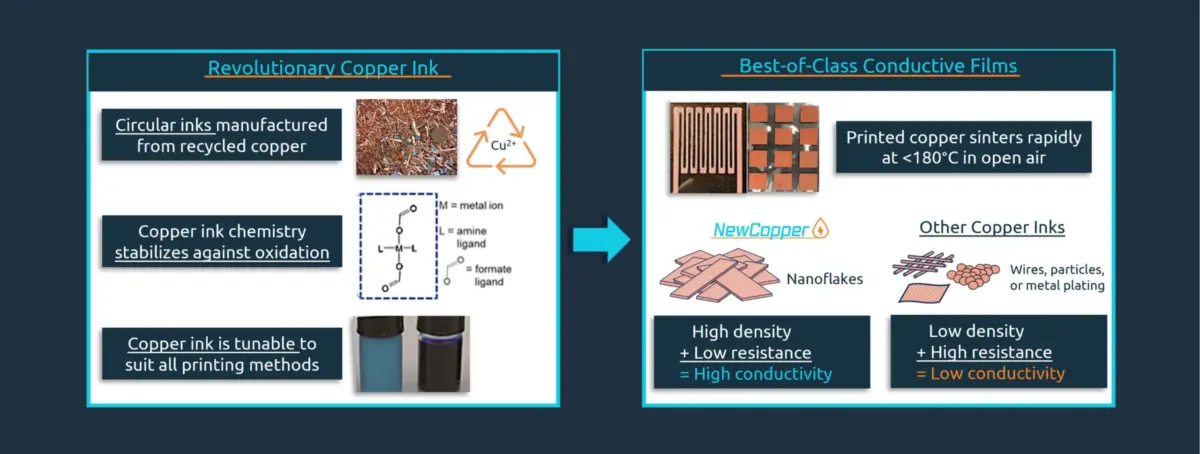
NewCopper’s proprietary technology is rooted in groundbreaking joint research conducted at the University of Maryland and Yale University. Holding an exclusive license from the University of Maryland for its copper ink formulation, NewCopper has solved a decades-old materials science challenge: how to utilize copper—a metal offering high electrical conductivity at a fraction of the cost of silver—without the severe limitations of oxidation.
By combining NewCopper’s pioneering chemical formulations with E Ink’s world-class roll-to-roll manufacturing infrastructure and display expertise, this partnership addresses a critical supply chain bottleneck for the global electronics industry. As demand surges for flexible displays, Internet of Things (IoT) sensors, wearable health devices, Radio-Frequency Identification (RFID) tags, and photovoltaic systems, the transition from costly silver-based inks to affordable copper alternatives represents a paradigm shift for device manufacturers worldwide.
Read Also
Detailed Chronology: From Academic Breakthrough to Industrial Partnership
The genesis of NewCopper’s technology trace back to advanced materials science laboratories at two of America’s leading research institutions: the University of Maryland and Yale University. For years, academic researchers sought to harness copper as a viable replacement for silver in printed electronics. While silver has long been the gold standard for conductive pathways due to its exceptional electrical properties and resistance to ambient corrosion, its prohibitive and volatile cost has constrained profit margins and limited the mass adoption of low-cost flexible electronics.
The Oxidation Dilemma
Copper offers roughly the same electrical conductivity as silver while costing a tiny fraction of the price. However, copper possesses a critical vulnerability: rapid oxidation. When exposed to air and moisture, copper instantly forms an insulating oxide layer (Cu₂O or CuO) that degrades electrical contact, ruins printed traces, and renders the material useless for precision electronic applications.
To overcome this, academic teams at the University of Maryland and Yale University engineered a novel low-temperature, reactive, and self-passivating copper ink formulation. This proprietary chemistry prevents surface oxidation during the curing process, allowing copper nanoparticles to coalesce into highly conductive, robust traces under mild thermal conditions compatible with flexible plastic substrates like polyethylene terephthalate (PET) and polyimide (PI).
Spin-Out and Commercialization
Following successful laboratory validations, NewCopper was established as an independent, privately held U.S. enterprise to commercialize the research. The startup secured an exclusive licensing agreement from the University of Maryland, positioning itself to bridge the notoriously difficult chasm between academic discovery and commercial industrialization—often referred to in technology circles as the "Valley of Death."
E Ink’s Strategic Intervention
Recognizing the transformative potential of NewCopper’s formulation, E Ink stepped in with a strategic investment via a post-money Simple Agreement for Future Equity (SAFE). Rather than acting purely as a financial backer, E Ink has committed its extensive R&D resources, materials engineering talent, and mass-manufacturing infrastructure to help NewCopper scale up its production lines.
Because NewCopper’s copper ink formulation is naturally compatible with E Ink’s advanced roll-to-roll (R2R) coating capabilities, the partnership opens immediate pathways for E Ink’s internal engineering teams to evaluate copper ink as a direct replacement for silver in current and future electrophoretic displays, touch sensors, and electrode backplanes.
Supporting Context & Metrics: The Economics of Conductive Inks
To understand the magnitude of E Ink’s investment in NewCopper, one must analyze the macroeconomic and technical dynamics governing the conductive ink market.
The Silver Problem vs. The Copper Promise
- Material Cost: Silver is a precious metal subject to intense market volatility. As the global demand for electric vehicles, solar panels, and consumer electronics grows, silver prices remain high, directly inflating the Bill of Materials (BoM) for printed circuit boards, antennas, and flexible sensors.
- Abundance and Price Stability: Copper is an industrial base metal with deep, stable global supply chains. Shifting from silver to copper ink can reduce conductive material costs by 70% to 90%, depending on application scale and purity requirements.
- Conductivity Parity: Bulk copper has an electrical conductivity of approximately $5.96 times 10^7 , textS/m$, compared to silver’s $6.30 times 10^7 , textS/m$. This marginal difference means performance is virtually uncompromised.
Target Markets and Applications
The market for printed electronics is expanding exponentially, driven by several key sectors:

- Flexible and Wearable Displays: ePaper, OLED, and micro-LED displays require flexible conductive backplanes that can withstand bending without fracturing. NewCopper’s low-temperature curing process prevents thermal damage to plastic substrates while maintaining mechanical flexibility.
- RFID and Smart Packaging: Low-cost inventory tracking tags require billions of printed antennas annually. Silver ink makes high-volume RFID tags economically unviable for low-cost retail goods, whereas copper ink unlocks true mass-market scalability.
- IoT Sensors and Smart Agriculture: Environmental sensors, moisture detectors, and biomedical patches rely on printed electrodes. Copper inks enable disposable, eco-friendly sensor manufacturing at scale.
- Photovoltaic (Solar) Technologies: Solar cell manufacturers continuously seek alternative metallization pastes to reduce production costs and improve energy conversion efficiencies.
Strengthening Localized Supply Chains
Beyond immediate cost savings, the collaboration between E Ink and NewCopper reinforces the localized supply chain for advanced electronic materials in North America. By developing domestic production capabilities for high-performance copper ink, the partnership mitigates geopolitical supply chain vulnerabilities, reduces reliance on overseas material imports, and establishes a secure industrial foundation for the next generation of smart devices and ePaper components.
Official Statements and Industry Perspectives
The partnership bridges two different eras of technology commercialization: E Ink’s evolution from an MIT media lab spin-out into a global display titan, and NewCopper’s current journey from university research to industrial scale.
Highlighting the shared heritage of academic innovation, Johnson Lee, Chairman and CEO of E Ink, reflected on the strategic alignment of the two companies:
"E Ink itself spun out of academia into a global technology company, so we recognize both the promise of NewCopper’s innovation and the challenges of moving breakthrough technology from the lab to the market.
As an established leader in materials and display manufacturing, it’s our responsibility to help promising companies scale. By supporting NewCopper with resources, expertise, and commercialization experience, we can also help guide the display industry to new heights."
Industry analysts note that CEO Johnson Lee’s perspective underscores a broader trend: established hardware and materials giants are increasingly acting as venture incubators, securing proprietary access to foundational technologies before they hit the open market. For E Ink, securing a stake in NewCopper ensures that its manufacturing lines will have privileged access to low-cost, high-performance conductive inks, protecting its market dominance in ePaper technologies ranging from retail electronic shelf labels (ESLs) to large-format digital paper billboards and e-readers.
Future Outlook: What Lies Ahead for E Ink and NewCopper
As NewCopper channels the capital and engineering support provided by E Ink into operational expansion, several key milestones lie on the horizon:
1. Scaling Pilot Production to Industrial Volumes
NewCopper’s immediate objective is to transition from batch synthesis in a laboratory setting to continuous roll-to-roll pilot production. With E Ink providing technical oversight in process scaling, NewCopper aims to guarantee consistent viscosity, particle size distribution, and shelf-life stability for its reactive copper ink.
2. Commercial Integration into ePaper Architectures
Over the next 12 to 24 months, E Ink’s R&D facilities will rigorously test NewCopper formulations across various ePaper display lines. Successful integration could see commercial ePaper displays utilizing copper-based conductive tracks hitting the market within a few years, dramatically lowering manufacturing costs and improving profit margins for display module makers.
3. Broadening Ecosystem Adoption
While E Ink is the primary strategic investor, NewCopper’s ink is engineered to be a platform technology compatible with standard industrial printing methods—including inkjet printing, screen printing, flexography, and gravure printing. As production ramps up, NewCopper is expected to supply global manufacturers across the RFID, printed circuit, and photovoltaic industries, setting a new industry standard for sustainable, cost-effective printed electronics.
Conclusion
The strategic partnership between E Ink and NewCopper marks a pivotal milestone for printed electronics. By solving the oxidation riddle that has plagued copper ink research for decades, NewCopper—backed by E Ink’s manufacturing might and financial investment—is poised to eliminate the industry’s heavy dependence on expensive silver. As this technology scales, the electronics manufacturing ecosystem stands on the brink of a more affordable, sustainable, and highly efficient future.





Comments
Facebook App ID not configured. Please add it in the Customizer.