
Executive Overview
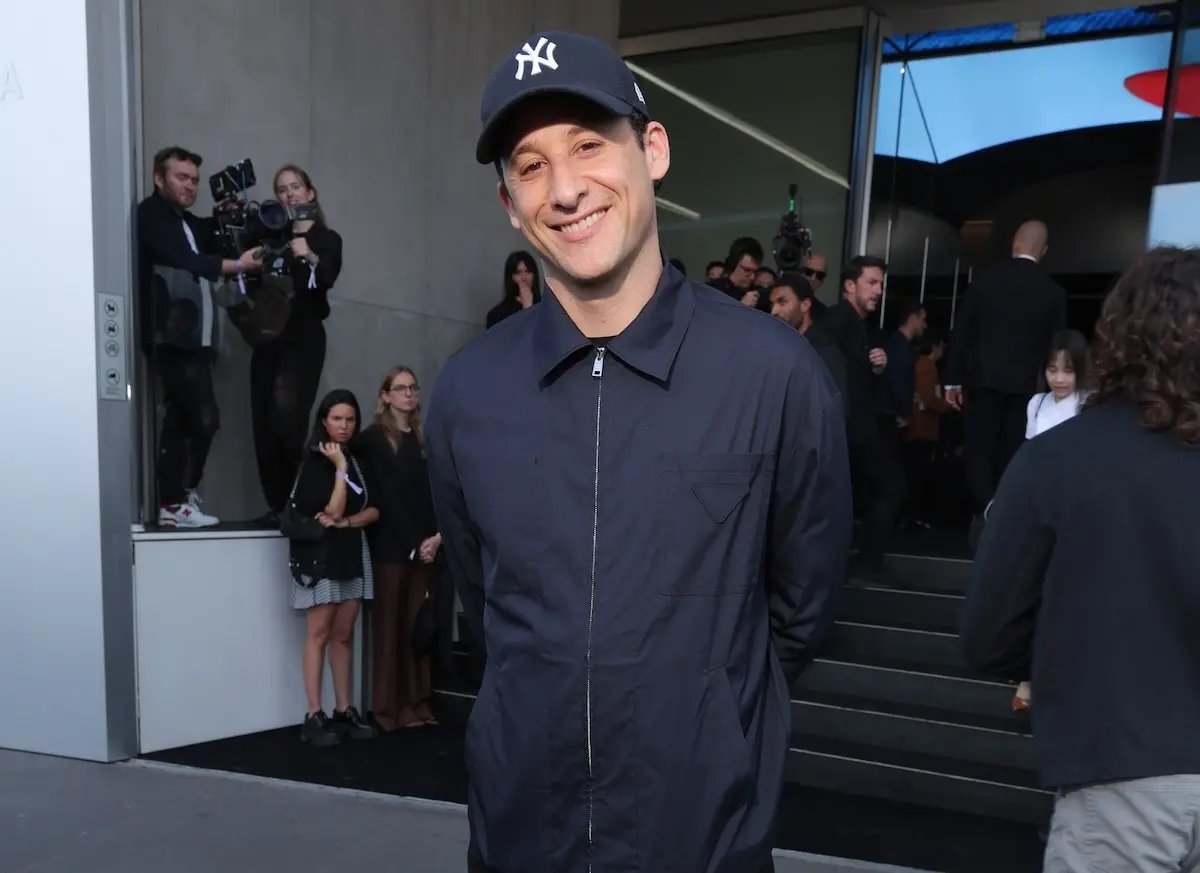
Jordan Wolfson, the contemporary art world’s reigning provocateur, has rarely been one to coddle his audiences. Known for pushing psychological boundaries through high-octane, technologically dizzying installations—such as a gyrating, hypnotic female android and a chained-up sculpture of a young boy repeatedly slammed against the floor—Wolfson has built a career on discomfort. This Friday, the artist is set to unveil his first major New York exhibition of entirely new work since 2018 at the Gagosian gallery, an event that has been shrouded in a dense fog of secrecy and reticence.
True to form, Wolfson has offered little in the way of traditional artist statements or promotional clarity. When queried by Artnet News editor Andrew Russeth about the highly anticipated showcase—which Wolfson offhandedly described in the interview as “a very traditional sculpture show”—the artist delivered a characteristically blunt dismissal: “I don’t care what people know or don’t know.” The official gallery press release, spanning just three sparse paragraphs, is similarly withholding.
Yet, a deep dive into the pages of the Gagosian Quarterly reveals the contours of what promises to be a deeply unsettling, culturally combustible exhibition. Through a virtual reality (VR) tour given to acclaimed novelist Ottessa Moshfegh, details have leaked regarding Wolfson’s latest suite of works. The pieces enlist advanced artificial intelligence to manipulate and generate jarring imagery related to deeply loaded touchstones of modern history and culture: Bob Dylan, the September 11 terrorist attacks, 1960s counterculture icon Allen Ginsberg, the 1991–92 cast of Saturday Night Live, and Jeff Koons’s fiercely controversial 1989 Made in Heaven series.
Read Also
This exhibition marks a critical inflection point in Wolfson’s trajectory. By pivoting toward artificial intelligence not merely as a novelty, but as a distorting mirror for societal trauma, collective memory, and modern alienation, Wolfson is interrogating the very nature of how contemporary humans process history. As the art world descends on Chelsea this week, critics and collectors alike are bracing themselves for an experience designed to provoke, destabilize, and disrupt.
Detailed Chronology & Exhibition Preview
The Silence Before the Storm: Refusing the Narrative
The path to Wolfson’s 2026 Gagosian exhibition has been defined by deliberate opacity. Since his celebrated and psychologically taxing exhibitions of the late 2010s, Wolfson’s output has been parsed by critics looking for signs of his next major evolution. However, his return to New York’s gallery scene has been handled with an almost monastic withdrawal from traditional public relations choreography.
When Artnet News reached out to preview the show, the artist’s deflection was absolute. Rather than building anticipation through curated soundbites or theoretical frameworks, Wolfson chose to abdicate the explanatory role entirely. The exhibition’s official press release reads more like a minimalist placeholder than a guide to a major art event, leaving a vacuum that specialty publications and insider journals have scrambled to fill.
The VR Unveiling via Gagosian Quarterly
To piece together what Wolfson has prepared for the public, one must turn to an unlikely source: the Gagosian Quarterly, the mega-gallery’s print publication. In a feature that serves as a rare window into the artist’s studio mind, Wolfson takes novelist Ottessa Moshfegh—author of the existential 2018 bestseller My Year of Rest and Relaxation—on a virtual reality walkthrough of the exhibition space.
The conversation immediately establishes the dark, reflective tone of the show. Moshfegh opens the dialogue by asking Wolfson why he recently re-read her novel. Wolfson’s deadpan reply sets off immediate alarm bells for cultural analysts: “Because my show has references to 9/11.”
While the exact nature of these historical citations remains partially veiled, the Gagosian Quarterly feature highlights a 2026 artwork featuring a haunting, generative image of the Twin Towers at night. By injecting the foundational trauma of 21st-century American consciousness into his sculptural ecosystem, Wolfson ties personal withdrawal and societal catastrophe together.
AI, Bob Dylan, and the Loneliness of Creation
Once Moshfegh dons the VR goggles, the exhibition’s digital landscape unfurls in unexpected ways. She encounters a computer-generated image of a half-naked Bob Dylan emerging from a swimming pool, dripping with water—an avatar she initially mistakes for Wolfson himself.
Explaining the inclusion of the iconic musician, Wolfson notes that Dylan serves as a potent cipher for “singularity”—a meditation on the profound loneliness of artmaking and the radical autonomy inherent in the creative experience. In Wolfson’s framing, Dylan is an archetype of the isolated genius, navigating a world increasingly mediated by algorithmic flattening.
The VR tour continues with a digitally manipulated historical photograph: a crowd watching poet Allen Ginsberg perform in London in 1967. Wolfson reveals how he and his team altered the source material using artificial intelligence. “We gave it the original of this image and then we changed it so all the eyes were looking at him,” Wolfson explains. He points out a telltale glitch of machine learning: a newspaper featured in the 1967 original was processed by the AI into an uncanny valley of “gibbily-gobbily text.”
Reflecting on this technological intervention, Wolfson offers a chilling critique of the medium: AI, he asserts, “takes all emotions and simplifies them.”
Appropriated History and Taboo Imagery
The digital gallery space also houses appropriated artworks, or hyper-rendered digital facsimiles thereof. Among them is a painting by Philip Guston—whose late-career, cartoonish explorations of the Ku Klux Klan and urban blight remain touchstones for grappling with ugly American truths—and a work drawn from Jeff Koons’s infamous Made in Heaven series.
Koons’s original 1989 collection, which featured explicit photographic depictions of Koons engaged in sexual acts with his then-wife, the pornographic actress and Italian politician Ilona Staller (La Cicciolina), scandalized the art world upon its debut. In Wolfson’s digital rendering, the imagery takes on an even stranger valence, appearing to Wolfson initially as something resembling “AI cartoon porn.” By filtering Koons’s high-stakes camp and commercial hubris through modern algorithmic generation, Wolfson bridges the gap between 20th-century shock art and 21st-century synthetic media slop.
Supporting Context & Metrics: The Architecture of Provocation
To understand the weight of Wolfson’s Gagosian exhibition, one must examine the broader metrics of his career, the critical polarization he consistently courts, and the evolution of his technical apparatus.
| Exhibition Element | Key Reference / Medium | Thematic Implication |
|---|---|---|
| Past Landmark Works | Colored sculpture (2016), Female Figure (2014) | Bodily trauma, mechanical autonomy, racial and gendered anxieties. |
| New Gagosian Show | AI-generated sculptures, VR, digital prints | Algorithmic flattening, collective memory, isolation. |
| Historical Ciphers | Bob Dylan, Allen Ginsberg, 9/11, SNL cast | National trauma, countercultural loneliness, systemic stratification. |
| Visual Borrowing | Philip Guston, Jeff Koons (Made in Heaven) | The legacy of shock, appropriation, synthetic pornography. |
The Spectacle of Discomfort: A Retrospective Look at Wolfson’s Oeuvre
Wolfson has never been interested in making art that simply hangs quietly on a white wall. Born in Los Angeles in 1980 and based in New York and Los Angeles, the artist first rose to international prominence through works that weaponized animatronics and video to induce visceral unease in viewers.
His 2014 masterpiece, Female Figure, featured a blonde, scantily clad animatronic woman writhing and dancing in front of a mirror while lip-syncing to a distorted audio track that alternated between a demonic voice shouting, “My mother is dead, my father is dead, I’m an evil human being,” and pop lyrics. The work forced viewers into an intimate, voyeuristic confrontation with objectification, misogyny, and mental decay.
Two years later, Wolfson debuted Colored sculpture at the Stedelijk Museum in Amsterdam (later traveling to David Zwirner in New York). The piece featured a life-sized, puppet-like sculpture of a cartoonish boy clad in dungarees, suspended by heavy steel chains from a motorized gantry system overhead. Throughout its viewing cycle, the mechanical rig violently slammed the boy onto the floor and jerked him back up, accompanied by an unsettling soundtrack of blues music and pop samples.
The piece ignited immediate, fierce debate regarding race, violence, and the spectacle of cruelty. Critic Ajay Kurian, writing a widely cited, highly critical essay for Phaidon/Artspace, interrogated the ethics of staging such racialized violence under the guise of high-art abstraction.
The Race Question and the Contemporary Psyche
The tension surrounding race and societal division inevitably bled into Wolfson’s conversation with Ottessa Moshfegh. During the VR walkthrough, Moshfegh’s attention is drawn to a Wolfson work featuring an archival photograph of the cast from the 1991–92 season of NBC’s Saturday Night Live.
Wolfson notes the structural composition of the photograph, describing it as “particularly racial” because the show’s producers and promotional teams consciously “divided up the Black people and the white people and made a pattern out of them.”
This observation prompts a direct, unvarnished question from the novelist: “Are you obsessed with race?”
Wolfson’s response cuts to the core of his artistic philosophy:
“I think I’m obsessed with the times we live in. It’s not so much about race, it’s about the idea that you would create separatism toward another individual based on a physical attribute that they have, and the absurdity of that. And your initial assumption would be that this individual or group of individuals is less good than me, or specifically less conscious than I am.”
This articulation reframes Wolfson’s past and present provocations. Rather than acting as an instigator of gratuitous offense, Wolfson positions himself as a diagnostician of systemic absurdity—someone holding a distorting mirror up to a culture perpetually trapped in tribalism, algorithmic simplification, and historical amnesia.
Official Statements & Critical Commentary
The lead-up to the Gagosian exhibition has catalyzed a broader discussion within the art press regarding the intersection of artificial intelligence, historical trauma, and the responsibilities of contemporary masters.
- Andrew Russeth (Artnet News): Highlighting Wolfson’s resistance to narrative framing, Russeth noted the artist’s utter indifference to traditional PR onboarding, writing that Wolfson’s casual dismissal—“I don’t care what people know or don’t know”—epitomizes a career built on subverting viewer expectations and demanding that audiences do the heavy lifting of interpretation.
- Ottessa Moshfegh (Gagosian Quarterly): Through her dialogue with the artist, Moshfegh serves as both surrogate for the viewer and literary foil. By juxtaposing her dystopian, disaffected fictional universes (My Year of Rest and Relaxation) with Wolfson’s hyper-technological installations, the interview underscores a shared cultural fatigue—a collective desire to sleep through or algorithmically bypass modern trauma.
- Art Critics and Observers: Market analysts and curators have pointed out that Wolfson’s shift toward AI-generated iconography marks a logical evolution for an artist obsessed with mediation. By integrating machine learning into his sculptural practice, Wolfson is confronting the moment when human memory is no longer just recorded, but synthesized and stripped of emotional nuance by code.
Future Outlook
As Jordan Wolfson’s Gagosian exhibition officially opens its doors to the public this Friday, the ripple effects across the international art market and critical establishment will be immediate.
- The Normalization of AI in High Art: While many contemporary artists have tentatively experimented with artificial intelligence, Wolfson’s deployment of AI to generate disturbing historical composites—from the Twin Towers to Jeff Koons’s Made in Heaven—raises the stakes. It forces museums and galleries to reckon with synthetic media not as a digital art subgenre, but as a core material for sculptural and conceptual critique.
- Re-evaluating the Provocateur: In an era where institutional self-censorship and risk-aversion frequently dominate museum programming, Wolfson remains a rare commercial and critical darling who doubles down on confrontation. The critical reception of this show will test whether audiences are still willing to stomach high-level psychological provocation, or if the culture has grown fatigued by shock tactics.
- The Legacy of Historical Amnesia: By linking the countercultural loneliness of Bob Dylan and Allen Ginsberg with the collective national grief of 9/11 and the systemic sorting of 1990s television culture, Wolfson has constructed a labyrinth of American memory. How collectors, historians, and casual gallery-goers navigate this algorithmic funhouse will shape the discourse around contemporary art’s engagement with history for years to come.
Ultimately, Jordan Wolfson’s refusal to explain his work is its most powerful statement. By leaving the audience to grapple unguided with the ghosts of the 20th and 21st centuries, rendered in the flat, hallucinated language of modern algorithms, Wolfson ensures that the true exhibition space is not the Gagosian gallery floor, but the unsettled minds of those who walk through it.

Comments
Facebook App ID not configured. Please add it in the Customizer.