The intersection of history, art, and civil rights activism finds a powerful modern expression in the upcoming picture book biography, Postcards from Malcolm X: How Yuri Kochiyama Became a Human Rights Activist. Written by Mia Wenjen and illustrated by acclaimed artist Keith Henry Brown, the book chronicles the profound and transformative relationship between Japanese American activist Yuri Kochiyama and civil rights leader Malcolm X. Set for publication by Abrams on October 13, 2026, the book brings to light a lesser-known narrative of cross-racial solidarity, political awakening, and intersectional movement-building.
In an exclusive interview, illustrator Keith Henry Brown opens up about the multi-year journey to bring this story to life, his personal connections to community-based activism, and his artistic process. From navigating a crowded production schedule to honoring historical landmarks in Harlem, Brown’s reflections offer profound insights into the mechanics of contemporary children’s literature and the enduring relevance of coalition-building across racial and cultural divides.
Detailed Chronology
The Historical Foundation: A 16-Month Alliance
The relationship at the heart of Postcards from Malcolm X spans a relatively brief window—just sixteen months—yet its impact reshaped the trajectory of Yuri Kochiyama’s life. Before meeting Malcolm X, Kochiyama was already a seasoned community organizer capable of rallying neighbors toward localized change. However, her encounter with the charismatic leader served as a vital catalyst, shifting her political lens from civil rights to international human rights. Malcolm X became her mentor and teacher, helping her decode the deep-seated structural and systemic injustices that governed American society.
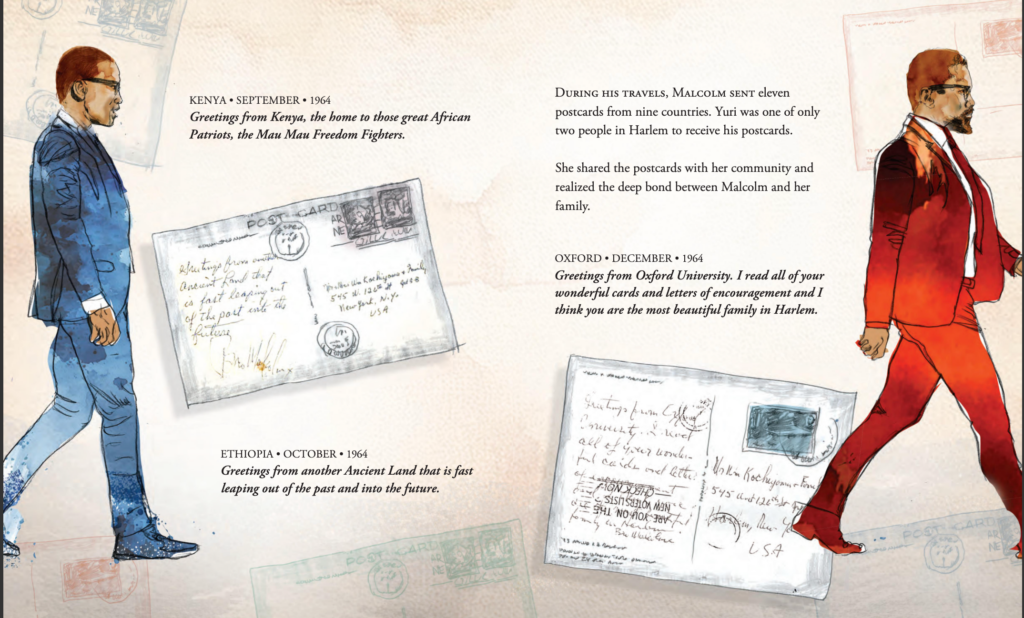
The physical artifacts of this intellectual and personal bond—eleven postcards sent by Malcolm X during his second trip abroad—stand as tangible testaments to a unique cross-racial partnership. Through Kochiyama’s eyes, Malcolm X was a gifted educator with a rare talent for translating complex sociopolitical frameworks into accessible truths.
Artistic Evolution: From Jazz Design to Historical Illustration
Keith Henry Brown’s path to illustrating Postcards from Malcolm X was unconventional. Beginning his career right out of high school as a comic book artist, Brown ultimately forged a distinguished path in graphic design, art director roles, and illustration.
The definitive turning point in his children’s literature career arrived while he was designing jazz album covers for Christian McBride, the 11-time Grammy Award-winning bassist and composer. Impressed by his visual vocabulary, a publisher asked Brown if he could apply that same signature style to an entire children’s book: Birth of the Cool: How Miles Davis Found His Sound, written by Kathleen Cornell Berman. The book earned a coveted starred Kirkus review, opening the floodgates for editorial and publishing commissions.
Despite his soaring demand—which necessitated a three-year scheduling wait before he could officially commit to illustrating Postcards from Malcolm X—Brown approached the manuscript with deliberate care. Rather than rushing, he prioritized concluding his work on the 200-plus-page graphic novel memoir Pushing Hope, co-authored with Raymond Santana, to ensure he could give Wenjen’s text the profound focus it merited.
Supporting Context & Metrics
Cultural Resonance and Personal Connections
Brown’s affinity for the subject matter is deeply rooted in his own upbringing. Growing up, he witnessed firsthand the power of cross-cultural solidarity when his brother became involved with the Basement Workshop during the 1970s. Founded in 1969, the Basement Workshop stands as New York City’s first Asian American political and arts organization, serving as a dynamic cultural hub in Manhattan’s Chinatown. Exposure to these cross-racial coalitions left an indelible mark on Brown’s worldview, making the partnership between Kochiyama and Malcolm X a deeply personal project.
Furthermore, Brown’s artistic process involved rigorous historical footwork. While researching the book, he visited the actual locations where Kochiyama and Malcolm X’s lives intersected. Anticipating a classic Harlem brownstone, Brown discovered instead that Kochiyama’s Harlem home was part of a housing project—a realization that deepened his appreciation for her commitment to embedding herself authentically within the working-class community.
Official Statements & Insights
In His Own Words: Keith Henry Brown on Postcards from Malcolm X
Reflecting on the core themes of the biography, Brown emphasizes the urgency of historical lessons in modern times:
"More than anything, I hope readers come away with a sense that people from different backgrounds can find common purpose."
Addressing the challenges of capturing historical figures on the page, Brown highlights a career-defining artistic milestone within the book:
"One of my favorite spreads is the one where Malcolm appears to be walking across time. On the left, he’s younger, clean-shaven, and wearing a blue suit. On the right, he’s older, bearded, and dressed in red, as if he’s been walking and evolving over the years. Surrounding him are reproductions of the actual postcards. I love that spread because it came very close to what I had envisioned. The watercolor effects worked the way I hoped, and the symbolism feels strong. I’m a very self-critical artist, and I rarely feel I’ve fully achieved what I see in my imagination, but that illustration came closer than most."
Elaborating on the book’s visual Easter eggs and historical grounding, Brown notes:
"If there’s an Easter egg, it’s that many of the settings are based on real places I visited while researching the book. More than anything, I hope readers come away with a sense that people from different backgrounds can find common purpose. I’ve always believed that people of different races and cultures can be friends, collaborators, and family. At a time when it sometimes feels like we’re pulling apart, I hope this story reminds readers of what’s possible when we come together."
Future Outlook
Looking Ahead: Pullman Porters Deliver and Beyond
With Postcards from Malcolm X scheduled for release on October 13, 2026, Keith Henry Brown shows no signs of slowing down. His next major picture book project, Pullman Porters Deliver, written by Lea Lyon and published by Abrams, tackles the historic labor struggles of African American railroad workers organizing for union recognition. For Brown, this project carries additional personal resonance, as a member of his own family worked as a Pullman porter.
As Brown continues to paint, write, and illustrate from his studio in Brooklyn, his body of work—spanning acclaimed titles like Birth of the Cool, Because of You, John Lewis, and now Postcards from Malcolm X—cements his status as a vital visual historian of social justice, music, and the enduring human spirit.



















Comments
Facebook App ID not configured. Please add it in the Customizer.