
Executive Overview
For generations, aspiring writers have been subjected to a litany of rigid storytelling mandates. Among the most revered—and frequently weaponized—is the principle of "Chekhov’s Gun." The doctrine is simple, elegant, and uncompromising: if a rifle is hanging on the wall in the first act, it must be fired by the third. Every detail must advance the plot, every loose end must be neatly tied, and every element must pay off with mathematical precision.
However, this dogmatic approach to narrative structure risks suffocating the very essence of art. By treating fiction as an engineering problem to be solved rather than an experiential alchemy to be shared, writers risk flattening their prose into predictable, sterile exercises.
This article investigates the origins of Chekhov’s famous maxim, examines how master storytellers across literature and film have continuously defied it, and redefines narrative purpose for the modern era. Far from promoting undisciplined chaos, this critical reassessment argues that ambiguity, unresolved threads, and un-fired weapons are not plot holes, but vital tools for evoking emotional resonance, psychological depth, and the chaotic beauty of human experience.
Read Also
Detailed Chronology: The Evolution of a Maxim
To understand the weight of Chekhov’s Gun, one must trace its origins back to late-19th-century Russian literature and the subsequent interpretations that ossified a casual piece of advice into an ironclad rule.
- November 1, 1889: Anton Chekhov writes a letter to Aleksandr Lazarev, offering a foundational critique of narrative economy: "It’s wrong to make promises you don’t mean to keep." At this stage, the sentiment is intuitive—an appeal against narrative dishonesty rather than a blueprint for architectural mechanics.
- 1911: Memoirist Sergius Shchukin publishes his recollections of Chekhov, cementing the most popular iteration of the maxim: "Remove everything that has no relevance to the story. If you say in the first act that there is a rifle hanging on the wall, in the second or third act it absolutely must go off. If it’s not going to be fired, it shouldn’t be hanging there."
- Mid-20th Century: As creative writing programs standardize workshop curricula, foundational adages like Chekhov’s Gun are codified alongside prohibitions against mirror-gazing character introductions, excessive flashbacks, and dream sequences. The focus shifts from artistic intuition to risk-mitigation for novices.
- The Cinematic Era (Late 20th Century): Visionary directors like David Lynch challenge the tyranny of plot mechanics. In works like Twin Peaks and Mulholland Drive, Lynch employs symbolic objects—such as ceiling fans or mysterious background figures—that serve atmospheric and psychological purposes rather than straightforward plot resolutions, frustrating traditionalists while mesmerizing audiences.
- Contemporary Literary Landscape: Authors of magical realism, horror, and literary fiction—including Haruki Murakami and Cormac McCarthy—routinely deploy unattended details, unverified phenomena, and dead-end subplots. These choices foster deep unease, proving that the modern reader is more than capable of navigating narrative uncertainty.
Supporting Context & Metrics: The Mechanics of the "Rule"
To evaluate the validity of Chekhov’s Gun today, we must deconstruct why writing rules exist in the first place and analyze the psychological contract between author and reader.
Guardrails vs. Straitjackets
Writing "rules" are rarely universal laws of physics; instead, they function like warning signs on a dangerous mountain road. Instructors tell beginners to avoid dream sequences, flashbacks, and red herrings because these techniques are notoriously difficult to execute without derailing a story. A novice misusing a flashback halts momentum; a novice introducing an un-fired gun feels like a broken promise.
However, treating these guardrails as permanent straitjackets assumes that the reader requires absolute hand-holding. Modern literary theory increasingly views reading as a collaborative dialogue—an interactive alchemy where the text and the audience meet.
Consider the following comparative metrics of traditional vs. exploratory storytelling approaches:
| Narrative Dimension | Dogmatic Approach (Strict Chekhovian) | Exploratory Approach (Ambiguous/Surreal) |
|---|---|---|
| Primary Goal | Plot resolution and logical closure | Emotional resonance and psychological immersion |
| Reader Role | Passive consumer of pre-determined outcomes | Active participant in interpretation |
| Unresolved Details | Perceived as "plot holes" or drafting errors | Utilized as thematic symbols and mood amplifiers |
| Character Introductions | Every character must directly impact the arc | Peripheral characters mirror the unpredictability of real life |
As the table illustrates, shifting away from mechanical perfection opens the door to deeper thematic engagement. If we strip every detail that does not directly push the plot forward, we run the risk of creating frictionless, sterile prose that mimics algorithmic output rather than human art.
Official Perspectives: Masters of Ambiguity
Literary history is replete with legendary creators who openly flouted structural dogmas to achieve profound artistic breakthroughs. Their work demonstrates that ambiguity is not a flaw, but a deliberate aesthetic choice.
Haruki Murakami and the Unrung Bell
In Haruki Murakami’s Killing Commendatore, the protagonist hears a mysterious bell ringing in the woods behind his home. While a bell is eventually discovered, the reader never learns who rang it or why. Murakami refuses to provide a neat explanation, allowing the mystery to linger in the protagonist’s (and the reader’s) psyche. The lack of resolution mirrors the unexplainable phenomena of daily life.
Cormac McCarthy’s Landscapes of Unease
In Cormac McCarthy’s post-apocalyptic masterpiece The Road, readers are confronted with haunting, unexplained images: marching soldiers, ash-covered ruins, and an unnamed global catastrophe. McCarthy does not waste pages detailing the geopolitics of the collapse. The unknown origins of these horrors amplify the existential terror of the journey, proving that withholding answers can be far more powerful than providing them.
Shirley Jackson’s Psychological Labyrinth
In The Haunting of Hill House, Shirley Jackson masterfully blurs the line between supernatural haunting and the protagonist Eleanor’s deteriorating mental health. By refusing to offer a definitive diagnosis, Jackson empowers the reader to inhabit the ambiguity, creating a masterpiece of psychological horror that endures precisely because it refuses to be neatly categorized.
Future Outlook: Redefining Purpose in the Age of AI
As we look toward the future of storytelling—particularly in an era saturated by automated text generation and algorithmic content—the value of intentional strangeness has never been higher.
Artificial intelligence thrives on patterns, logical progressions, and strict adherence to structural formulas like Chekhov’s Gun. AI can easily track a gun introduced in act one and ensure it discharges on schedule in act three. Because machines excel at predictable mechanical execution, human writers must lean into what algorithms struggle to replicate: genuine mystery, emotional alchemy, and the profound discomfort of the unresolved.
A New Theory for Narrative Elements
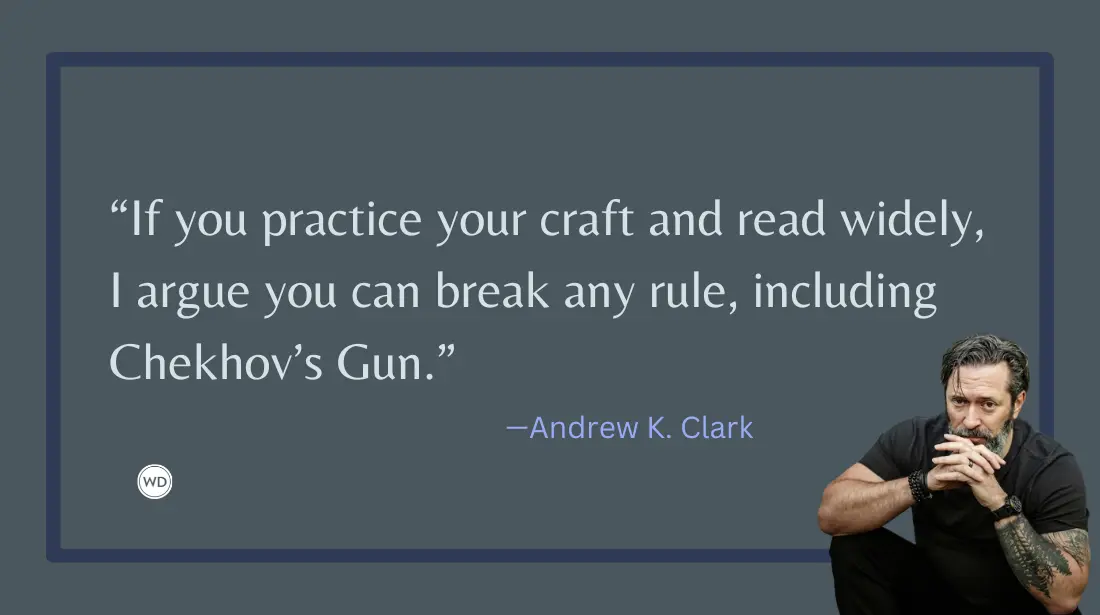
Does this mean writers should abandon all discipline and embrace pure, chaotic randomness? Absolutely not. Introducing bizarre elements purely for shock value results in self-indulgence. As author Andrew K. Clark notes in his approach to contemporary narrative:
“All elements in narrative do not have to connect directly to the plot, but they do need a purpose. If they have purpose, the reader will trust you and keep turning the page, even if their interpretation of the element’s purpose is different from your own.”
The future of fiction lies in redefining purpose. A detail does not need to propel the plot to justify its existence on the page. It can evoke a mood, symbolize a thematic truth, mirror the beautiful illogic of human memory, or simply cast a long, haunting shadow over the narrative landscape.
So, consider this your official dispensation: if you have a gun hanging on your wall, feel free to leave it there. Let it rust. Let the characters walk past it without a backward glance. Trust your readers, embrace the uncanny, and remember that sometimes, the most powerful thing a writer can do is leave the trigger unpulled.


Comments
Facebook App ID not configured. Please add it in the Customizer.