
Executive Overview
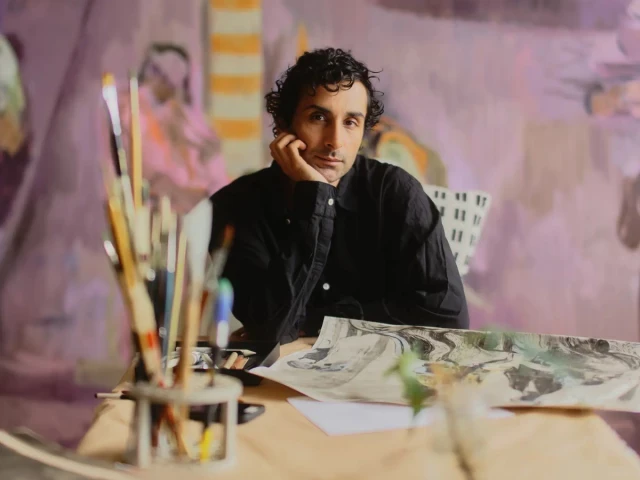
In a milestone that further cements his status as a defining voice of contemporary visual culture, Pakistani-American painter Salman Toor has been officially named to the prestigious TIME100 Art 2026 list. Unveiled on a Friday afternoon, the elite compilation highlights one hundred of the most visionary and influential figures actively shaping the future of global art. Toor, celebrated globally for his evocative, emerald-lit canvases that capture the nuanced realities of young, queer, brown men navigating modernity, finds himself listed alongside a formidable roster of international painters, conceptual photographers, pioneering museum directors, and transformative cultural philanthropists.
This inclusion marks Toor’s second major recognition by TIME, following his appearance on the TIME100 Next list in 2021. At 42 years of age, the Lahore-born, New York-based artist has experienced a meteoric rise through the echelons of the international art establishment. His work—hailed for its poetic juxtaposition of deep intimacy and profound isolation—resonates across borders, bridging the diasporic experience of South Asia with the urban realities of Western metropolises.
Beyond celebrating an individual accolade, Toor’s inclusion on the TIME100 Art 2026 list signals a broader, much-needed shift within the global art market and institutional spaces: a growing appetite for authentic, autobiographically-infused narratives that explore marginalized identities without reducing them to mere political talking points. As Toor prepares for a major upcoming European solo exhibition at London’s esteemed Courtauld Gallery this autumn, this latest recognition arrives at a critical juncture in his career, validating years of meticulous craft, narrative risk-taking, and commercial breakthrough.
Read Also
Detailed Chronology of an Artistic Rise
The trajectory of Salman Toor’s career is a testament to the power of persistence, stylistic evolution, and uncompromising narrative vision. To understand the gravity of his 2026 TIME recognition, one must trace the chronological milestones that transformed him from an observant painter into a global cultural phenomenon.
Early Foundations and Academic Grounding
Born in Lahore, Pakistan, in 1983, Toor was immersed in a culturally rich environment that profoundly influenced his early aesthetic sensibilities. He pursued his foundational training at Lahore’s National College of Arts (NCA), an institution renowned for producing some of South Asia’s most brilliant contemporary draftsmen. During his time at the NCA, Toor developed a rigorous command of traditional figurative painting, mastering the technical nuances of oil paint, composition, and classical portraiture.
Seeking to expand his artistic horizons, Toor relocated to the United States to attend Pratt Institute in Brooklyn, New York, where he earned his Master of Fine Arts (MFA) in 2009. The transition from Lahore to New York proved transformative. While his early works often engaged with art-historical tropes—reinterpreting European masterworks through a South Asian or queer lens—Toor eventually turned his gaze inward, focusing on the immediate social worlds he inhabited. He began documenting the private lives, social gatherings, and solitary moments of young brown men navigating the complexities of urban life, migration, and hidden queer identities.
The Breakthrough and the 2021 TIME100 Next Honor
For years, Toor refined this distinct visual vocabulary in relative obscurity, balancing studio work with teaching. However, the late 2010s and early 2020s marked a dramatic acceleration in his career. His intimate, signature palette—dominated by luminescent emerald greens, deep indigos, and warm amber tones—began capturing the attention of major curators and collectors.
A pivotal turning point arrived in 2020, when his works achieved unprecedented commercial validation. Paintings that had previously traded in modest brackets suddenly surpassed the $1 million mark at major international auctions, signaling an aggressive surge of institutional and collector interest in his distinct diasporic perspective.
This momentum culminated in 2021 when TIME recognized Toor on its annual TIME100 Next list, an accolade dedicated to rising stars who are shaping the future in their respective fields. The 2021 distinction validated his emerging status, positioning him as a vital voice for a new generation of artists who refused to choose between traditional painterly excellence and urgent, contemporary identity politics.
Institutional Expansion and Global Exhibitions
Following his initial national and international acclaim, Toor did not rest on his laurels. Instead, he embarked on an ambitious period of institutional expansion. He organized and toured a comprehensive solo exhibition across four major museums, bringing his immersive, narrative-driven canvases to diverse international audiences who engaged deeply with the themes of displacement, community, and longing embedded within his brushstrokes.
Further cementing his international standing, Toor participated in the Venice Biennale—the world’s most prestigious recurring contemporary art exhibition. His inclusion in the Biennale placed his work within the highest tier of global artistic discourse, sitting alongside historical pavilions and cutting-edge site-specific installations. Additionally, his two-part commercial gallery exhibitions sold out entirely within hours of opening, demonstrating a rare synthesis of critical adoration and ravenous market demand.
Supporting Context & Metrics: The Anatomy of Toor’s Aesthetic
To appreciate why TIME has chosen to honor Salman Toor for a second time, one must examine the specific thematic and stylistic elements that define his oeuvre. His work occupies a unique psychological and physical space, operating at the intersection of private vulnerability and public visibility.
The Poetics of Intimacy and Isolation
In its profile for the TIME100 Art 2026 list, TIME specifically highlighted Toor’s mastery in portraying young brown men "in states of convergence and of isolation." This dual state forms the emotional core of his paintings.
"Sometimes, the men are dancing at a bar, bathed in emerald light; other times, they are alone, lying in bed."
This duality speaks directly to the dual consciousness experienced by many diaspora members and queer individuals. The scenes of convergence—friends huddled around a kitchen table, figures sharing a cigarette on a cramped New York fire escape, or bodies swaying in the dim, pulsing light of an underground club—celebrate the profound solace found in chosen family and communal spaces. These moments are rendered with tenderness, capturing the subtle body language of shared jokes, protective gestures, and unspoken understandings.
Conversely, the moments of isolation capture the lingering weight of alienation. A lone figure curled on a mattress staring at the glowing screen of a smartphone; a man gazing pensively out a rain-streaked window; an artist wrestling with self-doubt in a sparsely furnished studio. Through these quiet vignettes, Toor avoids monolithic representations of immigrant or queer life. He presents his subjects not as political symbols or tragic victims, but as complex, multi-dimensional individuals experiencing the full spectrum of human joy, boredom, anxiety, and longing.
The Signature Palette and Technical Mastery
Stylistically, Toor’s work is instantly recognizable by its chromatic intensity. The pervasive use of emerald green—often functioning as both a literal light source from a neon sign, a computer screen, or streetlamp, and a psychological aura—bathes his figures in an ethereal, almost dreamlike atmosphere. This color choice creates a cinematic quality, making everyday domestic interiors or modest urban apartments feel charged with dramatic tension.
His brushwork is simultaneously fluid and deliberate. Figures often possess elongated limbs and expressive, slightly exaggerated facial features that evoke the stylizations of traditional miniature painting from the Mughal era, combined with the expressive distortion found in the works of early 20th-century modernists. This synthesis of Eastern art-historical traditions with Western figurative painting creates a rich, hybrid visual language that defies simple categorization.
Market Metrics and Cultural Impact
From a financial and institutional perspective, Toor’s trajectory offers a fascinating case study in contemporary art market dynamics. The crossing of the million-dollar threshold at auction in 2020 was not merely a financial anomaly; it represented a structural re-evaluation of whose stories hold market value. Historically, the art market has experienced systemic biases regarding the valuation of artists of color, particularly those engaging with non-Western narratives of migration and queerness. Toor’s sustained commercial success—anchored by sell-out gallery shows and competitive bidding at houses like Sotheby’s and Christie’s—has helped pave the way for a broader market recalibration, proving that intersectional narratives possess immense commercial viability and deep institutional value.
Official Statements and Institutional Reception
The announcement of the TIME100 Art 2026 list triggered an outpouring of acclaim from critics, curators, and cultural institutions worldwide, reflecting the profound impact Toor has made on the contemporary art ecosystem.
Art historians and museum curators have frequently praised Toor’s ability to bridge historical artistic lineages with urgent contemporary concerns. In statements accompanying his multi-museum tour, curators emphasized that Toor’s paintings do not merely depict scenes; they construct a new visual mythology for the contemporary diaspora. By placing brown, queer bodies at the center of classical compositional structures—reminiscent of the way Old Masters painted mythological or religious scenes—Toor quietly yet radically asserts their rightful place within the grand narrative of art history.
While Toor himself often maintains a measured, reflective public presence, focusing primarily on the meditative solitude required for his studio practice, his writings and interviews consistently emphasize the importance of empathy in art-making. He has frequently spoken about the necessity of capturing the "accidental communities" formed by young people adrift in foreign cities—communities sustained by shared meals, shared music, and mutual survival.
Cultural commentators noting his inclusion in the 2026 list have underscored the timing of the honor. As global sociopolitical landscapes witness renewed debates over migration, identity, and the rights of marginalized communities, Toor’s work serves as a vital counterweight to divisive rhetoric. His canvases offer spaces of radical empathy, reminding viewers of the universal human need for connection, touch, and understanding.
Future Outlook: The Road Ahead to London and Beyond
As Salman Toor basks in the well-deserved recognition of the TIME100 Art 2026 list, the horizon for the artist is marked by ambitious new creative chapters and prestigious institutional milestones.
The most immediate and anticipated event on Toor’s calendar is his upcoming solo European exhibition, slated to open at the Courtauld Gallery in London this coming October. The Courtauld—globally renowned for its peerless collection of Impressionist and Post-Impressionist masterpieces and its rigorous academic standards—provides a formidable historical backdrop for Toor’s contemporary visions.
This exhibition marks Toor’s first major solo museum presentation in Europe, representing a significant expansion of his institutional footprint outside of the United States. Curators at the Courtauld have hinted that the exhibition will place Toor’s recent works in direct conversation with historical masterpieces from the gallery’s permanent collection, offering visitors a rare opportunity to see how Toor deconstructs and reconstructs the art-historical canon from his unique vantage point.
Looking further ahead, Toor’s inclusion in the TIME100 Art 2026 list ensures that he will remain a central figure in conversations regarding the evolution of figurative painting over the next decade. As he continues to experiment with scale, narrative complexity, and psychological depth in his Brooklyn studio, the art world watches with bated breath.
Ultimately, Salman Toor’s journey—from the art schools of Lahore to the galleries of New York, the halls of the Venice Biennale, and now the pages of TIME’s most influential cultural lists—is a testament to the transformative power of authentic storytelling. By daring to paint the quiet, often overlooked moments of intimacy and isolation experienced by young brown men, Toor has not only secured his own place in art history; he has expanded the very boundaries of who gets to be seen, remembered, and celebrated on the global stage.




Comments
Facebook App ID not configured. Please add it in the Customizer.