
Executive Overview
In the wake of a deeply disturbing criminal case that sent shockwaves across Pakistan, prominent actor and cultural figure Ayesha Omar has used her platform to spotlight a silent, pervasive national crisis: the critical lack of institutional mental healthcare.
The catalyst for Omar’s impassioned public intervention was the arrest of a 19-year-old Afghan national in Peshawar, who was apprehended by local law enforcement after allegedly exhuming and desecrating the bodies of young girls from local cemeteries. The sheer depravity of the crime ignited widespread public revulsion, moral outrage, and intense condemnation across social media platforms. While the immediate public discourse focused on the horror of the crime and the necessity of swift legal justice, Omar pivoted the national conversation toward an equally urgent, yet chronically neglected, dimension of the tragedy: the deep psychological rot, unaddressed trauma, and societal fracturing that allows such pathology to fester.
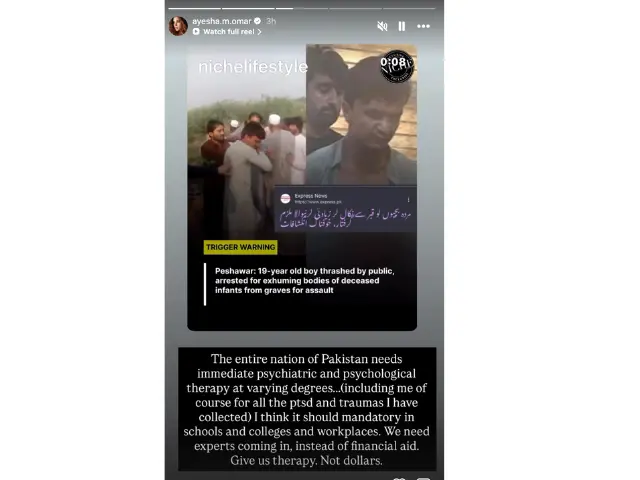
Taking to Instagram, Omar argued that the grotesque nature of the Peshawar incident is symptomatic of a broader, collective psychological decay. Asserting that the entire nation is operating under varying degrees of unhealed post-traumatic stress disorder (PTSD), generational trauma, and emotional distress, she issued a bold call to action. Omar demanded that psychological support systems be integrated directly into the foundational pillars of Pakistani society—specifically targeting schools, universities, and corporate workplaces.
Read Also
By challenging conventional paradigms of aid and institutional priorities, arguing that institutional frameworks require mental health experts rather than superficial financial injections, Omar has reignited a crucial national debate. Her advocacy raises fundamental questions about how Pakistan diagnoses, treats, and prioritizes the mental health of its citizens, transforming a localized criminal horror into a national reckoning on emotional wellbeing.
Detailed Chronology of the Peshawar Incident and Public Reaction
The Discovery and Arrest in Shaikhan
The sequence of events that provoked widespread national horror began in the Shaikhan area on the outskirts of Peshawar, Khyber Pakhtunkhwa. Local authorities received increasingly alarming reports from villagers who noticed signs of tampering at local burial sites. Graveyards, traditionally regarded as sanctuaries of final rest and deep communal reverence, had seemingly been violated.
Acting on local intelligence and stepped-up community vigilance, law enforcement units staked out sections of the local cemetery. On the night of the arrest, police caught a 19-year-old Afghan national red-handed in the act of exhuming the newly buried body of a young girl. According to initial police statements, the suspect had already successfully dug up several other graves containing the remains of young females in a series of deeply macabre acts.
The suspect was immediately taken into custody, sparking a chaotic and emotionally charged scene as local residents gathered outside the police station demanding severe and immediate accountability. Initial interrogations by district investigative units pointed toward severe psychological aberrations, prompting authorities to order comprehensive psychiatric evaluations alongside standard criminal proceedings. Police officials confirmed that the investigation was expanding to determine whether the suspect acted alone or if a wider network of grave desecration was operating in the region.
The Digital Shockwave and Social Media Outrage
As details of the Peshawar incident leaked into the public domain via local media and digital news outlets, the reaction was swift and visceral. Social media platforms instantly transformed into forums of grief, anger, and profound moral condemnation. Hashtags trending across X (formerly Twitter) and Instagram reflected a population grappling with a profound sense of insecurity and moral decay.
Civil society organizations, human rights advocates, and everyday citizens expressed horror not only at the act itself but at the apparent collapse of community safety nets that allowed a disturbed individual to repeatedly violate sacred grounds unhindered. Commentators noted that the crime transcended standard criminal behavior, pointing instead to extreme sociopathy, psychopathology, and a complete detachment from basic human empathy.
It was within this charged digital ecosystem—saturated by sensationalized headlines, expressions of public trauma, and calls for retributive justice—that Ayesha Omar intervened. Eschewing the conventional pattern of merely expressing superficial shock or offering hollow condolences, Omar seized the moment to redirect the collective public anxiety toward systemic reform.
Supporting Context & Metrics: The State of Mental Health in Pakistan
The Invisible Epidemic: Trauma and PTSD in Pakistan
Ayesha Omar’s assertion that the "entire nation of Pakistan needs immediate psychiatric and psychological therapy" is supported by a sobering body of epidemiological research and public health data. For decades, Pakistan has navigated a turbulent landscape defined by geopolitical instability, terrorism, economic volatility, climate-induced natural disasters, and rapid urbanization. These macro-level stressors have left an indelible mark on the collective psyche of its population of over 240 million people.
According to data compiled by the World Health Organization (WHO) and local psychiatric associations, an estimated 24 million Pakistanis are in active need of psychiatric assistance. Yet, despite these staggering figures, mental health remains one of the most severely underfunded, stigmatized, and neglected sectors of Pakistan’s public health infrastructure.
+------------------------------------------------------------------------+
|                      PAKISTAN MENTAL HEALTH LANDSCAPE                  |
+------------------------------------------------------------------------+
|  Total Population:            ~240 Million                             |
|  Estimated Need of Care:      ~24 Million Citizens                     |
|  Available Psychiatrists:     Fewer than 600 nationwide                |
|  Ratio of Experts to People:  Approx. 1 per 400,000 citizens           |
|  Public Health Budget Share:  Less than 1% allocated to mental health  |
+------------------------------------------------------------------------+
The structural deficit is stark: Pakistan possesses fewer than 600 qualified psychiatrists for a population of nearly 240 million, translating to a ratio of roughly one mental health professional for every 400,000 people. This falls catastrophically short of international benchmarks. Furthermore, the vast majority of these scarce specialists are concentrated in major metropolitan centers such as Karachi, Lahore, Islamabad, and Peshawar, leaving rural and semi-urban populations—where the vast majority of citizens reside—completely devoid of basic psychological support systems.
Institutional Neglect: Schools, Workplaces, and Social Stigma
Omar’s specific policy critique—that psychological support should be made mandatory and accessible within educational institutions and corporate workplaces—strikes at the heart of systemic institutional failure in Pakistan.
In traditional Pakistani schools and colleges, academic achievement is aggressively prioritized, while emotional literacy, psychological safety, and mental health education are virtually non-existent. Guidance counselors are rare luxuries found only in elite, high-fee private institutions, while public school systems—serving the vast majority of Pakistani youth—offer zero psychological scaffolding. Consequently, young people navigating the tumultuous waters of adolescence, academic pressure, domestic stress, and digital-age alienation are forced to do so without professional guidance. This frequently leads to unaddressed anxiety, depression, behavioral issues, and, in tragic cases, self-harm or violent outbursts.

Similarly, the Pakistani corporate and professional landscape has historically viewed mental health through a lens of dismissive apathy or active stigma. Burnout, workplace harassment, chronic stress, and emotional trauma are routinely dismissed as personal weaknesses or brushed aside with cultural platitudes. The absence of employee assistance programs (EAPs) or on-site mental health professionals in workplaces creates an environment where emotional distress festers silently, ultimately translating into plummeting productivity, fractured family dynamics, and heightened societal volatility.
Official Statements and Public Discourse
Ayesha Omar’s Provocative Mandate: "Give Us Therapy, Not Dollars"
Ayesha Omar’s commentary on her verified Instagram account went far beyond a standard celebrity statement of empathy; it was a trenchant socio-political critique. Sharing the harrowing news report from Peshawar, Omar bared her own vulnerabilities, framing her call for national healing from a position of shared humanity:
"The entire nation of Pakistan needs immediate psychiatric and psychological therapy at varying degrees," Omar wrote, candidly adding, "And I include myself in this, because of all the PTSD and traumas I have experienced."
By publicly acknowledging her own struggles with post-traumatic stress and mental health challenges—topics she has repeatedly addressed in past interviews regarding stress, overthinking, and the arduous process of emotional healing—Omar dismantled the artificial barrier of invulnerability often demanded of public figures.
However, it was her policy prescription for institutional reform that generated the most significant intellectual ripple effects. Directly addressing the structural deficiencies of the country, Omar argued for a total pivot in how institutional support is conceptualized:
"I think it should [be] mandatory in schools and colleges and workplaces. We need experts coming in, instead of financial aid. Give us therapy. Not dollars."
This pointed rhetorical jab—contrasting the influx of foreign financial aid, loans, and economic bailouts with the foundational need for psychological capital and human development—struck a deep chord with a weary public. It challenged the prevailing technocratic and economic narratives that dominate state policy, arguing that fiscal stability is meaningless if the human capital driving the nation is psychologically fractured and traumatized.
Reactions from Civil Society and Mental Health Advocates
Omar’s intervention catalyzed a broader public discussion, drawing praise from mental health professionals, educators, and civil rights advocates who have long fought to bring these issues into the legislative and cultural mainstream.
Dr. Saima Malik, a clinical psychologist based in Islamabad, noted that celebrities using their platforms to destigmatize therapy is a vital counterweight to deeply entrenched cultural stigmas. "In Pakistan, seeking psychological help is still widely viewed as a sign of spiritual weakness, madness, or social taboo," Dr. Malik explained. "When high-profile figures like Ayesha Omar normalize terms like PTSD, trauma, and therapy, it chips away at the wall of silence. It empowers ordinary citizens—particularly young people—to recognize that mental pain is real, valid, and treatable."
Educational reformers similarly echoed Omar’s demands for mandatory mental health infrastructure in schools. Several academic administrators pointed out that post-pandemic stress, economic anxieties, and the psychological fallout of digital media saturation have created an unprecedented mental health crisis among students. Without institutionalized counseling, schools risk becoming pressure cookers rather than incubators of holistic personal growth.
Future Outlook: Paving the Way for Psychological Reform
The Imperative for Policy Integration
The convergence of a horrific criminal act in Peshawar and a high-profile celebrity advocacy campaign presents Pakistan with a critical inflection point. The fundamental question moving forward is whether this moment of public shock will dissipate into the relentless 24-hour news cycle, or whether it will serve as the catalyst for genuine, systemic legislative and institutional reform.
For Omar’s vision of mandatory psychological support in schools, colleges, and workplaces to transition from aspirational rhetoric to concrete reality, concerted action is required across multiple levels of governance and civil society:
- Legislative Mandates: Provincial and federal ministries of education must draft and pass binding policies requiring every public and private educational institution above a certain enrollment threshold to employ certified, licensed school counselors and mental health professionals.
- Corporate Governance: Labor ministries and corporate regulatory bodies (such as the Securities and Exchange Commission of Pakistan) should incentivize or mandate employee wellness programs, establishing frameworks for psychological safety and stress management in professional environments.
- Public Health Overhaul: The allocation of national health budgets must be radically restructured to direct meaningful funding toward community-level psychiatric care, dismantling regional disparities in mental healthcare access.
- Destigmatization Campaigns: Sustained public awareness campaigns, backed by media regulators and cultural influencers, must reframe mental health not as a luxury or a taboo, but as an essential pillar of public health and national security.
Conclusion: Healing the Nation Within
The horrific events in Peshawar laid bare the dark extremities to which unaddressed human trauma and psychological decay can lead. While the wheels of criminal justice must turn to punish the perpetrators of such heinous acts, society ignores the root causes of such pathology at its own peril.
Ayesha Omar’s impassioned plea serves as a timely and necessary reminder that a nation cannot build a prosperous, stable, or compassionate future while ignoring the psychological wounds of its people. By shifting the national gaze from mere outward outrage to inward healing, Omar has challenged Pakistan to confront its deepest demons. Transforming schools, colleges, and workplaces into sanctuaries of mental wellness is no longer merely a progressive ideal—it is an existential necessity for the moral and psychological survival of the nation.





Comments
Facebook App ID not configured. Please add it in the Customizer.