
Executive Overview
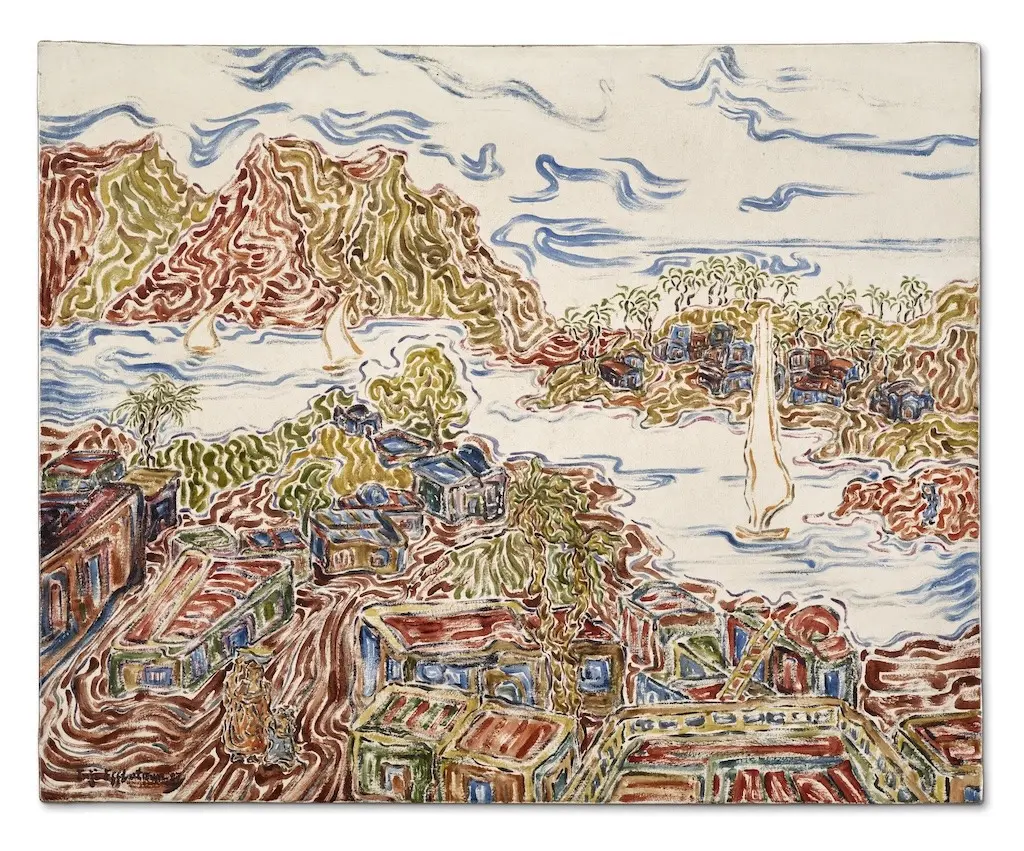
Two decades after Christie’s made history as the first international auction house to hold a sale in the United Arab Emirates, the venerable institution is commemorating its twentieth anniversary with a strategic shift down the road. On November 1, Christie’s will host its inaugural fine art auction in Abu Dhabi. Titled “MAWASIM: 20 Years of Modern and Contemporary Middle Eastern Art,” the landmark event will present more than 70 carefully curated works of modern and contemporary art from the Middle East and North Africa (MENA). Staged at the luxury Abu Dhabi Edition hotel, the auction features masterpieces by celebrated regional luminaries, including Paul Guiragossian, Samia Halaby, Mohamed Melehi, Marwan Kassab-Bachi, Inji Efflatoun, and Nabil Nahas.
While the anniversary itself serves as a natural catalyst for celebration, the decision to plant a flag in Abu Dhabi is far more than a symbolic nod to the past. It reflects a profound structural evolution within the UAE’s cultural capital. For years, the emirate focused heavily on building world-class institutional infrastructure—anchored by the Saadiyat Cultural District. Today, however, Abu Dhabi is aggressively cultivating a robust commercial art market to match its museum ambitions.
This pivot arrives amid an unprecedented surge of commercial activity across the city. Global competitors and institutions are converging on Abu Dhabi in rapid succession. Sotheby’s established a permanent presence in the city last year, laying the groundwork for a major rollout that culminates in its high-profile "Collectors’ Week" this December. Simultaneously, Frieze is launching its inaugural edition of Frieze Abu Dhabi at Manarat Al Saadiyat, bringing nearly 90 galleries from across the globe to the emirate.
Read Also
Christie’s twentieth-anniversary sale thus acts as both a retrospective of regional market maturation and a bellwether for the future. By anchoring this milestone not in Western trophy art, but in the rich, historical tapestry of MENA modernism, Christie’s is validating Abu Dhabi’s ascent as a premier global hub for international fine art commerce.
Detailed Chronology: Two Decades of Transformation
To fully understand the weight of Christie’s upcoming Abu Dhabi auction, one must retrace the twenty-year arc of the contemporary art market within the United Arab Emirates.
The Mid-2000s: Breaking Ground in Dubai
When Christie’s held its inaugural UAE sale in Dubai in 2006, the regional market was effectively uncharted territory for international auction houses. At the time, Dubai was rapidly positioning itself as the commercial and financial engine of the Gulf, making it a natural launchpad for a new frontier of art collecting. These early sales achieved robust records, proving that a localized market for regional and international art could thrive outside traditional Western capitals.
Simultaneously, plans for Abu Dhabi’s Saadiyat Cultural District were only beginning to take shape on the drawing boards. In those formative years, a distinct division of labor emerged within the UAE: Dubai cultivated a bustling commercial gallery scene and anchored the region’s auction landscape, while Abu Dhabi embarked on a sweeping, state-backed museum-building initiative designed to reshape the global cultural map.
The Institutional Build-Out: Saadiyat Island Takes Shape
Over the ensuing fifteen years, Abu Dhabi poured billions of dollars into transforming Saadiyat Island into a cultural powerhouse. The strategy began to bear institutional fruit with the opening of the Jean Nouvel-designed Louvre Abu Dhabi in 2017, which instantly established the city as a serious stop on the international museum circuit.

This institutional momentum is cresting in a remarkable wave of openings and expansions. Most notably, the long-awaited Guggenheim Abu Dhabi is scheduled to open its doors on December 11, joining a dense ecosystem of cultural institutions. Furthermore, the sovereign wealth landscape has actively backed this trajectory; in 2024, ADQ—Abu Dhabi’s prominent sovereign wealth fund—pumped a staggering $1 billion into Sotheby’s to fuel its global expansion and regional integration.
The 2025–2026 Commercial Convergence
The current moment represents a collision of institutional gravity and commercial velocity in Abu Dhabi. The distinctions that once separated Dubai’s commercial art scene from Abu Dhabi’s museum-centric model are rapidly dissolving.
- Sotheby’s Abu Dhabi: Following its establishment last year, Sotheby’s has initiated a comprehensive long-term program. This effort peaks during Collectors’ Week in early December, featuring multi-category auctions spanning fine art, luxury watches, rare automobiles, jewelry, and real estate.
- Frieze Abu Dhabi: From November 19 to 22, the inaugural Frieze Abu Dhabi will debut at Manarat Al Saadiyat. Developed in partnership with the Abu Dhabi Department of Culture and Tourism, the fair will host 84 galleries hailing from 64 cities across 37 countries and regions, blending institutional heavyweights like Gagosian, Pace, Thaddaeus Ropac, and Timothy Taylor with prominent regional dealers.
- Christie’s "MAWASIM" Sale: Landing on November 1, Christie’s anniversary auction serves as the opening salvo of this unprecedented autumn season, signaling that the capital is now fully equipped to host high-stakes fine art auctions.
Supporting Context & Metrics: The Surging Appetite for MENA Art
For decades, international auction houses relied heavily on Impressionist, Modern, and Contemporary Western blue-chip art to drive major sales in emerging markets. However, the success of Christie’s recent dedicated Middle Eastern sales demonstrates that a profound shift is underway among collectors, driven by deep-rooted institutional appreciation and rising global demand.
The Dalloul Collection Benchmark
A clear indicator of this robust market appetite occurred last November in London, where Christie’s staged a dedicated sale of works from the prestigious Dalloul Collection. The results shattered expectations, bringing in £4.1 million ($5.4 million) total.
- Sell-Through Rates: An extraordinary 93 percent of the sale was realized by value, while 85 percent sold by lot.
- Estimate Surges: More than half of all offered lots comfortably surpassed their high pre-sale estimates.
- Auction Records: The evening generated eight new auction records for regional artists.
Crucially, the demographic makeup of the buyers signaled a healthy, expanding collector base rather than a localized echo chamber. Thirty-eight percent of the buyers were completely new to Christie’s, and a remarkable 21 percent of those newcomers belonged to the millennial demographic. This indicates that a younger, globally minded generation of collectors is actively engaging with modern and contemporary MENA art.
Standout Historical Results
Several individual lots during recent sales underscored the explosive growth in asset valuations for mid-century Arab modernists:
- Saloua Raouda Choucair: Her sculptural canvas Poem (1966–68) fetched £393,700—a staggering 363 percent above its high estimate.
- Sliman Mansour: An Untitled work from 2014 brought in £323,850, outperforming its high estimate by 80 percent.
- Kamal Boullata: His mesmerizing abstract composition Nocturne I realized £165,100, more than tripling its maximum projected value.
Key Highlights for the Abu Dhabi Anniversary Sale
Building on this momentum, the upcoming "MAWASIM" sale in Abu Dhabi features an elite roster of museum-quality consignments designed to test the limits of collector demand in the capital:
| Artist | Work & Year | Pre-Sale Estimate |
|---|---|---|
| Paul Guiragossian | Noces (Wedding) (1958–59) | $300,000 – $500,000 |
| Samia Halaby | Yesterday (1978) | $200,000 – $300,000 |
| Marwan Kassab-Bachi | Kopf (Head) (1987) | $200,000 – $300,000 |
| Mohamed Melehi | A30 (1962) | $100,000 – $150,000 |
Furthermore, the provenance of these works speaks volumes about the institutional stewardship underpinning the market. Several key consignments originate from legendary collections that have dedicated decades to preserving and championing Arab modernism. Eight works are being sourced directly from Beirut’s renowned Dalloul Collection, while five come via the esteemed Sharjah-based Barjeel Art Foundation. The leaders of both institutions—Basel Dalloul and Sultan Sooud Al Qassemi, respectively—hold prominent positions on ARTnews’ authoritative Top 200 Collectors list.

Official Statements & Industry Perspectives
The convergence of top-tier auction houses, international art fairs, and sovereign-backed infrastructure has elicited widespread enthusiasm from regional leaders and international executives alike.
Reflecting on the two-year journey since Christie’s first arrived in the Emirates, Meagan Kelly Horsman, managing director of Christie’s UAE, emphasized the broader macroeconomic and cultural shifts at play. In an official statement, Horsman pointed directly to the "growing recognition of artists from the Middle East internationally" as the primary engine driving the market forward.
"This year marks twenty years since Christie’s inaugural Modern and Contemporary Art auction in Dubai," Horsman noted. "Bringing our fine art sales to Abu Dhabi for this anniversary is not merely a geographic relocation; it is the culmination of a twenty-year arc coming full circle, reflecting the maturation of the entire regional ecosystem."
Industry analysts view the pivot to Abu Dhabi as a calculated alignment with the emirate’s long-term vision. While Dubai established the initial commercial beachhead for international auction houses in the mid-2000s, Abu Dhabi’s methodical, capital-intensive development of Saadiyat Island has created an environment where high-end commercial art, world-class museums, and state-backed cultural initiatives exist in seamless synergy. The involvement of sovereign wealth funds, such as ADQ’s landmark investment in Sotheby’s, further underscores a unified national strategy to make the UAE an indispensable node in the global art market network.
Future Outlook: A New Capital for Art Commerce
As the art world turns its attention to the United Arab Emirates this autumn, the implications of Christie’s move to Abu Dhabi extend far beyond a single anniversary auction.
The juxtaposition of Christie’s November 1 sale, Frieze Abu Dhabi’s mid-November debut, and Sotheby’s December Collectors’ Week signals a fundamental realignment of the Middle Eastern art market. Abu Dhabi is no longer content to serve solely as a destination for institutional leisure and museum-going; it has decisively entered the fray as a dominant commercial arena capable of hosting multi-million-dollar transactions, major international galleries, and elite global collectors.
Whether Christie’s intends to establish a permanent, recurring auction calendar in Abu Dhabi remains to be officially confirmed. However, the symbolism of the house’s choice of venue—and its deliberate centering of MENA modern masters rather than Western trophy assets—speaks volumes. It demonstrates an abiding confidence in the local collector base, a deep respect for regional art history, and an acute awareness that the epicenter of the UAE’s art market gravity has officially expanded to encompass its capital.
As the ribbon is cut on Frieze Abu Dhabi, museums open their doors on Saadiyat Island, and collectors crowd the salesrooms of the Abu Dhabi Edition, one thing is abundantly clear: the next chapter of the Middle Eastern art market is being written in Abu Dhabi, and the international trade is racing to keep pace.

Comments
Facebook App ID not configured. Please add it in the Customizer.