
Executive Overview
For nearly a millennium, the Tower of London has stood as an impenetrable symbol of royal might, weathering medieval sieges, political coups, and twentieth-century wartime bombing raids. Yet, on a stifling June day in 1381, this formidable fortress suffered a catastrophic breach—the first and only time in its history that insurgents successfully stormed its walls. Dragging some of the realm’s most powerful officials to a makeshift execution block, the mob exacted swift, merciless justice, severing the heads of the kingdom’s elite.
This unprecedented eruption of violence marked the boiling point of the Peasants’ Revolt, a sweeping, decentralized mass uprising catalyzed by an oppressive poll tax. Levied for the third time in four years, the tax was designed to fund England’s faltering military campaigns in the Hundred Years’ War. However, its deeply regressive nature—demanding an equal financial contribution from impoverished laborers as from wealthy nobles—pushed a traumatized populace past its breaking point. Just decades after the catastrophic devastation of the Black Death, which wiped out between 30 and 50 percent of the nation’s population, England was a tinderbox of economic exploitation, rigid serfdom, and aristocratic impunity.
/https://tf-cmsv2-smithsonianmag-media.s3.amazonaws.com/filer_public/eb/84/eb843981-bc89-40b9-a3bb-384c8e813db7/uprising.png)
Now, acclaimed director Paul Greengrass—renowned for visceral, high-tension thrillers like Captain Phillips and The Bourne Ultimatum—brings this pivotal historical tremor to the cinematic screen in The Uprising. Starring Andrew Garfield as a fictionalized, unnamed Essex ploughman, the film reimagines the 1381 rebellion through the eyes of the ordinary citizens who shouldered its heaviest burdens. Rather than focusing solely on elite historical figures like rebel leader Wat Tyler or radical priest John Ball, Greengrass centers his narrative on the silent majority of working people who rose against a corrupt political apparatus and paid a devastating price for their defiance.
Read Also
Detailed Chronology: From Village Resistance to London Bloodshed
The cascading events of the summer of 1381 did not happen overnight; they were forged in the crucible of post-plague demographic shifts, draconian labor laws, and systemic financial abuse.
/https://tf-cmsv2-smithsonianmag-media.s3.amazonaws.com/accounts/headshot/meilan_headshot2.png)
The Spark in Essex (Late May – Early June 1381)
Historians generally pinpoint the genesis of the revolt to May 30, 1381, in the village of Fobbing, Essex. When royal commissioners arrived to enforce compliance with the deeply resented poll tax and arrest those who refused to pay, local villagers fiercely resisted. The defiance spread like wildfire. Runners and riders crisscrossed the region to coordinate with neighboring communities, and by June 2, rebel leaders convened to formalize their resistance.
Crucially, the early insurgency was not an unorganized, feral riot. It was meticulously orchestrated through sworn pacts, strategic communication channels, and targeted strikes against administrative infrastructure. The rebels pledged to dismantle the corrupt political machinery advising the 14th-century boy-king, Richard II, and to institute their own vision of societal law.
:focal(750x500:751x501)/https://tf-cmsv2-smithsonianmag-media.s3.amazonaws.com/filer_public/eb/84/eb843981-bc89-40b9-a3bb-384c8e813db7/uprising.png)
The March on London and the Breach of the Tower (June 12–13, 1381)
As forces swelled under the leadership of figures like Wat Tyler from Kent and the newly liberated radical priest John Ball, the insurgents marched toward London. Along the way, they systematically dismantled symbols of oppression: burning manorial court rolls, releasing prisoners, and executing local officials who enforced serfdom.
On June 13, the rebels breached London via London Bridge, aided by sympathizers or keepers who recognized that resistance was futile. Their immediate fury targeted the Savoy Palace—the opulent London residence of John of Gaunt, Duke of Lancaster, who served as the de facto ruler during Richard II’s minority. Although John of Gaunt was away, the palace was razed, and rioters established a strict code of conduct: anyone caught looting for personal gain was hurled directly into the flames as punishment.
/https://tf-cmsv2-smithsonianmag-media.s3.amazonaws.com/filer_public/f3/23/f3230542-3c0b-4154-ac2c-1883dab3c485/towrlndn.jpeg)
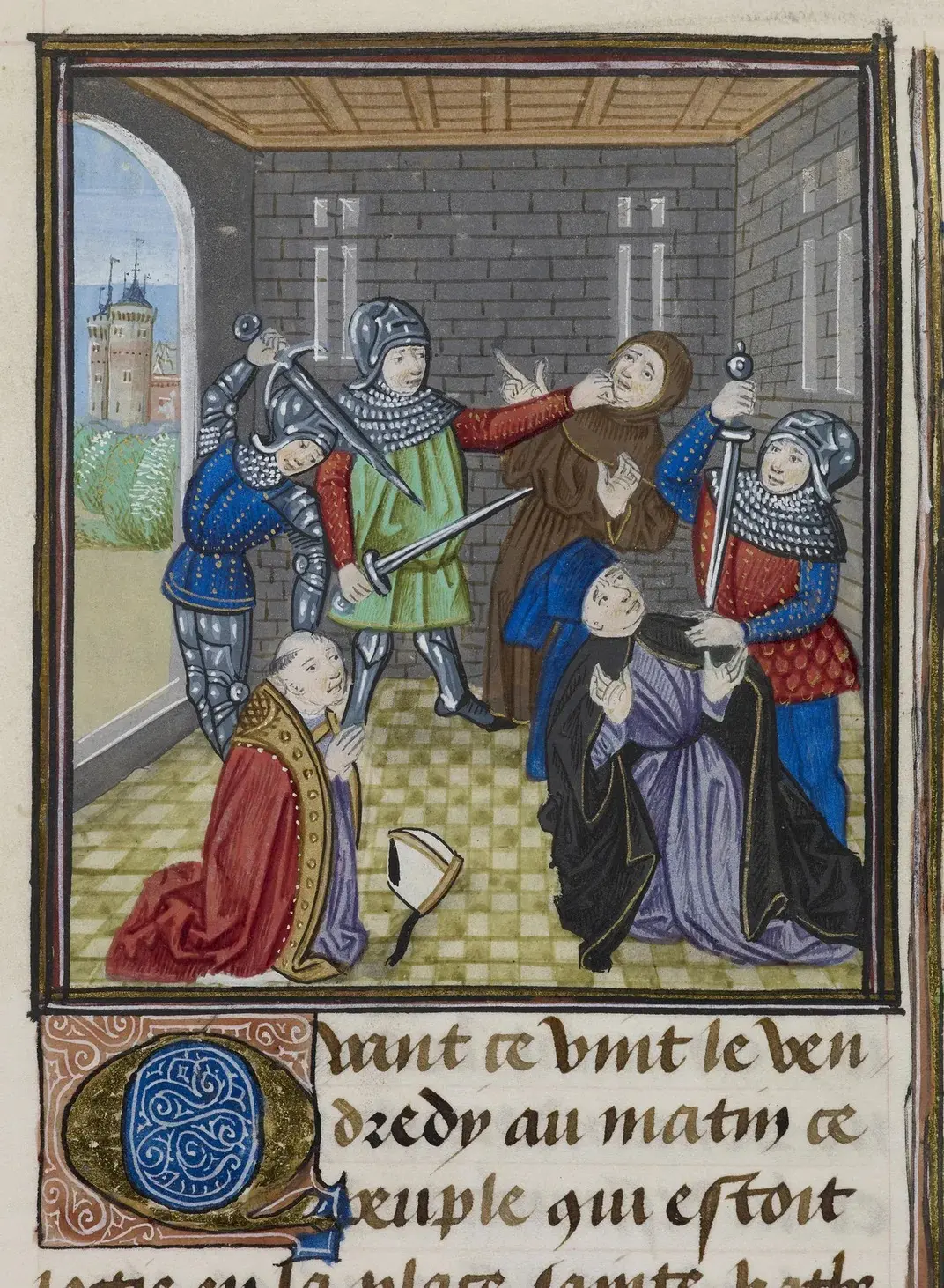
Simultaneously, a contingent of insurgents targeted the Tower of London, where 14-year-old Richard II and his inner circle—including Lord High Treasurer Robert Hales and Archbishop of Canterbury Simon of Sudbury—had sought refuge. Through a mix of insider sympathy and overwhelming psychological pressure, the mob breached the fortress gates, dragged Hales and Sudbury to Tower Hill, and executed them. Sudbury’s execution was notoriously botched, requiring eight desperate blows to sever his head.
The Conferences at Mile End and Smithfield (June 14–15, 1381)
Desperate to stem the carnage, King Richard II agreed to meet the rebels at Mile End on June 14. In a stunning display of political capitulation, the young monarch listened to their demands and granted every single request, including the abolition of serfdom, the capping of rents, and general pardons.

However, the violence outside the negotiating table quickly spiraled out of control as opportunistic Londoners settled personal scores and targeted foreign merchants, particularly Flemish weavers viewed as economic competition.
A final, fateful confrontation occurred the next day at Smithfield on June 15. Wat Tyler presented an expanded, radical manifesto demanding the total abolition of lordship (save for the crown) and the dissolution of the church hierarchy. Tensions flared when Tyler acted aggressively toward the king. William Walworth, the Lord Mayor of London, intervened and struck Tyler down. As chaos threatened to consume the royal party, King Richard II stepped into the vacuum, famously shouting: "I will be your leader! Follow me!" The king successfully defused the immediate threat by assuring the crowd of their safety and leading them away from the execution site, allowing the massive gathering to peacefully disperse.

Supporting Context & Metrics: The Scale of the Insurgency
To fully comprehend the magnitude of the Peasants’ Revolt, historians rely on extensive demographic and judicial data compiled by modern research initiatives, most notably the People of 1381 project led by scholars like Andrew Prescott of the University of Glasgow.
- Geographical Spread: The rebellion was far from a localized London riot; active insurgencies were recorded in more than half of England’s counties, stretching from Yorkshire in the north down to Kent, and westward to Gloucestershire.
- Participant Diversity: While cultural memory frames the event exclusively as a peasant uprising, judicial records reveal a broad cross-section of society. The insurrection drew in urban craftspeople, artisans, wealthy yeoman farmers, lower clergy, and members of the landed gentry who had grown disillusioned with royal taxation.
- The Judicial Aftermath: The People of 1381 database houses roughly 28,000 records detailing participants, victims, jurors, and bail-payers. Following the collapse of the revolt, royal commissions launched widespread retributions, resulting in the execution of hundreds of "principal instigators" via beheading and bodily mutilation before a general pardon was issued in November 1381.
- Demographic Trauma: The backdrop of the revolt was defined by the Black Death (1348–1350), which eradicated 30 to 50 percent of the English population. This acute labor shortage empowered the working class to demand higher wages, prompting Parliament to pass the Statute of Labourers in 1351, which legally froze wages at pre-plague rates and served as a primary catalyst for systemic outrage.
Official Statements & Scholarly Perspectives
Historians and filmmakers alike have weighed in on the profound historical resonance of the 1381 rebellion and its modern cinematic translation:
/https://tf-cmsv2-smithsonianmag-media.s3.amazonaws.com/filer_public/e9/d7/e9d7b6f4-cbe4-4824-b39c-ffbe2bee4dc3/coronation_richard2_england_01.jpg)
"That poor administration helped trigger the revolt… It’s a revolt as much about wanting cheaper land and fair trade as it is about feeling oppressed to the level where life becomes impossible."
— Andrew Prescott, University of Glasgow historian and researcher for the People of 1381 project.
Reflecting on why he chose to bypass famous historical figureheads in favor of an everyman protagonist, director Paul Greengrass noted in his production statement:
/https://tf-cmsv2-smithsonianmag-media.s3.amazonaws.com/filer_public/b2/57/b2575827-b9cd-4d4c-9251-e10942e3e30a/jean_froissart_chroniques_154v_12148_btv1b8438605hf336_crop.jpg)
"I didn’t want to tell this story through the names we remember… I wanted to focus on someone history never named at all: a farmer, the first man to raise his hand in Essex. I wanted him to stand for all the ordinary people who actually rose up and paid the price for it."
Historical consultant and author Dan Jones (Summer of Blood: England’s First Revolution) emphasizes the structural impact of the uprising on subsequent English governance:
/https://tf-cmsv2-smithsonianmag-media.s3.amazonaws.com/filer_public/5a/75/5a75f505-b703-436f-91c9-4f1c4e214740/john_ball_encouraging_wat_tyler_rebels_from_ca_1470_ms_of_froissart_chronicles_in_bl.jpg)
"After 1381, it became if not impossible, then highly inadvisable, to ignore the effects of policy on ordinary people. You have a character, an ordinary guy who’s in a world in which the law seems to have been corrupted… In order for these things to be brought back together, he has to fight. He has to take vengeance. He has to be violent."
Future Outlook: The Enduring Legacy of 1381
Although the Peasants’ Revolt ultimately failed to achieve its most radical utopian aims—such as the complete dismantling of the feudal land-tenure system and the eradication of the nobility—its long-term socio-political legacy proved transformative.
/https://tf-cmsv2-smithsonianmag-media.s3.amazonaws.com/filer_public/fc/82/fc82e3ce-8a30-4e0b-80b7-2c56129421dc/murder_of_simon_sudbury_-_froissart_chroniques_de_france_et_d-39d103daba131be7940d74d1e915f053.jpg)
Landowners and monarchs received an unmistakable, terrifying warning: the working populace was capable of collective, highly organized resistance. This underlying threat permanently altered the dynamics of labor relations in England, accelerating the natural decline of serfdom over the subsequent century and forcing future administrations to exercise greater caution when drafting tax policies. Remarkably, the toxic political legacy of the poll tax echoed through British history well into the late twentieth century, with violent anti-poll tax protests famously erupting as recently as 1990 during the administration of Margaret Thatcher.
As The Uprising hits theaters across the United States, its themes resonate with striking contemporary urgency. Speaking to Esquire, lead actor Andrew Garfield reflected on the timeless nature of systemic disenfranchisement:
/https://tf-cmsv2-smithsonianmag-media.s3.amazonaws.com/filer_public/45/87/4587ddb2-c9f0-40af-9c9b-9ae54bb8956d/peasants_revolt_death_of_wat_tyler.jpg)
"There’s a kind of genuine awakening happening, an awakening to one’s own dignity, to the dignity of every living thing, and with that a quest to put the world right. What was inspiring and exciting in the making of the film was this possibility of justice, this possibility of healing."
Ultimately, the 1381 rebellion remains a foundational chapter in the global struggle for economic equity and human rights. It serves as an enduring reminder that when the machinery of power becomes deaf to the cries of the vulnerable, ordinary citizens possess the latent collective power to shake kingdoms to their very foundations.


Comments
Facebook App ID not configured. Please add it in the Customizer.