

By Global Fashion & Luxury Desk
Published: September 24, 2026 | 4 min read
Executive Overview
In a seismic shift for the upper echelons of the global fashion industry, luxury powerhouse Gucci has officially broken away from its sacrosanct "Made in Italy" manufacturing heritage. The catalyst for this transformation is the debut of the "Drip" sneaker, the very first footwear creation designed for the brand by creative director Demna. Featuring a prominent "Made in China" label, the futuristic shoe is retailing at approximately €800 in Europe and $1,000 in the United States.
This calculated pivot is far more than a simple supply chain adjustment; it is a desperate and daring strategy deployed by parent company Kering to recapture the affection of price-sensitive, middle-class "aspirational" shoppers. Over the past three years, Gucci—Kering’s undisputed flagship brand—has seen its sales virtually halved, compressing profit margins and forcing management to shutter dozens of retail storefronts worldwide.
Read Also
Under the leadership of CEO Luca de Meo, who took the helm last year to orchestrate a high-stakes corporate turnaround, the brand is walking a perilous tightrope. By outsourcing production to leverage China’s unmatched technological capabilities in technical footwear fabrication—while simultaneously implementing targeted price cuts in key markets like China—Gucci risks alienating its core purist consumers. Industry analysts, brand consultants, and investors are now locked in a fierce debate: Can a heritage luxury house survive a dilution of its geographic provenance in exchange for mass-market commercial accessibility, or will the "Made in China" stamp permanently erode the mystique of exclusivity that underpins the luxury business model?
Detailed Chronology: The Evolution of Demna’s Gucci and the Manufacturing Shift
The Fall from Grace: A Three-Year Sales Slump
To understand the gravity of Gucci’s current strategy, one must examine the turbulent trajectory of the brand since 2023. Once the crown jewel of the Kering portfolio—consistently outperforming competitors through maximalist, high-octane designs—Gucci experienced a severe cool-down among global consumers. Fatigue set in regarding its previous aesthetic codes, leading to a disastrous halving of sales over a consecutive three-year period.
The resulting contraction squeezed operating margins, left vast retail footprints underperforming, and ultimately triggered a management overhaul. Kering brought in Luca de Meo as CEO to arrest the downward spiral, tasking him with modernizing operations, stabilizing revenues, and restoring the brand’s cultural relevance.
Enter Demna: Replicating the Balenciaga Playbook
Central to Kering’s turnaround strategy was the appointment of Georgian designer Demna as Gucci’s creative director. Famed for his disruptive, internet-era streetwear sensibilities during his tenure at Balenciaga—where he popularized chunky, unorthodox silhouettes—Demna was brought in to jolt Gucci out of its creative stagnation.
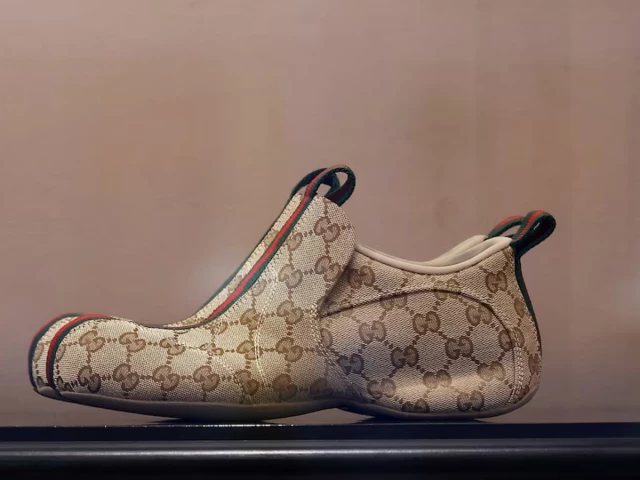
True to form, Demna’s debut footwear offering for Gucci—the Primavera collection—features the laceless, sock-like "Drip" sneaker. Characterized by nylon, canvas, and suede panels, the design draws heavily from the futuristic, bulky aesthetic that dominated late-2010s urban fashion. However, alongside the aesthetic shockwave came an administrative bombshell: the sneakers were manufactured not in the hills of Tuscany or the footwear hubs of the Veneto, but in China.
- August 2026: The Drip sneaker officially goes on sale globally via Gucci’s e-commerce platform and flagship retail locations, including a prominent display in Paris, France, where Reuters first verified the "Made in China" labeling.
- Late August 2026: A second slip-on leather sneaker model from the same Primavera collection surfaces on Gucci’s website, likewise bearing the "Made in China" country-of-origin tag.
- September 24, 2026: Kering insiders reveal that Gucci has quietly initiated selective price cuts across several product lines, specifically targeting the Chinese market to stimulate sluggish local demand.
- Upcoming (Friday): Demna is scheduled to present his latest collection at a heavily anticipated runway show in Milan, where media scrutiny regarding pricing, manufacturing origins, and brand identity will reach a fever pitch.
Supporting Context & Metrics: The Economics of Aspirational Luxury
The decision to manufacture in China is underpinned by cold, hard economic mathematics. The modern luxury market is structurally divided into two distinct consumer tiers: the ultra-rich (who remain relatively insulated from macroeconomic fluctuations) and the aspirational middle class. The latter group—younger consumers, urban professionals, and trend-focused individuals—drives the bulk of luxury volume, yet they are increasingly vulnerable to inflation, economic uncertainty, and cost-of-living pressures.
The Pricing Equation
At roughly €800 ($1,000 USD), the Drip sneaker is positioned at a distinct price point within Gucci’s catalog. While still definitively inside the luxury bracket, it is notably cheaper than many of the brand’s traditional leather footwear lines.
| Metric / Financial Indicator | Context / Value |
|---|---|
| Gucci Sales Performance | Sales have halved over the past 3 years, necessitating aggressive corporate restructuring. |
| Drip Sneaker Price Point | ~€800 in Europe / ~$1,000 in the United States. |
| Manufacturing Hub | Shifted to China for specific technical footwear lines; all other website-listed shoes remain "Made in Italy." |
| Retail Adjustments | Selective price cuts implemented in key Asian markets, notably China. |
The Global Sneaker Ecosystem
China is indisputably the global epicentre of advanced footwear manufacturing. Over the past four decades, Chinese factories have cultivated world-class technological know-how, precise automation capabilities, and sophisticated supply chain infrastructures capable of handling complex synthetic and technical fabrics that traditional European leather ateliers are often ill-equipped to process efficiently at scale.
For Demna’s technical, synthetic-heavy sneaker designs—which require precision-engineered molded soles and specialized stretch textiles—Chinese production facilities offer capabilities that are difficult to replicate cost-effectively within traditional Italian artisanal clusters.
However, this pragmatic operational decision collides head-on with the psychological architecture of luxury marketing, where geographic provenance ("Made in Italy", "Swiss Made", "Savile Row") has historically functioned as a primary proxy for quality, prestige, and emotional value.
Official Statements and Industry Reactions
The revelation of the "Made in China" labels has ignited a firestorm across the global fashion landscape, drawing sharp critiques from financial analysts, luxury consultants, and brand loyalists alike, while drawing defensive clarifications from corporate headquarters.
Gucci’s Official Corporate Stance
In an official statement addressing the controversy, Gucci doubled down on its historical commitment to Italian craftsmanship while defending its pragmatic diversification of manufacturing partners:
"Italy will always be at the heart of Gucci’s manufacturing model and identity. However, we have decided to work with this Chinese manufacturer just as we have historically worked with Swiss and Japanese suppliers for specialized categories like watches and eyewear in the past.
The partner selected offered the technological know-how and capabilities most appropriate for achieving the performance and quality standards we were seeking for this specific design."
Gucci representatives firmly stressed that there are no broader, sweeping plans to move the brand’s production footprint out of Italy, framing the Chinese manufacturing arrangement as an isolated exception dictated strictly by technical design requirements.
Analyst Apprehensions and Criticisms
Financial institutions and independent market experts have expressed immediate concern over the potential dilution of brand equity.
-
Berenberg Analysts: In a research note distributed to investors, Berenberg warned of an impending identity crisis:
"We think this creates a potential tension between provenance and the luxury positioning Gucci is seeking to reclaim."
-
Simon Whitehouse (Milan-based Luxury Business Consultant): Offering a more blunt appraisal of the optics, Whitehouse stated:
"Made in China is not a good look for a storied Italian house trying to reclaim high-end exclusivity."
-
Carole Madjo (Barclays Analyst): Speaking on the dual impact of Chinese manufacturing combined with recent price cuts, Madjo highlighted the confusion rippling through the investor community:
"Some people are wondering: should we keep buying Gucci if the price is coming down? Having Chinese-made products could fuel the debate around the brand’s price-value equation."
Future Outlook: The Milan Runway and the Road Ahead
As the fashion world converges on Milan for Demna’s upcoming Friday runway presentation, the stakes could not be higher for Kering and CEO Luca de Meo. The early share-price bounce that greeted de Meo’s appointment last year has largely flattened, leaving investors impatient for tangible proof of a sustained operational and cultural revival.
The Core Dilemma for Kering
Gucci finds itself trapped in the classic luxury paradox: Volume versus Exclusivity.
- If Gucci maintains ultra-high prices and strict Italian manufacturing, it risks alienating the cash-strapped aspirational middle class, leading to continued revenue stagnation and depressed store traffic.
- Conversely, if Gucci lowers prices and shifts production to lower-cost, highly efficient technological hubs like China to capture volume, it risks cheapening its brand halo, alienating high-net-worth collectors, and triggering a race to the bottom that destroys its long-term luxury pricing power.
What to Watch For Next
- The Milan Collection Reception: Industry insiders will be closely examining the material composition, pricing architecture, and consumer reception of Demna’s new ready-to-wear and accessory lines.
- Consumer Elasticity: Market researchers will monitor whether the "Made in China" label on the Drip sneaker deters core luxury buyers or successfully captures a younger, streetwear-literate demographic unconcerned by historical geographic markers.
- Kering’s Margin Reports: Upcoming quarterly earnings reports will reveal whether the combination of Chinese manufacturing efficiencies and targeted price cuts successfully restores profit margins or merely damages brand equity without yielding the anticipated volume recovery.
Ultimately, Demna’s debut sneaker is a litmus test for the future of modern luxury. As globalization, shifting consumer demographics, and macroeconomic pressures force heritage brands to adapt, Gucci’s bold experiment will serve as a definitive case study on whether the allure of a luxury label can survive the transition from the artisanal workshops of Florence to the high-tech production lines of the East.





Comments
Facebook App ID not configured. Please add it in the Customizer.