
Executive Overview
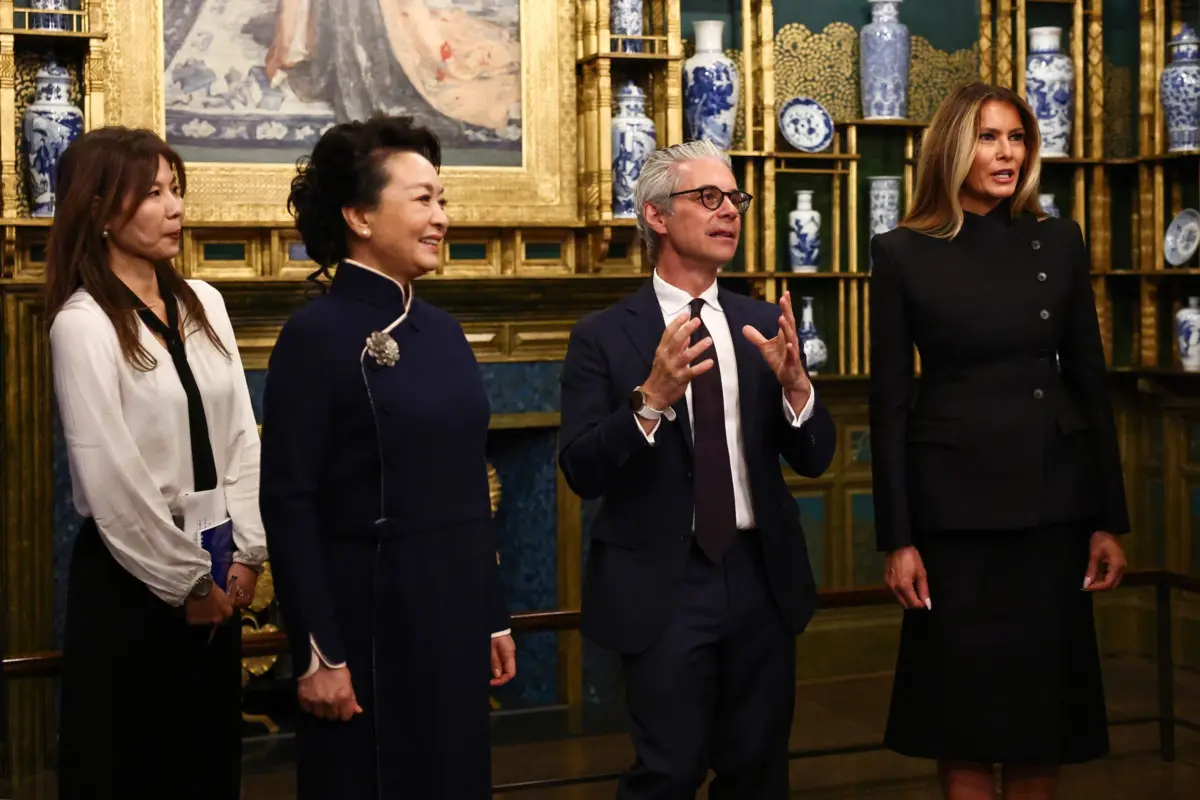
In the intricate theater of international diplomacy, cultural touchstones often speak louder than policy communiqués. On a brisk Thursday in Washington, D.C., First Lady Melania Trump and China’s First Lady, Peng Liyuan, provided a masterclass in soft-power engagement during a high-profile, private tour of the Smithsonian’s National Museum of Asian Art.
Against the backdrop of high-level geopolitical negotiations between the United States and the People’s Republic of China, the two figures stepped away from the traditional confines of the West Wing to explore centuries of artistic exchange. The 45-minute excursion—centered on the museum’s crown jewel, the iconic Peacock Room—was meticulously designed to highlight deep historical bridges between Washington and Beijing.
Beyond the diplomatic symbolism, the encounter generated significant cultural and sartorial analysis. Both women utilized fashion as a subtle lexicon of mutual respect, seamlessly weaving cross-cultural nods into their public appearances. This cultural summit unfolded synchronously with a major state dinner at the White House, where President Donald Trump presented Chinese President Xi Jinping with a symbolic sculpture of a bald eagle.
Read Also
This comprehensive report examines the chronology of the Smithsonian visit, analyzes the historical and artistic weight of the artifacts on display, evaluates the sartorial diplomacy of both figures, and provides an authoritative outlook on how these cultural overtures influence broader U.S.–China bilateral relations.
Detailed Chronology of the Smithsonian Visit
Arrival and Welcome
The midday excursion began at the National Museum of Asian Art (formerly the Freer and Sackler Galleries), situated on the National Mall. Museum Director Chase Robinson greeted the two first ladies upon arrival, orchestrating a tightly managed yet intimate tour tailored to bridge Eastern and Western aesthetic traditions. Security protocols were rigorous, reflecting the heightened diplomatic sensitivity of the state visit, yet the atmosphere within the galleries remained focused on art, history, and shared heritage.
The Peacock Room: The Centerpiece of the Tour
The focal point of the 45-minute visit was the world-renowned Peacock Room—an architectural and artistic marvel that bridges 19th-century British aesthetics, American industrial patronage, and profound Chinese artistic influence.
As Mrs. Trump and Madame Peng walked through the chamber, they observed firsthand the intricate displays of blue-and-white Chinese porcelain that line the gilded, peacock-themed walls. Museum Director Robinson noted that both women displayed a keen fascination with the scale and depth of 19th-century cross-cultural interactions.
“What better place to introduce the two first ladies to our museum on the occasion of high-level conversations and discussions between our two countries?” Robinson remarked in an interview with the South China Morning Post.
The discussion in the room naturally drifted toward the historical trade, travel, and artistic admiration that characterized the era. Madame Peng, a renowned soprano and cultural figure in her own right, engaged deeply with the curatorial explanations, demonstrating an acute appreciation for the historical preservation of Chinese export porcelain in Western institutions.
Conclusion of the Tour
Following their deep dive into the Peacock Room, the first ladies toured adjacent galleries showcasing centuries of Asian design, rare scrolls, and historical artifacts. The visit concluded with private remarks exchanged in the museum’s administrative quarters before both motorcades departed to prepare for the evening’s state dinner festivities at the White House.
Supporting Context & Metrics: History, Art, and Diplomacy
The Genesis and Migration of the Peacock Room
To fully understand the weight of the Smithsonian visit, one must examine the extraordinary provenance of the Peacock Room itself. Originally designed and decorated between 1876 and 1877 by British artist James McNeill Whistler—whose broader works have enjoyed major retrospectives, including exhibitions at the Tate Britain—the room was originally installed in the London townhouse of British shipping magnate Frederick Leyland.
The room represents a legendary clash of artistic egos between Whistler and Leyland, culminating in Whistler’s famous mural Harmonie in Blue and Gold: The Peacock Room, which famously depicts two fighting peacocks representing the patron and the artist.
Following Whistler’s completion of the masterpiece, the room caught the eye of American industrialist and connoisseur Charles Lang Freer. In 1904, following Leyland’s death, Freer purchased the entire interior woodwork, shelving, and canvases, having them shipped across the Atlantic to his mansion in Detroit, Michigan. Freer, who had developed a profound reverence for Chinese art and culture during a transformative expedition to East Asia between 1910 and 1911, eventually bequeathed the room—along with his massive collection of Asian and American art—to the Smithsonian Institution upon his death.
Today, the Peacock Room serves as a permanent testament to late-19th-century Orientalism, international trade, and the aesthetic dialogue between the Western world and Qing-dynasty China.
Sartorial Diplomacy: Decoding the Wardrobe Choices
In modern statecraft, wardrobe selection is rarely accidental; it is a calculated visual statement. Both Mrs. Trump and Madame Peng used their attire to communicate respect, identity, and bridge-building.
- Melania Trump: The U.S. First Lady opted for an architectural black McQueen tweed jacket featuring an asymmetrical collar. Fashion historians immediately recognized the silhouette as a subtle nod to the traditional Chinese qipao (or cheongsam), which famously employs a distinctive, elegant asymmetrical collar closure. She paired the jacket with a matching tweed skirt and classic black Christian Louboutin heels, balancing high-end Western luxury design with a reverent aesthetic tribute to her guest’s heritage.
- Peng Liyuan: Renowned for her sophisticated and dignified personal style, Madame Peng wore a traditional, understated navy qipao. The garment, tailored with impeccable precision, underscored her status as a cultural ambassador for contemporary China while honoring the traditional craftsmanship of her homeland.
The visual harmony between Mrs. Trump’s subtle sartorial nod and Madame Peng’s authentic national dress did not go unnoticed by international style analysts, serving as an early highlight of the state visit’s media coverage.
The White House State Dinner Exchange
The cultural diplomacy initiated at the Smithsonian carried directly into the evening’s state dinner at the White House. During the formal proceedings, President Donald Trump presented Chinese President Xi Jinping with an exquisite sculpture of a bald eagle.
The bald eagle, native to North America, serves as the preeminent national symbol of the United States. In presenting the gift, President Trump emphasized its symbolic weight, stating that the sculpture represented "the free and soaring spirit of America."
Art historians and diplomatic observers noted that the exchange of native wildlife imagery—frequently utilized in both American and Chinese traditional diplomacy—served to reinforce themes of national pride, sovereignty, and mutual respect at the highest levels of governance.
Official Statements and Diplomatic Reactions
The intersection of art and geopolitics generated immediate commentary from cultural institutions, political analysts, and international media outlets.
Museum Leadership Perspective:
Chase Robinson, Director of the Smithsonian’s National Museum of Asian Art, underscored the unique timing of the visit:
"Institutions like ours exist to preserve the material culture that connects civilizations across millennia. When political leaders and their spouses take the time to engage directly with these histories, it reinforces the enduring value of cultural diplomacy, transcending the temporary cycles of political negotiation."
International Media Reception:
Coverage from the South China Morning Post and major Western outlets focused heavily on the relaxed yet significant nature of the interaction. Observers noted that while trade tariffs, security concerns, and geopolitical competition dominated the closed-door meetings between President Trump and President Xi Jinping, the cultural itinerary curated for the first ladies provided a crucial humanizing element to the high-stakes summit.
Future Outlook: The Role of Soft Power in U.S.–China Relations
As Washington and Beijing navigate a complex era defined by economic competition, technological rivalry, and shifting global alliances, the events at the Smithsonian’s National Museum of Asian Art offer a compelling blueprint for the future of bilateral relations.
1. Institutional Resilience Through Cultural Exchange
Museums, libraries, and academic institutions remain frontline assets in maintaining open channels of communication when official diplomatic conduits face friction. The preservation and celebration of shared artistic heritage—such as the Chinese export porcelain housed within the Peacock Room—remind both nations of deep historical ties that predate modern geopolitical friction.
2. The Increasing Importance of Public Diplomacy
The positive public reception of the first ladies’ joint museum outing highlights the efficacy of public diplomacy. Moving forward, policymakers on both sides are likely to continue leveraging cultural institutions as neutral, dignified settings for high-level delegations to humanize bilateral relations before global audiences.
3. Long-Term Cultural Stewardship
The National Museum of Asian Art continues to position itself as a primary nexus for East-West dialogue. By maintaining world-class collections that honor Asian artistic traditions, the Smithsonian ensures that future generations of American and Chinese leaders will have tangible historical touchstones to reference as they shape the future of international diplomacy.
Ultimately, the 45-minute tour through the galleries of the Smithsonian was far more than a routine diplomatic photo-op. It was a calculated, elegant reaffirmation of the power of art to bridge divides, honor history, and foster mutual understanding at the absolute pinnacle of global power.


Comments
Facebook App ID not configured. Please add it in the Customizer.