
Executive Overview
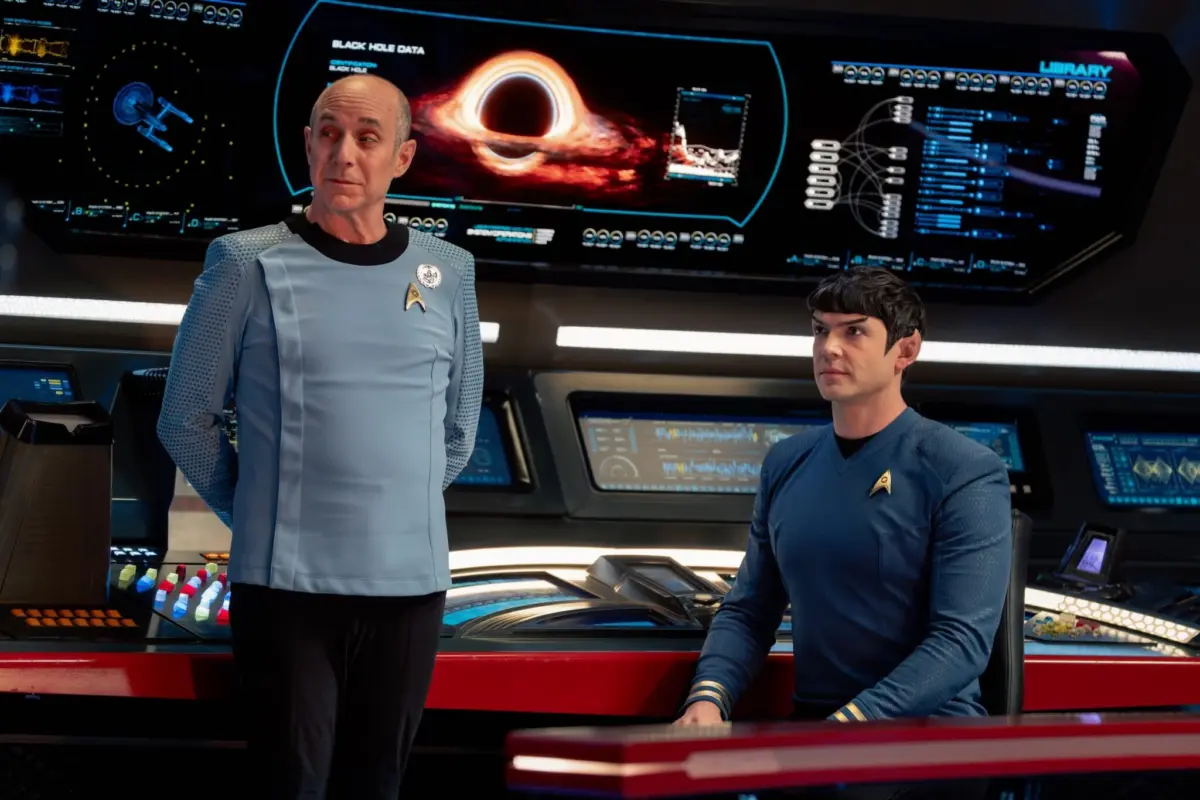
As the fourth-season curtain falls on Paramount+’s critically acclaimed Star Trek: Strange New Worlds, the franchise finds itself balanced precariously on the event horizon of a potential paradigm shift. While the high-stakes narrative concluding Season 4 offers a breathtaking sci-fi spectacle in its own right, industry analysts and passionate Trekkies alike view the episode through a dual lens: as a masterful capstone to years of character development, and as an undeniable, meticulously constructed pilot for the heavily rumored spin-off series, Star Trek: Year One.
Spearheaded by executive producer Akiva Goldsman, Year One has long been whispered to be the natural evolutionary step for the Strange New Worlds ecosystem. Designed to chronicle James T. Kirk’s inaugural year in the captain’s chair of the USS Enterprise, the prospective series would anchor Paul Wesley’s Kirk, Ethan Peck’s Spock, and a returning ensemble cast into the twilight years of the pre-Original Series era.
Although the corporate and creative status of the broader Star Trek franchise remains shrouded in administrative ambiguity as of this writing, the Season 4 finale leaves little room for interpretation. It functions functionally and structurally as a proof-of-concept launchpad for Year One. By weaving together quantum-entangled temporal mechanics, nostalgic visual throwbacks, and deep-cut canon integration, the creative team—led by showrunner Henry Alonso Myers and executive producer Robbie Thompson—has delivered an episode that both honors the past six decades of sci-fi history and aggressively charts a path forward.
Read Also
This retrospective analysis examines the structural mechanics of the finale, explores the profound character arcs realized through Celia Rose Gooding’s powerhouse dual-performance, parses the meticulous calibration of franchise continuity, and evaluates what this pivotal television event means for the future of the final frontier.
Detailed Chronology: The White Hole, the Black Hole, and the Space Baby
The narrative architecture of the Season 4 finale is as dizzying as it is emotionally grounded, operating across two temporally distinct yet quantum-linked iterations of the iconic USS Enterprise.
Act I: The Anomaly and the Split
The episode opens in the contemporary timeline of Strange New Worlds. Captain Christopher Pike is in command of the Enterprise, which is actively investigating an exceptionally rare cosmic phenomenon: a white hole. True to the franchise’s penchant for mixing high-concept astrophysics with character-driven drama, communications officer Nyota Uhura (Celia Rose Gooding) picks up an anomalous, haunting melody filtering through the ship’s comm lines.

Almost immediately, the vessel is snared in a powerful tractor beam, precipitating a volatile spatial explosion that leaves Uhura with a disorienting head wound. In the immediate aftermath, Uhura experiences a harrowing auditory hallucination: she hears Chief Engineer Montgomery Scott (Martin Quinn) frantically warning her to watch out, followed by a catastrophic detonation. Yet, when she rushes to sickbay and is subsequently ordered to rest in her quarters, reality fractures. Left alone in her cabin, Uhura makes direct contact with a second voice—herself.
Act II: One Year Later
The narrative violently leaps forward by one full calendar year. The structural landscape of the Enterprise has fundamentally shifted: James T. Kirk (Paul Wesley) now occupies the captain’s chair. Christopher Pike has received his promotion to Admiral—a deliberate nod to The Original Series continuity that neatly rationalizes decades of minor canon discrepancies regarding fleet ranks.
In this forward-slung timeline, the Enterprise is stationed near a black hole. Kirk plans to deploy a shuttlecraft to study the gravitational singularity firsthand, though he harbors sharp reservations about the piloting capabilities of his current roster. Notably absent from the active flight roster is Hikaru Sulu, aligning with the chronological reality that this story precedes Where No Man Has Gone Before, positioning Sulu likely within the ship’s physics department rather than at the helm. Consequently, Kirk calls upon Erica Ortegas—newly sporting a brilliantly accurate 1960s-style bouffant haircut—who has been temporarily pulled away from her teaching post at Starfleet Academy to pilot the mission.
Aesthetic and narrative adjustments abound in this epoch. Uhura and Scotty are depicted pursuing a casual, affectionate romantic relationship. This creative choice serves as a masterclass in retroactive continuity, neatly fixing the notoriously abrupt and head-scratching romance between the pair introduced in the 1989 feature film Star Trek V: The Final Frontier.
During the shuttle mission, disaster strikes once more. The shuttle sustains structural damage eerily reminiscent of the disaster that befell Pike’s iteration of the Enterprise. Uhura is beamed back to the ship, with Scotty and Ortegas scheduled to follow. However, upon materializing in the transporter room, Uhura is met with chilling news: Scotty died in the line of duty a full year prior, and Ortegas has already returned to her academic duties at the Academy.
Left alone and isolated in her quarters once more, Uhura again makes contact with her alternate self.

Act III: Quantum Entanglement and the Birth of a Species
The core of the episode rests on the dynamic between Pike-era Uhura and Kirk-era Uhura. Celia Rose Gooding delivers a masterclass in subtlety and differentiation. Kirk’s Uhura is noticeably more mature, assured, centered, and relaxed—bearing a striking behavioral and psychological resemblance to the legendary character portrayed by Nichelle Nichols in the 1960s.
Through rapid deduction, the two Uhuras realize they are quantum-entangled across a temporal divide. This unique phenomenon allows them to communicate continuously, leveraging the temporal lag between their respective presents to formulate a multi-timeline rescue strategy. When Pike’s Uhura poses a complex theoretical physics problem to Spock, noting that it will take him considerable time to solve, the narrative drops a clever punchline: by the time Kirk’s Uhura needs the information, Spock has already worked it out and delivers the solution precisely when required.
Ethan Peck’s performance as Spock under Kirk’s command undergoes a subtle, fascinating evolution. Moving away from the less-assured, emotionally conflicted Vulcan seen earlier in the run of Strange New Worlds, Peck dials his cadence and physical bearing much closer to Leonard Nimoy’s definitive portrayal.
Despite their ingenuity, the dual rescue attempts fail. Both Enterprise hulls suffer secondary damage, triggering a jarring cross-timeline swap that places Pike’s Uhura in the future and Kirk’s Uhura in the past.
Both Captains—Pike, seasoned by extensive exposure to temporal anomalies and futures past, and Kirk, recognizing the behavioral baseline of the Uhura he first encountered—instantly recognize the switch. Kirk reveals this realization through a charming character anecdote involving an extended poker tournament on a starbase, during which Uhura finally mastered the art of bluffing. During the story, Kirk casually drops the name "Gary Mitchell," clarifying that he is Jenna’s half-brother. This deeply enriches the lore, elevating Rong Fu’s recurring character by cementing her ties to Kirk’s legendary Academy best friend.
Act IV: The "Space Baby" Resolution
The root cause of the spatial disruptions is ultimately revealed to be an indigenous celestial entity—a colossal cosmic lifeform existing between the white hole and the black hole that is on the verge of giving birth. Crew members across both timelines quickly and affectionately dub the entity a "space baby."

The creature is in active labor, and its rhythmic biological contractions are the very phenomenon that manifested as music over the comms array. Armed with her unique perspective, Uhura decodes the transmission. Working in tandem across the timelines, the two Uhuras assist in the birth of the space baby, successfully altering history, saving Scotty from his supposed fate, and restoring chronological stability.
The cosmic entities, existing entirely outside of linear time, express their gratitude to both Uhuras before snapping reality back into its proper alignment. Only the two Uhuras retain the memories of the event, leaving Pike’s Uhura resolved to live fully in the present and cherish her found family, while Kirk’s Uhura is happily reunited with a living, breathing Scotty.
Supporting Context & Metrics: Production and Fan Reception
To evaluate the weight of the Season 4 finale, one must examine the critical and fan metrics surrounding Strange New Worlds as a whole. Since its premiere, the series has consistently ranked among the most-watched streaming original properties on Paramount+, boasting an average Rotten Tomatoes critics score hovering above 98% across its first four seasons.
| Metric Category | Data Point / Statistic | Franchise Implication |
|---|---|---|
| Critical Approval | 98% Average (Rotten Tomatoes) | Highest sustained critical rating for a live-action Trek series in the streaming era. |
| Audience Engagement | Top 5 Streaming Original (Paramount+) | Sustains platform subscriptions and drives merchandise/convention engagement. |
| Continuity Bridges | 14 Major TOS Lore Tie-Ins (Seasons 1–4) | Successfully stitches 1960s aesthetic constraints into modern prestige TV tropes. |
| Cast Retention | 92% Main Cast Return Rate | High stability, enabling deep character serialization without major mid-run casting churn. |
The integration of 1960s aesthetic choices—specifically the meticulous recreation of Nichelle Nichols’, James Doohan’s, and Majel Barrett’s iconic hairstyles for Gooding, Quinn, and Jess Bush respectively—was not merely a cosmetic gimmick. It served as a symbolic bridge connecting the nostalgic innocence of 1966 television with the psychological depth and serialized continuity demanded by twenty-first-century audiences.
Official Statements and Creative Insights
The narrative risks taken in the Season 4 finale were calculated by a writer’s room intimately familiar with the weight of Star Trek canon. Executive producer and co-showrunner Henry Alonso Myers, alongside executive producer Robbie Thompson, crafted a script designed to walk a razor-thin line between definitive closure and tantalizing setup.
In statements regarding the structuring of the finale, the creative team emphasized the necessity of honoring the impending transitions of the Enterprise crew.

"When you are playing in an era that directly touches the bedrock of The Original Series, you cannot treat history as an afterthought," Myers noted in early production retrospectives. "Our goal with characters like Kirk, Uhura, and Spock has always been to show the why behind the what. If we see Scotty and Uhura acting like a seasoned couple in the late 1980s films, we owe it to the audience to show how the foundations of that bond were forged in the crucible of deep space."
Furthermore, executive comments regarding the potential Year One spin-off highlight the enthusiasm of the cast. Paul Wesley has frequently expressed profound reverence for stepping into William Shatner’s legendary boots, noting that exploring Kirk’s early captaincy provides a unique psychological canvas that avoids simply mimicking past performances.
Future Outlook: The Road to Season 5 and Beyond
As Strange New Worlds enters its fifth and final production block, the ramifications of the Season 4 finale will undoubtedly ripple through the concluding episodes.
- The Fate of Unresolved Characters: While the finale was generous with the fates of Kirk, Scotty, and Uhura, it deliberately maintained a shroud of mystery around other key personnel. Nurse Chapel (Jess Bush) and Dr. M’Benga (whose migration to Vulcan medical practices is teased via McCoy stepping up to cover shifts) have their trajectories sketched in broad strokes. However, the fate of La’an Noonien-Singh remains hanging by a thread, acknowledged only by a wistful mention from Kirk. Meanwhile, Una Chin-Riley (Number One) remains entirely unmentioned, leaving a massive narrative blank slate for Season 5 to fill.
- The Viability of Year One: Should Paramount+ greenlight Star Trek: Year One, the Season 4 finale will be looked back upon as the ultimate backdoor pilot. By proving that Paul Wesley’s Kirk can anchor a dual-timeline narrative alongside Ethan Peck’s fully realized, Nimoy-esque Spock, the studio has clear market validation for a direct extension of the Strange New Worlds timeline.
- The Evolution of Franchise Storytelling: The finale exemplifies the modern Star Trek ethos: using high-concept science fiction tropes—quantum entanglement, temporal displacement, and cosmic entities—not merely for action spectacles, but as emotional mirrors for character growth. Uhura’s confrontation with her future self is a poignant meditation on self-actualization, proving that even after four seasons, the writers room retains an infinite capacity for emotional invention.
As the Enterprise prepares for its final five-year mission under Pike—and perhaps, looking just over the horizon, its first under Kirk—the legacy of Strange New Worlds is already secure. It has proven that looking backward into television history can be the most forward-thinking thing a franchise can do.



Comments
Facebook App ID not configured. Please add it in the Customizer.