
Executive Overview
For decades, cultural currency was minted in the coin of irony. To be cool was to be detached; to be sophisticated was to look at the world through a lens of cynical amusement, guarding oneself against disappointment with a thick armor of sarcasm and self-deprecation. From the deadpan television comedies of the late 20th century to the post-modern literary movements that prized linguistic gymnastics over emotional clarity, sincerity was frequently treated as a design flaw—a hallmark of naivety, sentimentality, or artistic laziness.
Yet, a seismic shift is underway. Across contemporary literature, film, television, and even dating culture, a profound cultural renaissance of earnestness is taking root. Critics, readers, and creators are increasingly casting aside the protective shell of irony in favor of radical vulnerability, emotional honesty, and unashamed optimism.
This essay-turned-cultural analysis explores how the embrace of earnestness is reshaping creative writing—using author Stef Ferrari’s journey in drafting the queer, cozy YA holiday romance Pining for You as a case study. By examining the psychological mechanics of optimistic characters, the broader societal hunger for human connection, and the recent critical discourse highlighted by platforms like The New Yorker, we discover why vulnerability has become the boldest creative and personal choice a person can make. Far from being simple or simplistic, true earnestness is a complex, high-stakes literary engine capable of generating profound narrative tension.
Read Also
Detailed Chronology: The Evolution of a Skeptic
The reevaluation of earnestness rarely happens overnight; for many, it begins as a personal friction point before manifesting as an artistic realization.
The Third-Date Epiphany
The journey often starts in the messy, unscripted theater of modern romance. Picture a third date: the initial awkwardness has faded, replaced by the cautious optimism of getting to know someone new. Then, a bomb drops—not of anger or incompatibility, but of pure, unfiltered emotional exposure.
As Ferrari recalls, the friction point arrived when a woman across the table stated, without a single drop of irony, that she was “optimistic about us.”
In a culture conditioned to wait for the punchline, the immediate reflex was suspicion. Surely it was a joke; after all, they barely knew each other. A quick glance at a freshly made, still-full drink ruled out liquid courage. A nervous laugh followed, met only by stony, unblinking sincerity.
Walking home through the crisp night air, that nervous reaction invited deep introspection. The attraction was undeniable, and the desire for mutual affection was strong. Yet, the sheer, unmitigated earnestness of the statement felt like an obstacle. Why should radical emotional transparency cause such visceral discomfort?
From Real-Life Friction to the Writer’s Desk
This exact psychological knot soon manifested on the blank page. While drafting the novel Pining for You—a queer, cozy young adult holiday romp tracking a journey from small-town Connecticut to a snowbound Brooklyn—the protagonist, 17-year-old Bennie, emerged with a startlingly pure worldview. Bennie unironically believed in Christmas magic. She was profoundly unpretentious, possessing a degree of hopefulness that felt almost painful in its innocence.
Initially, the author experienced a familiar wave of petrification. Would readers and critics read this purity, sincerity, and true hopefulness as simple-mindedness? Would it be dismissed as authorial laziness? How could a modern audience possibly relate to a character entirely devoid of cynical armor?
Whether at a bar listening to a date express genuine optimism or staring at a word processor trying to anchor a hopeful teenager, the underlying creative anxiety remained identical: Without irony, cynicism, or the torturous ambiguity of hidden subtext, what chance is there for a compelling story?
Supporting Context & Metrics: The Anatomy of the Optimistic Protagonist
To solve the puzzle of Bennie, Ferrari embarked on a literary deep dive into the canon of candid art. Icons of unwavering optimism—ranging from The Muppets and Mikey Walsh in The Goonies to Rudy and Samwise Gamgee—demonstrated that hopeful narratives possess enduring, mass appeal. Clearly, this archetype could work. The challenge lay in reverse-engineering how.
Radiating Sunshine Without Flattening the Character
A common pitfall in character development is the assumption that an optimistic character must be one-dimensional—a walking ray of sunshine devoid of internal conflict. However, a close analysis of effective hopeful protagonists reveals the exact opposite: they are uniquely exciting to write because they possess an expansive emotional range.
- Heightened Vulnerability: Because these characters care deeply, they are easily wounded. Their profound capacity for hope is directly proportional to their capacity for devastation.
- Complex Behavioral Responses: When confronted with pain, betrayal, or unmet expectations, unshielded optimists do not simply absorb the blow with cool detachment. Instead, their distress can manifest as demanding, unreasonable, stubborn, self-righteous, or outraged behavior.
The Danger of Artificial Edges
Early attempts to “fix” Bennie by adding sharper edges, wry humor, and ironic distance failed miserably. Those cynical attributes felt false to her core identity, getting metaphorically kicked off the page like a misfit holiday snack cake on a conveyor belt.
The breakthrough arrived when the author simply allowed Bennie to experience authentic pressure. Bennie clings to her belief in Christmas magic precisely because her life is painfully unmagical:
- Her sister battles mental illness and addiction.
- Her mother is emotionally absent.
- Her lifelong friendships stand on the precipice of fracture as high school graduation looms.
When she buys her mother a Christmas tree and it fails to magically bring her parent home from work on time, or when her friends balk at participating in an annual ugly sock swap, the pressure cooker reaches its limit. Bennie cracks. She becomes frustrated, deeply lonely, controlling, indignant, and genuinely angry.
These jagged edges—far from ruining her character—are what make her remarkably human.
Revealing the True Nature of Others
Another fascinating systemic byproduct of placing a ball of sunshine at the center of a narrative is that their radical openness acts as a social prism. An unshielded, hopeful soul forces everyone else in their orbit to reveal their true colors:
- Some characters attempt to rise and match that vulnerable frequency.
- Others seek to exploit that perceived innocence for personal gain.
- Cynics mistake the openness for weakness, entirely unable to fathom such vulnerability.
- Protectors emerge, sometimes rushing to shield the earnest character to their own detriment.
Ultimately, hope guarantees high-stakes narrative tension simply by existing in direct opposition to grief, embarrassment, disappointment, fear, and betrayal. No artificial tension is required.
Official Statements and Cultural Discourse: The Return of Earnestness
This literary realization mirrors a broader cultural phenomenon. Across the media landscape, cultural commentators have noted a sharp pivot away from postmodern detachment.
The cultural conversation received a major focal point when The New Yorker dedicated an episode of its acclaimed Critics at Large podcast to exploring what they diagnosed as "the return of earnestness." In the episode, cultural critics like Vinson Cunningham attempted to define this rising zeitgeist, suggesting that earnestness functions as "the quality that reinforces our sameness with other people."
Whether driven by generational shifts, digital fatigue, or a turbulent global political climate, society is collectively searching for connection, shared human experiences, and an optimistic baseline.
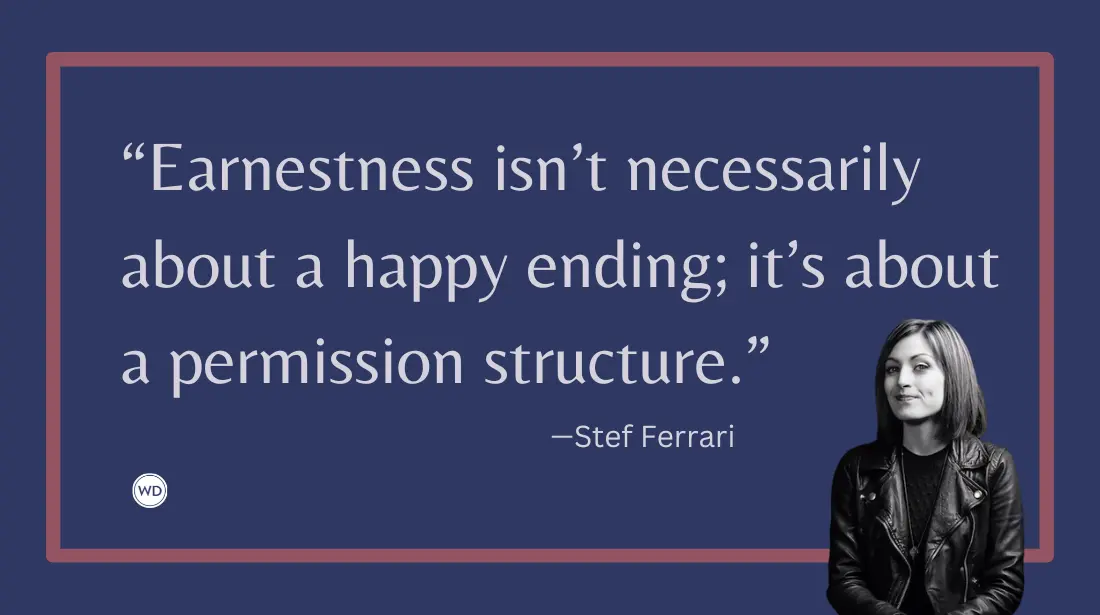
As cultural analysts note, earnestness is not merely about securing a tidy, happy ending. Rather, it functions as a permission structure. Stories rooted in sincerity provide a safe harbor for audiences to fully feel emotions that they might otherwise suppress in a cynical world. They do not gloss over trauma, grief, or systemic harshness; instead, they present immense challenges to characters who initially seem ill-equipped to handle them.
Audiences lean in—clutching their mugs of cocoa or holding their partners’ hands—to see if the hero will choose to stay vulnerable, honest, and hopeful against all odds. That choice transforms a narrative from a simple fable into a sophisticated, deeply connective, and enduring work of art.
Future Outlook: The Boldest Risk of All
As the cultural renaissance of earnestness continues to permeate literature and media, its lessons extend far beyond the margins of a young adult novel or the runtime of a cozy film.
In creative writing, the validation of sincerity proves that writers do not need to rely on the crutch of irony to be taken seriously. Complex, messy, hopeful human beings navigating a difficult world can carry a story entirely on the strength of their convictions.
In personal life, the realization is even more striking. Looking back at that third-date confession of optimism, the initial instinct to run from vulnerability looks very different today. Laying real feelings out on the table is not a sign of naivety, impatience, or boredom. On the contrary, it is the boldest move a person can make: stepping forward into the unknown, fully aware that the journey could end in disappointment—because it just as easily might not.
And how did that particular real-life story turn out? That unashamedly optimistic woman from the third date is now a devoted fiancée.
If that isn’t a testament to the power of earnestness, nothing is.


Comments
Facebook App ID not configured. Please add it in the Customizer.