

In the landscape of contemporary children’s literature, few works bridge the echoes of historical trauma and modern humanitarian crises with the poetic precision of Barbed Wire Between Us. Written by Japanese Chinese American author Mia Wenjen and illustrated by Violeta Encarnación, this 48-page hardcover release from Red Comet Press ($19.99) has garnered critical acclaim—most notably via a profound review in Nichi Bei.
The book establishes a visceral dialogue across an 80-year chasm. It chronicles the parallel, unjust incarcerations of two young girls behind barbed wire: one a Japanese American child forcibly removed from her home during the 1940s World War II internment era, and the other a contemporary Latina child who arrived in the United States in search of a better life, only to encounter state-sponsored detention and family separation.
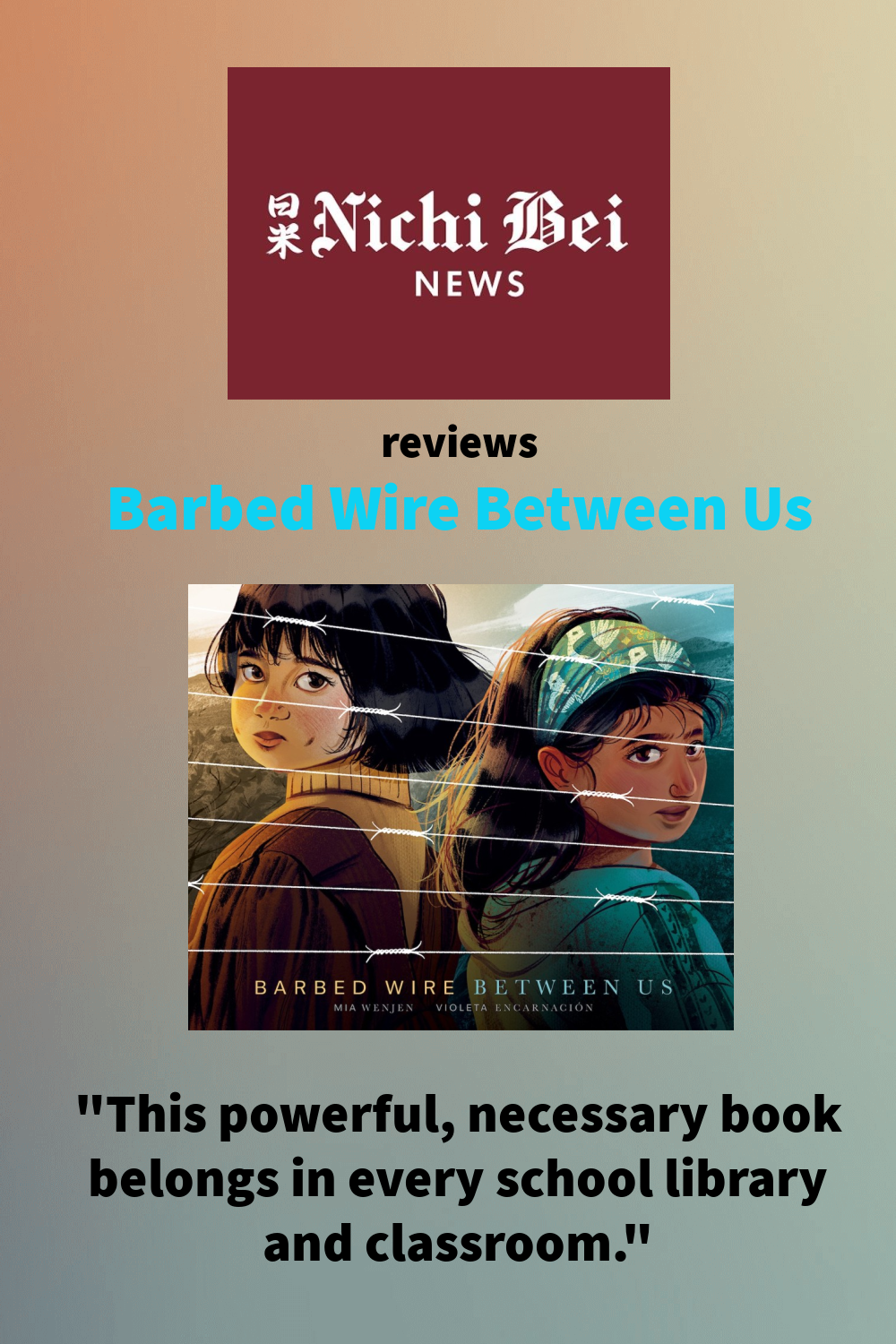
Employing the innovative "reverso" poem format—invented by renowned poet Marilyn Singer—Wenjen transforms verse into a structural metaphor for history repeating itself. Paired with Encarnación’s evocative artwork, which juxtaposes somber palettes with resilient flashes of gold and turquoise, Barbed Wire Between Us serves as both an artistic triumph and an essential pedagogical resource for students ages 5 to 12. This comprehensive review examines the structural mechanics, historical grounding, artistic nuances, and classroom applications of a text destined to shape conversations around civil rights, empathy, and institutional injustice for years to come.
Read Also
Detailed Chronology: Bridging Eras of Injustice
To understand the emotional architecture of Barbed Wire Between Us, one must trace the chronological dualism established within its pages. The narrative is partitioned into two distinct historical moments that mirror one another with chilling accuracy.

The 1940s: The Shadow of Executive Order 9066
The book’s first movement plunges the reader directly into the wartime hysteria of the United States during World War II. It follows a young Japanese American girl whose family—like over 120,000 individuals of Japanese descent—was uprooted under the color of state authority.
Reflecting on the initial aspirations of her family, the protagonist notes, "In this land of promise, we hoped to find a place to belong." Instead, that promise was shattered by forced removal orders. Permitted to bring only what they could physically carry, families were fragmented, stripped of their properties, and transferred to desolate remote outposts. The text specifically highlights the historical reality of the incarceration camp at Fort Sill in Oklahoma—a site loaded with painful historical ironies, having previously served as a confinement location for Indigenous populations before housing Japanese Americans during World War II.

Contemporary America: The Modern Borderlands
Without missing a beat, the narrative seamlessly transitions into the present day. A second girl and her family arrive in the United States seeking refuge, safety, and economic survival. They, too, seek out the traditional American ethos: "in this land of promise."
However, contemporary immigration policies greet them with an identical bureaucratic cruelty. Rather than finding sanctuary, the family faces border enforcement mechanisms that result in immediate separation, detention, and the imprisonment of children. By placing these two narratives in direct conversation, Wenjen exposes how structural xenophobia adapts across decades while retaining its core mechanisms of containment and alienation.

Supporting Context & Metrics: The Mechanics of the Reverso Poem
The literary vehicle driving Barbed Wire Between Us is the reverso poem, a specialized poetic form that consists of two halves. While the second half reverses the line sequence of the first, it alters only capitalization and punctuation to generate a completely distinct meaning.
The Dual Meaning of Migration and Incarceration
Mia Wenjen’s mastery of the reverso is most explicitly demonstrated through the recurring motif: "we came with only what we could carry."

- Forward Reading: In the first half of the reverso, read in the context of the 1940s, the phrase underscores the forced eviction of Japanese Americans. It highlights the suddenness of military edicts, the loss of homes, and the forced march into internment camps.
- Backward Reading: When the lines are inverted in the second half, the same exact phrasing takes on the desperation, hope, and vulnerability of modern immigrants crossing borders under duress.
This technical execution provides a structural metaphor for historical recurrence. Wenjen demonstrates that the rhetoric used to justify the internment of citizens in the 1940s echoes in modern debates surrounding border security, administrative detention, and human rights abuses against migrants.
Visual Architecture: Color Theory and Historical Symbolism
The literary weight of Wenjen’s verses is matched by Violeta Encarnación’s illustrative genius. Utilizing a hybrid medium combining traditional textures with digital rendering, Encarnación establishes an atmosphere of oppressive gravity through desaturated, somber backgrounds.

However, the artist introduces intentional color coding to signify human resilience:
- Shades of Gold: Bathes the 1940s Japanese American protagonist, linking her heritage to enduring dignity and cultural perseverance.
- Shades of Turquoise: Frames the contemporary Latina girl, highlighting her vibrant inner spirit amidst the cold sterility of modern detention facilities.
Furthermore, Encarnación’s imagery demonstrates a deep awareness of socio-political dynamics. In one powerful plate, towering shadows of American soldiers’ rifles loom over a despondent Japanese American girl boarding a deportation or transfer train. In a parallel modern composition, the long, menacing shadows of coyotes (and human traffickers or border enforcers) stretch over handcuffed adults while the young Latina protagonist protects a younger sibling. These visual motifs anchor abstract policy discussions in immediate, heartbreaking human realities.
Official Statements & Critical Reception
The cultural impact of Barbed Wire Between Us has been underscored by early reviews and institutional recognitions. Writing in Nichi Bei, critics noted that the book acts as a "profound and deeply moving story of two girls connected by their parallel experiences of unjust incarceration."
Publishing houses and educational advocates have similarly pointed to the timeliness of the work. Red Comet Press positioned the book as a cornerstone for conversations around civil liberties. In an interview with Publishers Weekly covering both Barbed Wire Between Us and her concurrent works, Mia Wenjen discussed the imperative of telling stories that challenge sanitized versions of American history.
While critical reception has been overwhelmingly positive—with outlets praising its ability to cultivate empathy and historical consciousness—educators and reviewers have also engaged in critical discourse regarding its pedagogical completeness. Notably, reviewers have pointed out that while the back matter provides robust historical context regarding Fort Sill and personal reflections on Wenjen’s family World War II experiences, the book would achieve an even greater contextual balance by including explicit historical and legal frameworks regarding the modern imprisonment of immigrant children. This critique does not detract from the book’s value; rather, it positions the text as a springboard for deeper classroom research.
Future Outlook & Pedagogical Implementation
Barbed Wire Between Us arrives as an essential tool for educators seeking to navigate complex sociopolitical themes with young learners. Designed for children ages 5 to 12, the book encourages classrooms to move beyond passive reading into active civic empathy.
Classroom Strategies for Educators
Educational experts have outlined versatile frameworks for integrating the book into primary and upper-elementary curricula:
- Primary Grades (Ages 5–8): Instructors can scaffold the unique poetic structure by pacing the reading across three distinct sessions: reading the first half of the reverso, reading the reversed second half, and finally conducting a complete, uninterrupted reading to experience how the structure alters meaning.
- Upper Elementary (Ages 9–12): Students can analyze the text independently or in literature circles, comparing primary source documents from the War Relocation Authority (1940s) with contemporary human rights reports on modern family separation policies.
Extended Resources and Community Engagement
The release of Barbed Wire Between Us is supported by an array of ancillary materials designed to maximize its impact in schools and libraries:
- A free, downloadable Teacher’s Guide is available to assist lesson planning.
- Interactive companion activities, such as tutorials on folding origami cranes (a symbol of peace and resilience tied to Japanese American history), connect creative arts with historical reflection.
- The book has been integrated into national reading initiatives, including the Read Across America calendar.
- Special institutional exhibitions, such as displays at the Japanese American National Museum, highlight the book’s alignment with institutional efforts to preserve civil rights history.
By connecting the past to the present, Mia Wenjen and Violeta Encarnación have crafted a modern classic. Barbed Wire Between Us demands that readers look past nationalistic myths to confront systemic injustices, ensuring that the mistakes of yesterday are neither forgotten nor repeated in the classrooms of tomorrow.

Comments
Facebook App ID not configured. Please add it in the Customizer.